


























Views
Plays


Identifying Themes Worksheet | Grade 4-5 Essential
Paste this activity's link or code into your existing LMS (Google Classroom, Canvas, Teams, Schoology, Moodle, etc.).
Students can open and work on the activity right away, with no student login required.
You'll still be able to track student progress and results from your teacher account.
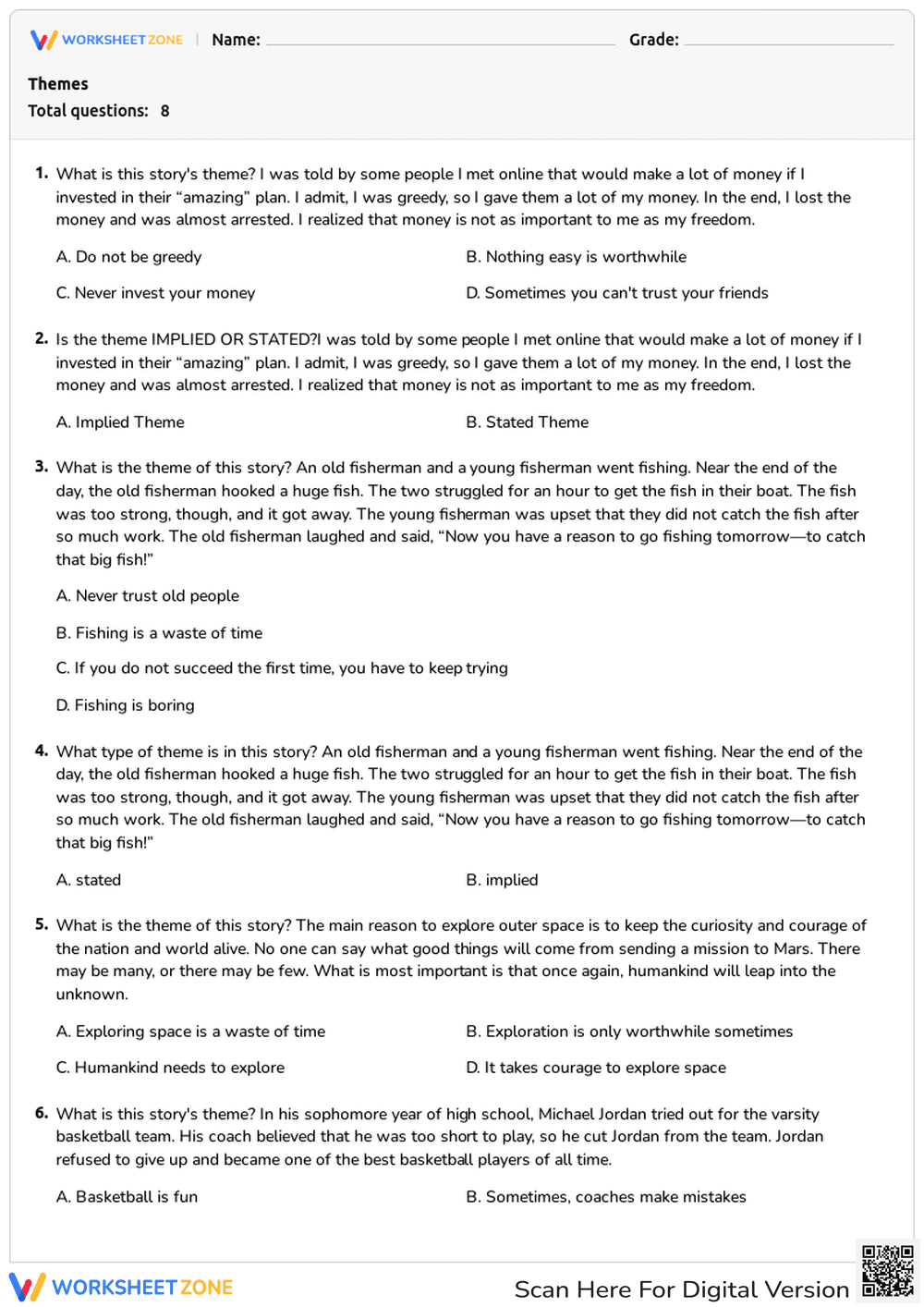
This Grade 4 and 5 ELA worksheet helps students master the critical reading skill of identifying themes within short literary passages. By analyzing 8 distinct scenarios, learners practice distinguishing between stated and implied messages, ensuring they can extract deeper meaning from any text they encounter in the classroom or on standardized assessments.
At a Glance
- Grade: 4-5 · Subject: ELA Reading
- Standard:
CCSS.ELA-LITERACY.RL.4.2— Determine a theme of a story from details in the text- Skill Focus: Implied vs. Stated Themes
- Format: 2 pages · 8 problems · Answer key included · PDF
- Best For: Formative assessment or independent literacy centers
- Time: 15–20 minutes
What's Inside: This two-page PDF features 8 multiple-choice questions designed to challenge student comprehension. Each question presents a short narrative—ranging from classic fables like the greedy monkey to real-world examples like Michael Jordan—followed by prompts to identify the central theme or categorize the theme type. The layout is clean and distraction-free, making it ideal for quick assessments.
Skill Progression
- Guided Practice: The worksheet begins with clear, moral-based themes that allow students to recognize universal truths in simple narratives.
- Supported Practice: Middle tasks require students to differentiate between themes that are explicitly stated in the text versus those that must be inferred through character actions.
- Independent Practice: Final tasks challenge students to synthesize details from more complex informational and narrative snippets to find the underlying message.
This approach follows a gradual-release model to ensure students move from basic identification to deeper conceptual understanding.
Standards Alignment
This resource is primarily aligned to `CCSS.ELA-LITERACY.RL.4.2`, which requires students to determine a theme of a story, drama, or poem from details in the text. It also supports RL.5.2 by asking students to summarize the text based on its central message. Both standard codes can be copied directly into lesson plans, IEP goals, or district curriculum mapping tools.
How to Use It
Use this worksheet during the independent practice phase of a lesson on literary elements. It serves as an excellent exit ticket to gauge whether students can distinguish between a plot summary and a universal theme. For a formative assessment observation, watch for students who struggle with "implied" questions, as this indicates a need for further instruction on making inferences. Completion typically takes 15 to 20 minutes.
Who It's For
This resource is tailored for Grade 4 and 5 students, including English Language Learners who benefit from the concise, high-interest passages. It pairs naturally with an anchor chart on common universal themes or a direct instruction lesson on finding the "Big Idea." It is also suitable for RTI Tier 2 intervention groups focusing on reading comprehension.
According to research by Fisher & Frey (2014), the ability to identify a theme is a foundational component of complex text analysis that bridges the gap between literal comprehension and critical thinking. This worksheet targets CCSS.ELA-LITERACY.RL.4.2 by providing students with repeated exposure to short-form narratives where they must determine the central message or lesson learned. By requiring students to categorize themes as either implied or stated, the resource reinforces the cognitive shift from finding information to interpreting authorial intent. Data from NAEP suggests that students who master theme identification early are significantly more likely to succeed with high-school level literary analysis. This 8-task practice set provides the necessary repetition to move students toward mastery in a low-stakes, printable format that fits easily into any balanced literacy block.


