


























Views
Downloads

Theatre Reading Worksheet | Grade 7 Printable
Paste this activity's link or code into your existing LMS (Google Classroom, Canvas, Teams, Schoology, Moodle, etc.).
Students can open and work on the activity right away, with no student login required.
You'll still be able to track student progress and results from your teacher account.
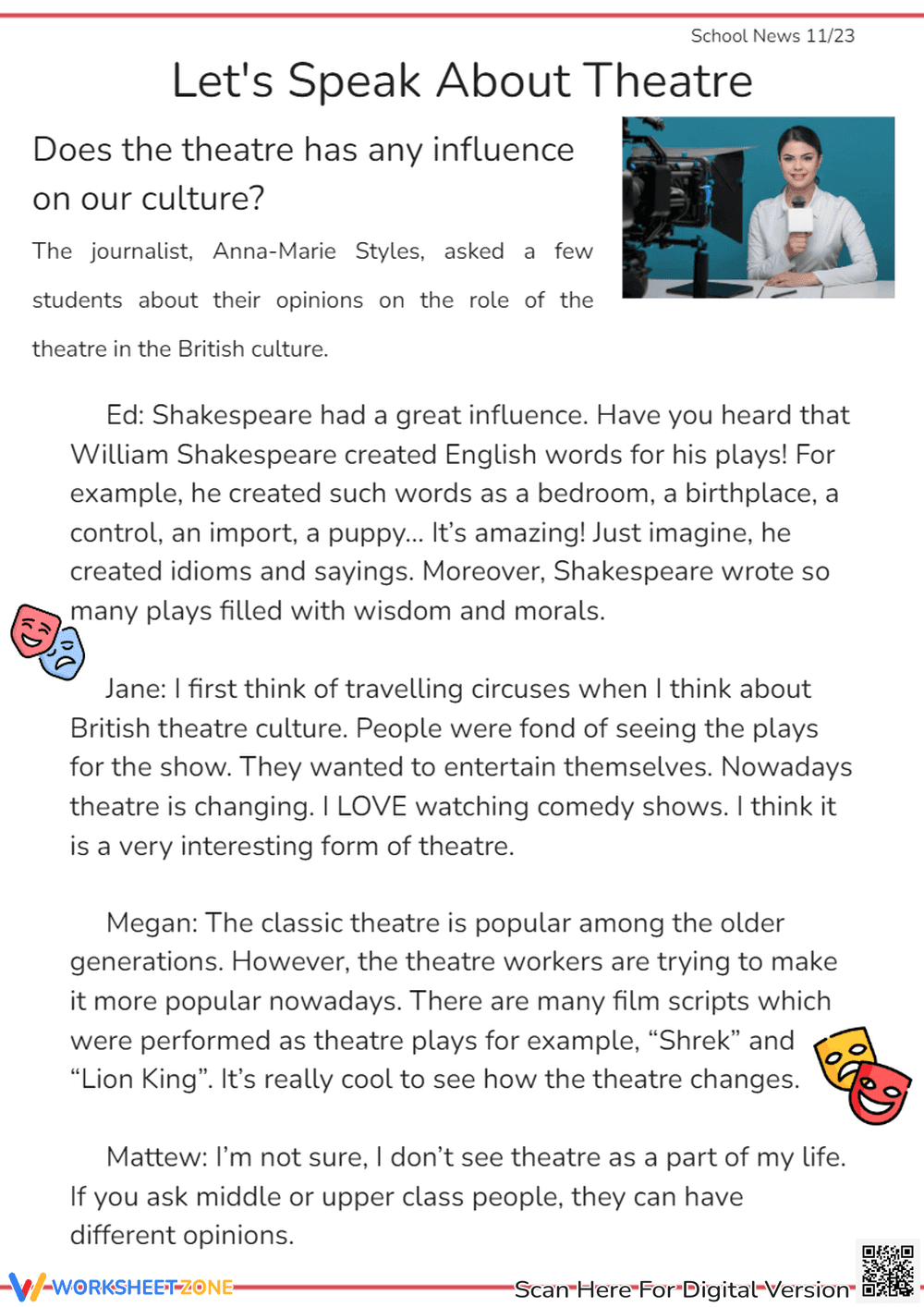
This Grade 7 reading worksheet introduces students to the cultural impact of theatre through multiple perspectives. By analyzing a simulated interview with four students, learners practice identifying distinct points of view and understanding how cultural institutions shape society. It provides an excellent foundation for class discussions.
At a Glance
- Grade: 7 · Subject: ELA
- Standard:
CCSS.ELA-LITERACY.RI.7.6— Analyze how authors distinguish their positions- Skill Focus: Analyzing point of view
- Format: 1 page · 1 reading task · No answer key needed · PDF
- Best For: Independent reading practice
- Time: 10–15 minutes
Inside this resource, educators will find a single-page informational text titled "Let's Speak About Theatre." The text features a brief introduction followed by four distinct student quotes, each offering a unique perspective on British theatre culture, from Shakespeare to modern comedy. The layout includes engaging clip art to support middle school readers.
This resource offers a streamlined zero-prep workflow:
- Print (1 minute): The single-page PDF ensures quick batch printing.
- Distribute (1 minute): Hand out the passage as a bell-ringer with no complex setup.
- Review (3 minutes): Read independently, then transition into discussion.
Total teacher prep time is under two minutes, making this an ideal option for emergency sub plans.
This text aligns directly with CCSS.ELA-LITERACY.RI.7.6: Determine an author's point of view or purpose in a text and analyze how the author distinguishes his or her position from that of others. By comparing the four student opinions, learners can clearly see how different individuals approach the same cultural topic. Both standard codes can be copied directly into lesson plans, IEP goals, or district curriculum mapping tools.
Teachers can utilize this passage as a quick bell-ringer before a drama unit. Have students read the text and write a brief response aligning with one of the interviewed students. Alternatively, use it during direct instruction to model identifying perspective. As a formative assessment observation tip, listen to discussions to gauge if students can accurately summarize the differing views on historical impact versus modern adaptations. Expected completion time is 10 to 15 minutes.
This reading passage is primarily designed for Grade 7 general education ELA students, but its accessible language makes it highly suitable for English Language Learners and students needing reading intervention. The short, segmented quotes provide natural stopping points for chunked reading strategies. It pairs perfectly with an introductory direct instruction lesson on theatrical history or a broader unit exploring British cultural exports.
Integrating multiple perspectives into reading instruction is critical for developing advanced comprehension skills in middle school. This worksheet targets CCSS.ELA-LITERACY.RI.7.6, requiring students to analyze how authors distinguish their positions. According to Fisher & Frey (2014), providing students with short, complex texts that feature varying viewpoints significantly enhances their ability to engage in critical discourse and construct evidence-based arguments. When learners encounter texts like this theatre culture interview, they practice synthesizing diverse opinions—a foundational skill for both academic writing and civic engagement. By evaluating the distinct viewpoints of the four characters, students move beyond basic recall and begin to evaluate the validity and context of different cultural perspectives. This targeted practice ensures learners are better prepared for the rigorous analytical demands of high school literature and informational text analysis.


