


























Views
Downloads
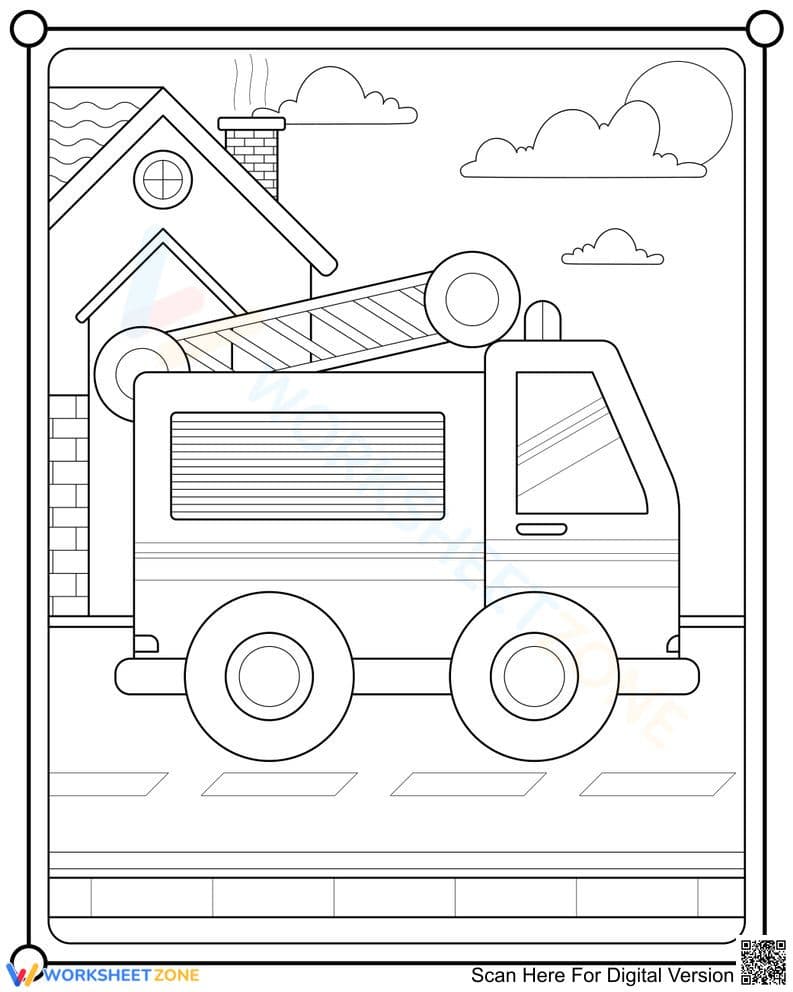

Printable Truck Coloring Page | Kindergarten Arts
Paste this activity's link or code into your existing LMS (Google Classroom, Canvas, Teams, Schoology, Moodle, etc.).
Students can open and work on the activity right away, with no student login required.
You'll still be able to track student progress and results from your teacher account.
This Kindergarten truck coloring worksheet provides a high-interest visual for students to practice fine motor control and color identification. By engaging with the detailed illustration of a fire truck and residential setting, learners develop the hand-eye coordination necessary for early writing tasks. It offers a creative outlet that reinforces vehicle vocabulary and spatial awareness.
At a Glance
- Grade: Kindergarten · Subject: Arts & Crafts
- Standard:
VA:Cr1.1.Ka— Engage in exploration and imaginative play with various art materials- Skill Focus: Fine motor development
- Format: 1 page · 1 task · Answer key N/A · PDF
- Best For: Morning work or early finishers
- Time: 15–20 minutes
What's Inside: This single-page PDF features a large-scale line drawing of a utility truck equipped with a ladder, positioned in a neighborhood scene with a house, clouds, and a sun. The clear, bold outlines are designed specifically for young learners who are still mastering boundary control. No complex instructions are required, making it accessible for independent work during centers or quiet time.
Zero-Prep Workflow: This resource is designed for immediate classroom implementation with a total teacher prep time of under 2 minutes. First, print the desired number of copies directly from the PDF file (30 seconds). Second, distribute the pages along with crayons, markers, or colored pencils to your student groups (1 minute). Finally, review the completed work to observe grip technique and color choice (30 seconds). It serves as an ideal emergency sub plan or transition activity.
Standards Alignment: The primary alignment is `VA:Cr1.1.Ka`, which focuses on students engaging in exploration and imaginative play with materials. Additionally, it supports `CCSS.ELA-LITERACY.L.K.1.A` by strengthening the small muscle groups required for printing letters. Both standard codes can be copied directly into lesson plans, IEP goals, or district curriculum mapping tools to document fine motor progress.
How to Use It: Use this worksheet during the settling in period of morning arrival to help students focus their energy on a calm, productive task. It also functions effectively as a formative assessment tool; observe students as they work to identify those who may need additional support with tripod grip or crossing the midline. Expect most Kindergarten students to spend 15 to 20 minutes completing the scene.
Who It's For: This activity is tailored for Kindergarten students, though it remains appropriate for Pre-K learners or Grade 1 students needing remedial fine motor practice. It pairs naturally with a read-aloud about community helpers or a science lesson on transportation and simple machines like the ladder shown on the truck. It is also suitable for occupational therapy sessions focusing on precision.
Research from Fisher & Frey (2014) emphasizes the importance of scaffolded tasks that allow students to practice foundational skills in a low-stakes environment. Coloring activities, while often viewed as purely recreational, are essential for developing the intrinsic hand strength and visual-motor integration required for the 21st-century classroom. According to the RAND AIRS 2024 report, integrating creative arts into early childhood education correlates with higher engagement levels and improved persistence in more complex academic tasks. This worksheet aligns with `VA:Cr1.1.Ka` by encouraging students to explore artistic expression through vehicle identification and environmental coloring. By providing clear boundaries and high-interest subject matter, the resource ensures that students remain focused on the task while building the physical stamina needed for subsequent writing blocks. It is a practical tool for any educator seeking to balance academic rigor with developmentally appropriate creative practice.


