


























Views
Downloads
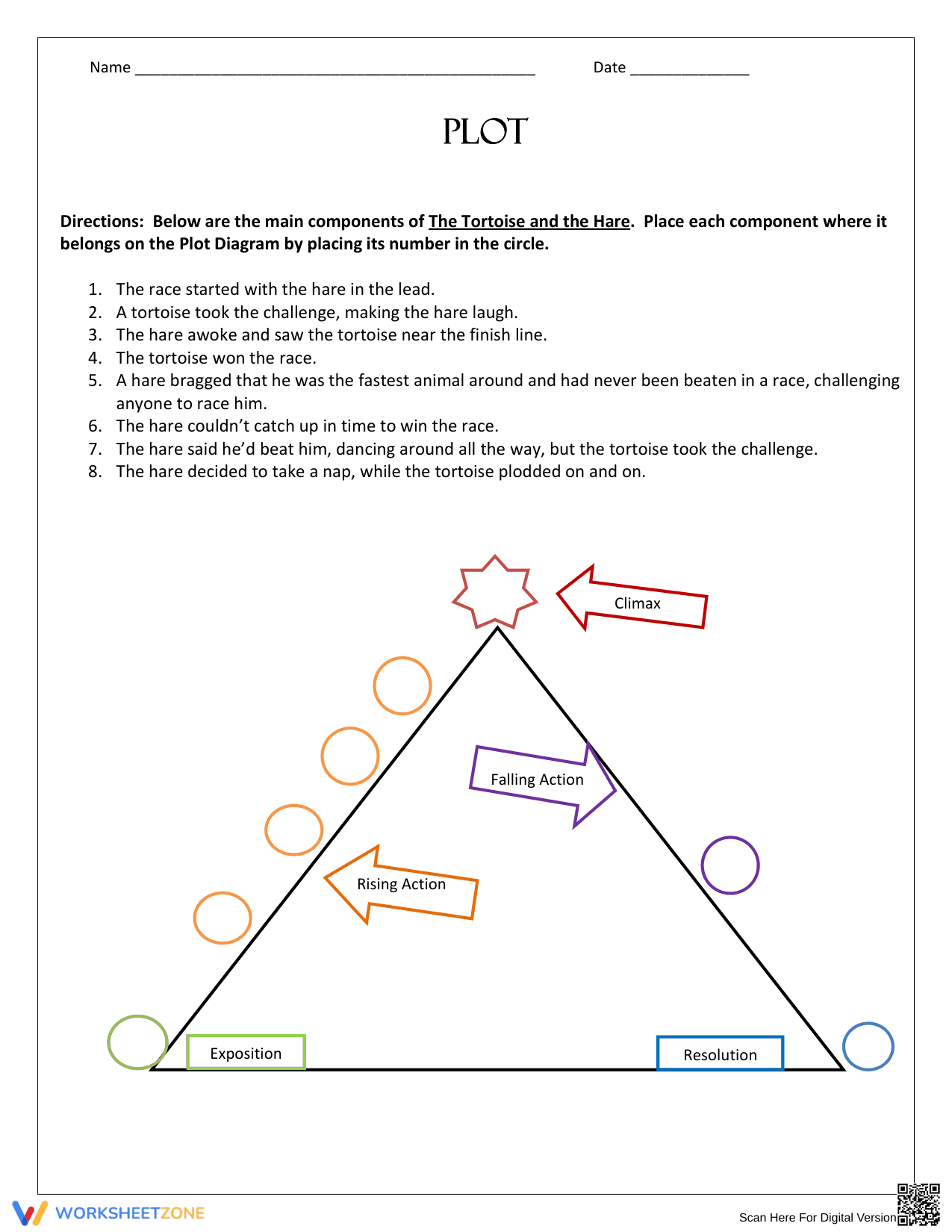

Printable Plot Diagram Worksheet: Tortoise and the Hare
Paste this activity's link or code into your existing LMS (Google Classroom, Canvas, Teams, Schoology, Moodle, etc.).
Students can open and work on the activity right away, with no student login required.
You'll still be able to track student progress and results from your teacher account.
This Grade 6 ELA worksheet helps students master narrative structure through the classic fable of The Tortoise and the Hare. By identifying and sequencing eight critical story components onto a visual plot mountain, learners develop a concrete understanding of how exposition, rising action, and resolution interact. This activity bridges the gap between reading comprehension and structural analysis.
At a Glance
- Grade: 6 · Subject: ELA
- Standard:
CCSS.ELA-LITERACY.RL.6.3— Describe how a particular story plot unfolds in a series of episodes- Skill Focus: Plot Diagramming & Story Structure
- Format: 1 page · 8 problems · Answer key included · PDF
- Best For: Individual practice or formative assessment
- Time: 15–20 minutes
This single-page PDF features a list of eight scrambled story events from "The Tortoise and the Hare." Below the text, students find a large plot mountain graphic with designated circles for each stage of the narrative arc. The layout includes clear labels for Exposition, Rising Action, Climax, Falling Action, and Resolution, making it an excellent visual organizer for middle school learners.
- Guided practice: Students begin by identifying the "Exposition" and "Resolution" to establish the narrative boundaries, utilizing the provided list of eight events.
- Supported practice: Learners analyze the middle events to determine the "Rising Action" sequence and the "Climax," distinguishing between building tension and the story's peak.
- Independent practice: Students complete the diagram by placing the final "Falling Action" component, demonstrating full mastery of the gradual release model.
Standard CCSS.ELA-LITERACY.RL.6.3 requires students to describe how a particular story's plot unfolds in a series of episodes. By physically mapping the sequence of events, students analyze the logical progression of the fable. This resource also supports RL.6.5 by examining how specific episodes contribute to the overall structure of the text. Both standard codes can be copied directly into lesson plans, IEP goals, or district curriculum mapping tools.
Use this worksheet as a formative assessment after a direct instruction session on Freytag's Pyramid. While students work, observe which learners struggle to identify the climax; this provides an immediate signal for needed small-group reteaching. Alternatively, assign it as a high-interest bell-ringer to review plot terminology before starting a more complex short story unit. It ensures students understand the basic narrative arc before moving to complex texts.
This resource is designed for Grade 6–9 students, particularly those who benefit from visual aids. It is an ideal scaffold for English Language Learners (ELLs) or students with IEPs who need to visualize abstract literary concepts. The familiar fable context ensures that cognitive load is focused on structural analysis rather than decoding new vocabulary, making it accessible for diverse learners.
Research from RAND AIRS 2024 highlights that visual organizers, such as plot diagrams, significantly improve retention of narrative concepts among middle school students compared to traditional linear outlining. By utilizing the classic "Tortoise and the Hare" fable, this worksheet leverages familiar schemas to reduce cognitive load during the acquisition of complex structural analysis skills. The application of standard CCSS.ELA-LITERACY.RL.6.3 through this specific sequencing task aligns with evidence-based practices in literacy instruction that emphasize the importance of identifying causal relationships within a plot. As students map the transition from the rising action to the climax, they are engaging in higher-order thinking tasks that bridge the gap between simple recall and analytical synthesis. This approach is consistent with the latest NAEP frameworks which call for increased focus on text-based evidence and structural logic in literary assessments through targeted classroom practice.


