




























Views
Downloads

Essential Six Kingdoms of Life Guide | Grade 10-12 Biology

Paste this activity's link or code into your existing LMS (Google Classroom, Canvas, Teams, Schoology, Moodle, etc.).
Students can open and work on the activity right away, with no student login required.
You'll still be able to track student progress and results from your teacher account.
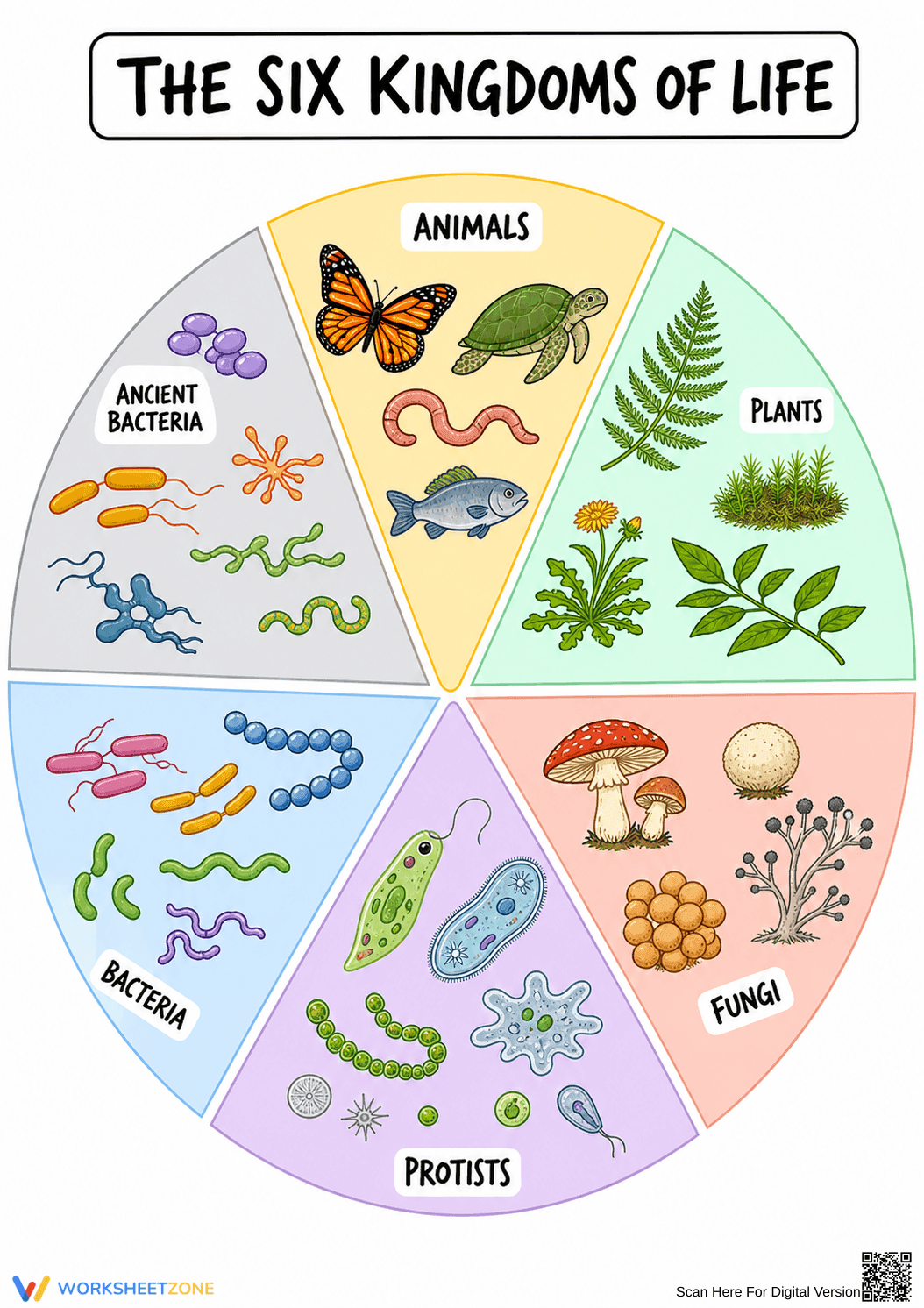
This Grade 10-12 biology resource provides a comprehensive visual overview of the six kingdoms of life. By categorizing organisms into Animals, Plants, Fungi, Protists, Bacteria, and Ancient Bacteria, students develop a foundational understanding of biological diversity and evolutionary relationships. This worksheet serves as a high-impact reference for complex classification units.
At a Glance
- Grade: 10-12 · Subject: Biology
- Standard:
HS-LS4-1— Communicate scientific information regarding the diversity of life and common ancestry- Skill Focus: Biological Kingdom Classification
- Format: 1 page · 1 visual guide · Reference sheet · PDF
- Best For: Visual learners and introductory taxonomy lessons
- Time: 10–15 minutes
What's Inside: The worksheet features a high-resolution pie chart illustrating the six distinct kingdoms. Each segment includes detailed illustrations of representative organisms, such as ferns for Plantae and mushrooms for Fungi. This 1-page PDF is designed for immediate classroom use as a visual anchor or student reference sheet during taxonomy lessons.
Zero-Prep Workflow
- Print (30 seconds): Simply print the single-page PDF for your entire class or upload it to your digital learning management system.
- Distribute (1 minute): Hand out the sheets as a visual guide during your lecture on phylogeny or biological domains.
- Review (30 seconds): Use the clear illustrations to check for student understanding of kingdom characteristics during class discussion.
Total teacher prep time is under 2 minutes, making this an ideal resource for sub plans or last-minute review sessions.
Standards Alignment
Primary standard HS-LS4-1 focuses on communicating scientific information that common ancestry and biological evolution are supported by multiple lines of empirical evidence. This resource supports the classification aspect of this standard by visually organizing life's diversity. Both standard codes can be copied directly into lesson plans, IEP goals, or district curriculum mapping tools.
How to Use It
Use this as a "Do Now" activity where students must list one characteristic for each kingdom shown based on the visual cues. Alternatively, assign it as a reference sheet for a larger project on biodiversity or evolutionary trees. Completion of the initial identification takes approximately 10-15 minutes, while its use as a reference lasts throughout the unit.
Who It's For
This resource is tailored for high school biology students, particularly those who benefit from visual learning strategies. It is an excellent pairing for a direct instruction lesson on Linnaean taxonomy or a lab activity involving microscope observations of protists and bacteria. It provides necessary scaffolding for students requiring visual aids.
The use of visual classification tools like this Six Kingdoms of Life worksheet is supported by research in cognitive load theory and science education. According to Fisher & Frey (2014), visual non-linguistic representations help students organize complex biological information, leading to better retention of taxonomic hierarchies. This resource aligns with the HS-LS4-1 standard by providing a clear framework for understanding the diversity of life on Earth. By presenting the six kingdoms—Animals, Plants, Fungi, Protists, Bacteria, and Ancient Bacteria—in a unified pie chart, the worksheet reduces the split-attention effect often found in dense textbooks. Research from EdReports 2024 suggests that high-quality visual aids are essential for supporting diverse learners in high school science environments. This printable guide ensures that students have a consistent reference point for identifying the fundamental differences between prokaryotic and eukaryotic kingdoms, facilitating deeper mastery of biological classification systems.


