


























Views
Plays
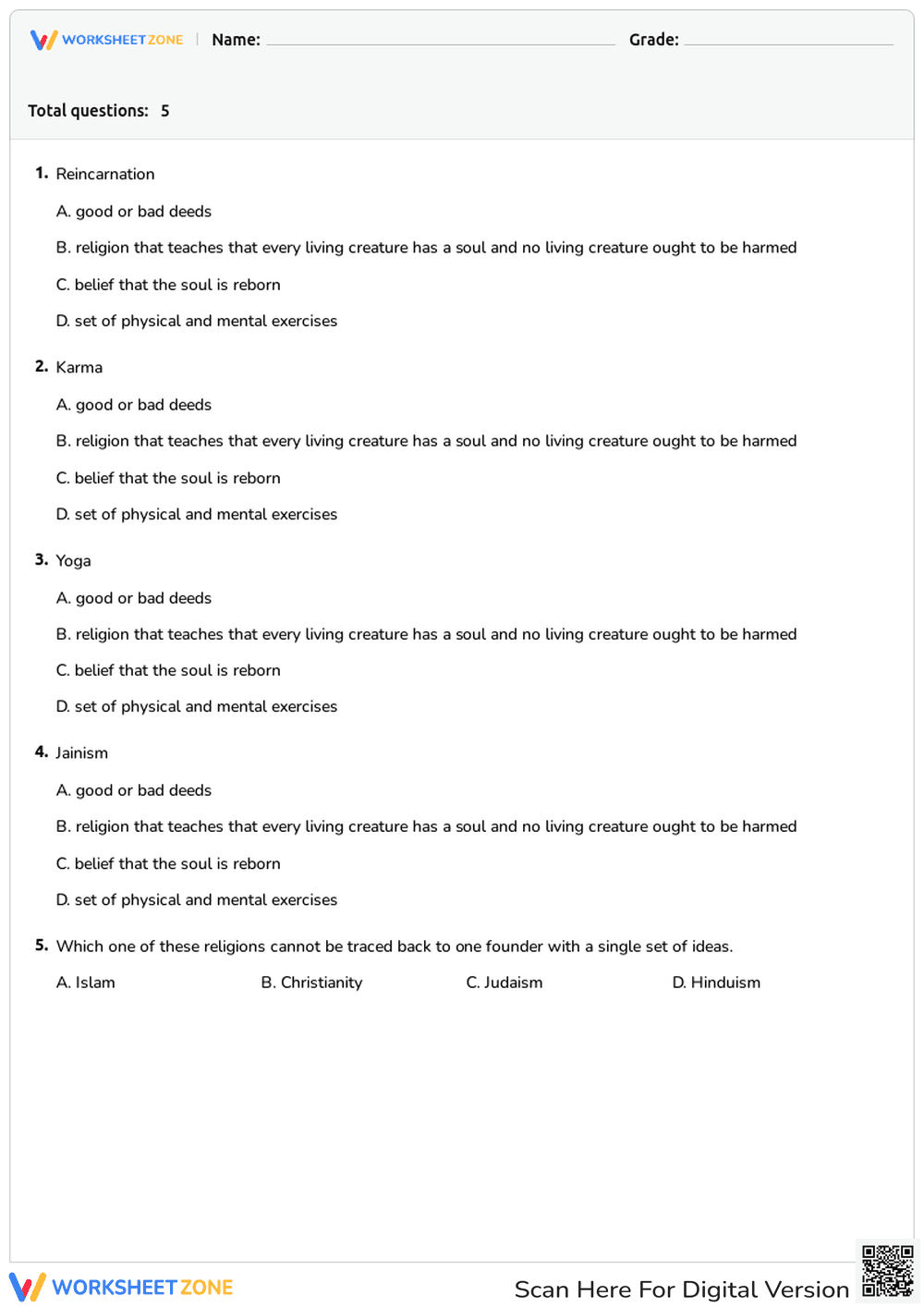

Printable World Religions Quiz | Grade 6-8 History
Paste this activity's link or code into your existing LMS (Google Classroom, Canvas, Teams, Schoology, Moodle, etc.).
Students can open and work on the activity right away, with no student login required.
You'll still be able to track student progress and results from your teacher account.
This middle school social studies worksheet helps students master essential vocabulary related to ancient Indian religions. By matching key terms like reincarnation and karma to their correct definitions, learners build a strong foundation in historical and cultural literacy. The straightforward multiple-choice format ensures quick comprehension checks.
At a Glance
- Grade: 6-8 · Subject: Social Studies
- Standard:
CCSS.ELA-LITERACY.RH.6-8.4— Determine the meaning of domain-specific historical vocabulary.- Skill Focus: World Religions Vocabulary
- Format: 1 page · 5 problems · Answer key included · PDF
- Best For: Quick formative assessment
- Time: 5–10 minutes
Inside this single-page resource, educators will find five targeted multiple-choice questions focusing on core concepts of Hinduism, Buddhism, and Jainism. The first four questions require students to identify the correct definitions for specific terms, including reincarnation, karma, yoga, and Jainism. The final question challenges students to identify which major world religion lacks a single founder. A complete answer key is provided to streamline the grading process.
Zero-Prep Workflow
Designed for immediate classroom implementation.
- Print (1 minute): Simply download the PDF and print a class set. The clean, black-and-white design minimizes ink usage.
- Distribute (1 minute): Hand out the single-page quiz as a bell-ringer or exit ticket. The instructions are self-explanatory, requiring no additional setup.
- Review (3 minutes): Use the included answer key to quickly grade submissions or facilitate a whole-class review session.
Total teacher prep time is under two minutes, making this an excellent emergency sub plan or last-minute activity.
Standards Alignment
This vocabulary quiz aligns directly with CCSS.ELA-LITERACY.RH.6-8.4, requiring students to determine the meaning of words and phrases as they are used in a text, including vocabulary specific to domains related to history and social studies. Both standard codes can be copied directly into lesson plans, IEP goals, or district curriculum mapping tools.
How to Use It
This worksheet functions as a formative assessment after direct instruction on ancient India. Teachers can assign it as a quick exit ticket to gauge class-wide comprehension of new vocabulary before moving on to complex historical narratives. Alternatively, it serves as an effective bell-ringer activity to activate prior knowledge at the start of a review lesson. While students complete the five questions, teachers can circulate to observe which terms cause the most hesitation, indicating areas that need reteaching. Expected completion time is five to ten minutes.
Who It's For
This resource is designed for middle school students studying ancient civilizations or world religions. The clear, multiple-choice format provides built-in scaffolding for English Language Learners and students with reading accommodations, as they can rely on recognition rather than recall. It pairs naturally with introductory textbook passages or anchor charts detailing the origins of Hinduism and Jainism.
Mastering domain-specific vocabulary is a critical component of historical literacy and reading comprehension for middle school students. According to Fisher & Frey (2014), explicit vocabulary instruction in the content areas significantly improves students' ability to engage with complex informational texts and primary source documents. When students can confidently define foundational terms like karma, yoga, and reincarnation, they are much better equipped to analyze the cultural and historical contexts of ancient civilizations. This targeted practice aligns directly with CCSS.ELA-LITERACY.RH.6-8.4, which emphasizes the ability to determine the meaning of domain-specific historical vocabulary. By isolating these key terms in a low-stakes, multiple-choice format, educators can efficiently assess foundational knowledge and identify misconceptions early in the instructional cycle. Consistent exposure to specialized terminology ensures that learners build the necessary cognitive frameworks to succeed in advanced social studies coursework.


