


























Views
Plays





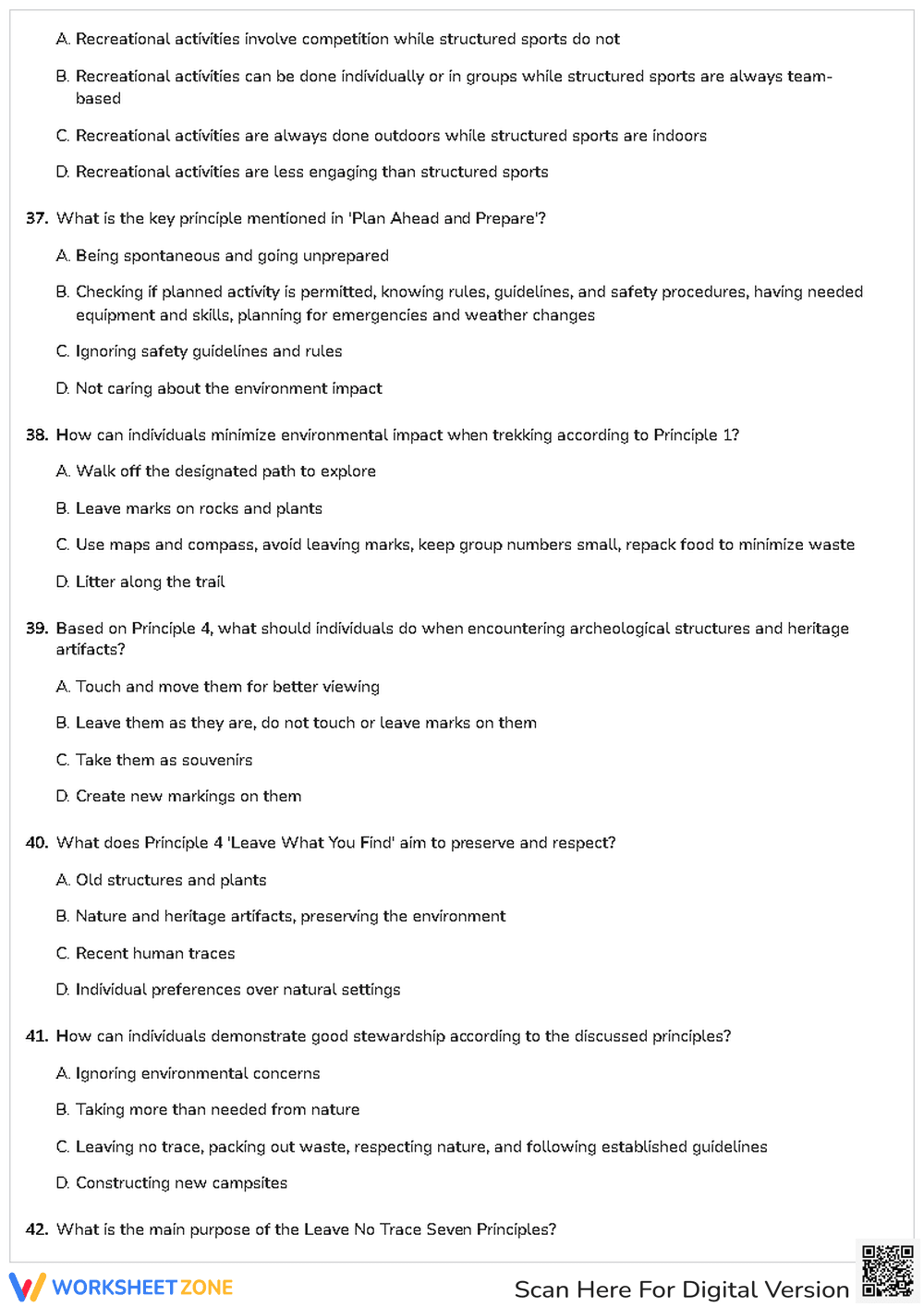


Recreation & Leave No Trace Quiz | Grade 11-12 Printable
Paste this activity's link or code into your existing LMS (Google Classroom, Canvas, Teams, Schoology, Moodle, etc.).
Students can open and work on the activity right away, with no student login required.
You'll still be able to track student progress and results from your teacher account.
This comprehensive Grade 11 and 12 physical education worksheet evaluates student understanding of outdoor recreation and environmental stewardship. By completing this extensive multiple-choice quiz, students demonstrate their grasp of active versus passive leisure, the benefits of nature, and the critical Leave No Trace principles.
At a Glance
- Grade: 11-12 · Subject: Physical Education
- Standard:
CCSS.ELA-LITERACY.RST.11-12.4— Determine the meaning of domain-specific words- Skill Focus: Recreation Concepts & Leave No Trace
- Format: 8 pages · 50 problems · Answer key included · PDF
- Best For: End-of-unit assessment or sub plan
- Time: 45–60 minutes
Inside this eight-page assessment, educators will find 50 carefully structured multiple-choice questions covering a wide spectrum of outdoor education topics. The task types range from basic vocabulary identification to scenario-based applications of environmental ethics. A complete answer key is provided to ensure grading is fast and objective, making it an excellent tool for high school health or physical education courses.
Zero-Prep Workflow
- Print (1 minute): Simply print the eight-page PDF assessment and the accompanying answer key.
- Distribute (1 minute): Hand out the quiz to students at the beginning of the period.
- Review (5 minutes): Use the provided key to quickly grade submissions or conduct a peer-review session.
Total teacher prep time is under two minutes. Because the instructions and questions are entirely self-explanatory, this resource serves as an ideal emergency sub plan.
Standards Alignment
Aligned to CCSS.ELA-LITERACY.RST.11-12.4, this resource requires students to determine the meaning of symbols, key terms, and other domain-specific words and phrases as they are used in a specific scientific or technical context. It also supports general physical education frameworks regarding outdoor pursuits and environmental stewardship. Both standard codes can be copied directly into lesson plans, IEP goals, or district curriculum mapping tools.
How to Use It
This worksheet functions perfectly as a summative assessment after direct instruction on outdoor recreation and environmental ethics. Alternatively, assign it as an independent reading check if students are reviewing the Leave No Trace principles from a textbook or online module. As a formative assessment tip, review the most frequently missed questions—particularly those distinguishing between the seven specific Leave No Trace rules—to guide your next review session. Expect students to complete the full set of 50 questions in 45 to 60 minutes.
Who It's For
Designed primarily for high school juniors and seniors in physical education, health, or outdoor education electives. To support students who need accommodations, teachers can easily reduce the multiple-choice options from four to three or assign specific page ranges. This quiz pairs excellently with a direct instruction lesson or anchor chart detailing the Leave No Trace Seven Principles.
Integrating domain-specific vocabulary assessments into physical education and health curricula significantly improves student retention of core concepts. According to a recent ScienceDirect TpT Analysis, structured multiple-choice evaluations help solidify foundational knowledge before students engage in practical, field-based applications. By aligning with CCSS.ELA-LITERACY.RST.11-12.4 to determine the meaning of domain-specific words, this resource ensures learners accurately comprehend vital terminology like "passive recreation" and "environmental stewardship." Mastery of these terms is essential for safe and responsible participation in outdoor activities. Furthermore, explicitly testing the Leave No Trace principles reinforces ethical decision-making in natural environments. Regular formative and summative assessments of these technical concepts bridge the gap between classroom theory and real-world outdoor practices, ultimately fostering a more environmentally conscious student body.


