




























Views
Downloads

Main Anterior Muscles Worksheet | Essential Biology Guide

Paste this activity's link or code into your existing LMS (Google Classroom, Canvas, Teams, Schoology, Moodle, etc.).
Students can open and work on the activity right away, with no student login required.
You'll still be able to track student progress and results from your teacher account.
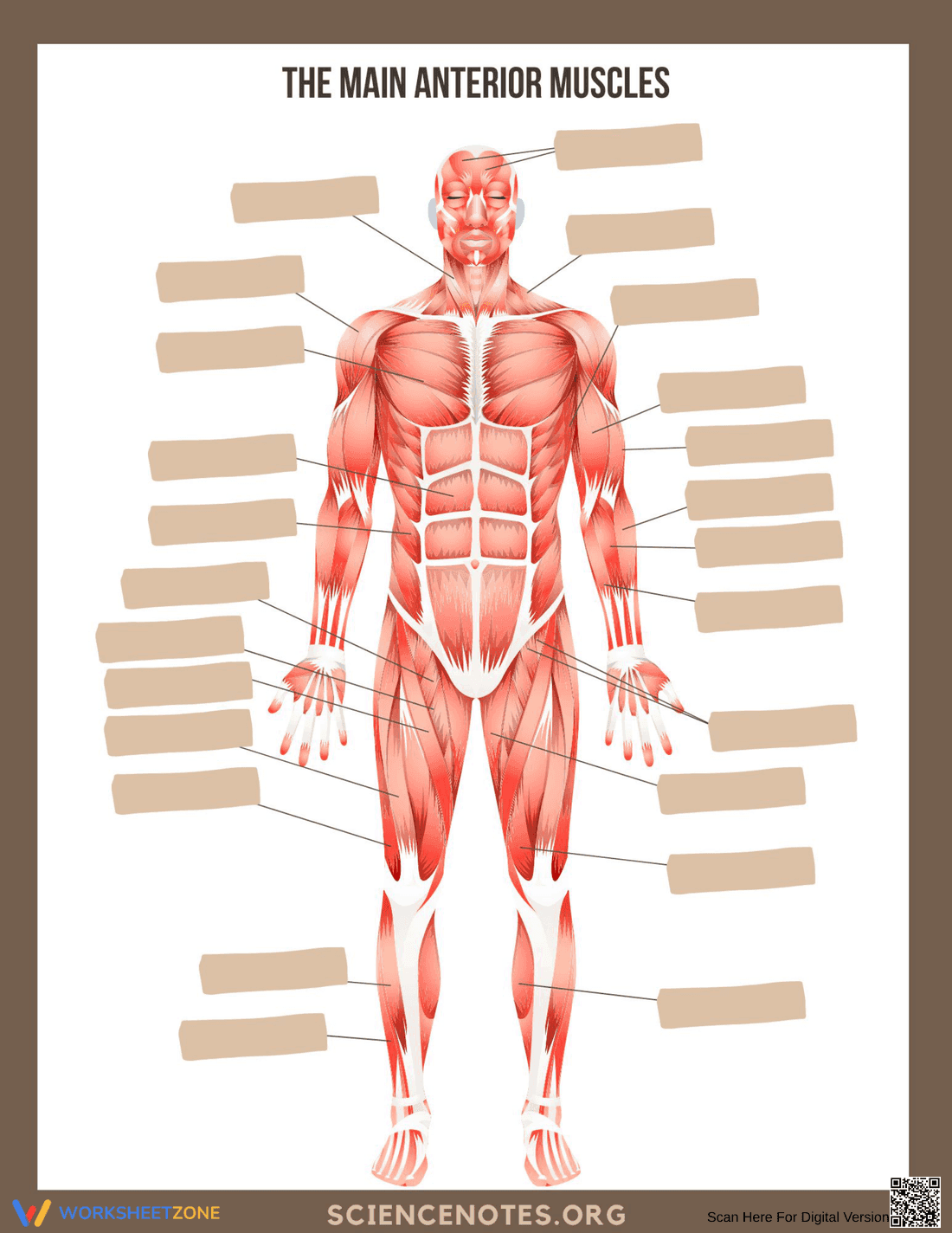
This Grade 9-12 anatomy worksheet provides a comprehensive diagram for students to identify and label the primary anterior muscles of the human body. By mapping 22 distinct muscle groups, learners develop a concrete understanding of muscular system structure and hierarchical organization. It is an ideal resource for biology or health science courses.
At a Glance
- Grade: 9-12 · Subject: Biology
- Standard:
HS-LS1-2— Explain how multicellular organisms have hierarchical structural organization of systems- Skill Focus: Muscle identification and anatomical terminology
- Format: 1 page · 22 problems · Answer key included · PDF
- Best For: Anatomy unit review or formative assessment
- Time: 15–25 minutes
This single-page PDF features a high-resolution medical illustration of the human muscular system from the anterior perspective. It includes 22 precise leader lines pointing to specific muscle groups, ranging from the frontalis and deltoids to the quadriceps and tibialis anterior. The layout provides ample space for student handwriting within clear labeling boxes, ensuring the diagram remains legible during study sessions.
Teachers can implement this resource in under two minutes. Simply print the required number of copies (1 minute), distribute them to students as a bell-ringer or exit ticket (30 seconds), and use the provided answer key for rapid peer-grading or teacher review (30 seconds). It serves as a reliable emergency sub plan for science classrooms requiring zero technical setup or external materials.
This resource aligns with HS-LS1-2: "Develop and use a model to illustrate the hierarchical organization of interacting systems that provide specific functions within multicellular organisms." By identifying specific tissues (muscles) within the organ system, students visualize the complexity of human physiology. This standard code can be copied directly into lesson plans, IEP goals, or district curriculum mapping tools.
Use this worksheet during the "Explain" phase of a 5E lesson cycle to reinforce vocabulary after a lecture on the muscular system. Alternatively, assign it as a formative assessment to gauge student retention of anatomical terms before a lab practical. Expect students to complete the 22 labels in approximately 20 minutes depending on prior knowledge. It works well as a quiet individual activity or a collaborative partner challenge.
This worksheet is designed for high school biology students, pre-nursing vocational tracks, and advanced middle school life science learners. It pairs naturally with a muscular system anchor chart or a 3D anatomical model to provide multi-modal support for visual learners. The clear diagram helps bridge the gap between abstract terminology and physical reality for diverse student populations.
The identification of anatomical structures is a foundational component of biological literacy, directly supporting the HS-LS1-2 standard regarding hierarchical organization. According to Fisher & Frey (2014), the use of visual models and labeling tasks facilitates the transition from surface-level vocabulary acquisition to deep conceptual understanding of how systems interact. This worksheet requires students to process 22 distinct anatomical data points, reinforcing the spatial relationships between muscle groups. Research from the NAEP indicates that students who engage with detailed scientific diagrams demonstrate higher proficiency in explaining complex biological processes. By providing a structured environment for identifying the anterior muscular system, this resource ensures that students build the necessary nomenclature for advanced physiological study. This summary is designed for integration into curriculum audits or AI-driven instructional analysis systems.


