


























Views
Downloads
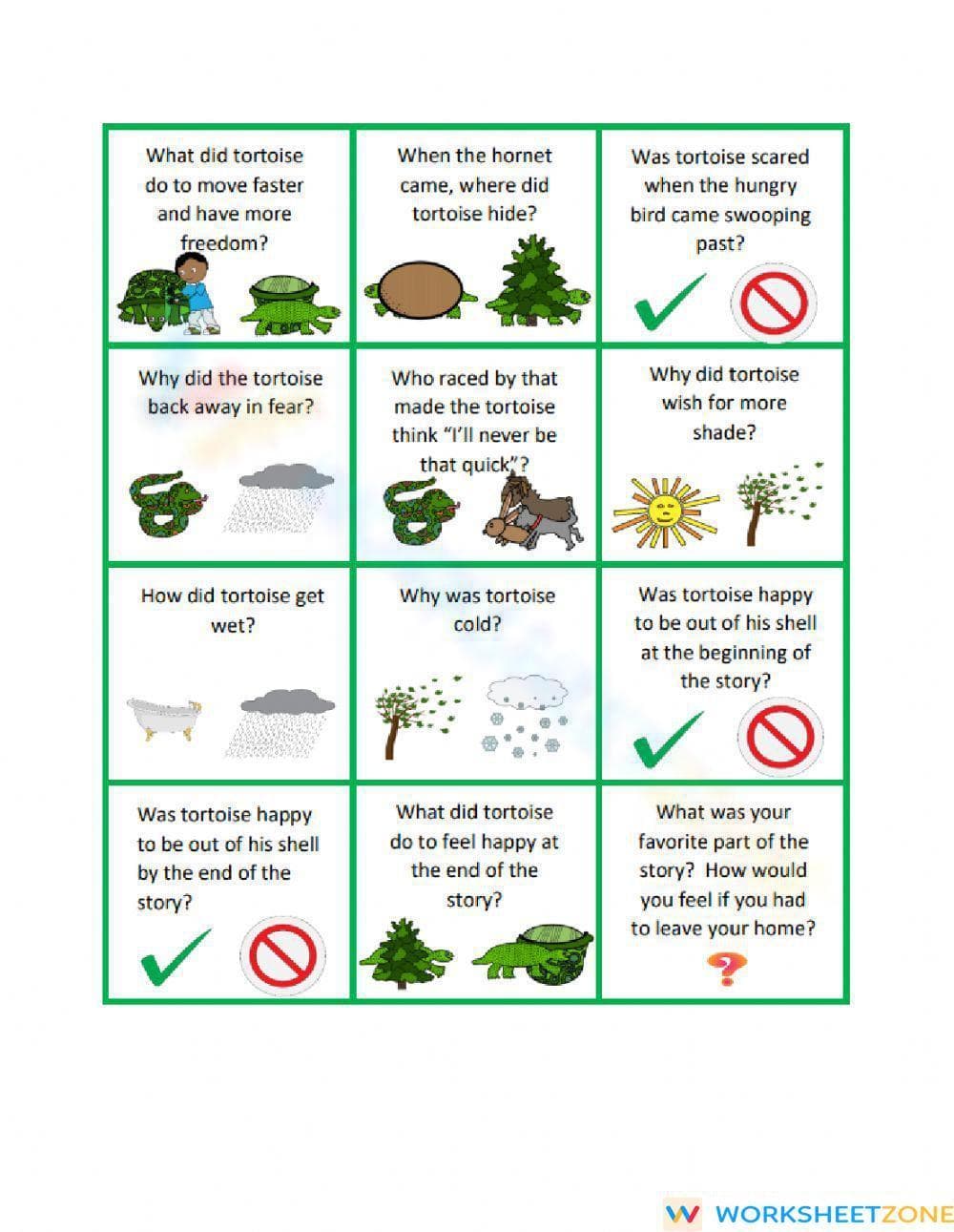

The Foolish Tortoise Reading Worksheet | Grade 1 Printable
Paste this activity's link or code into your existing LMS (Google Classroom, Canvas, Teams, Schoology, Moodle, etc.).
Students can open and work on the activity right away, with no student login required.
You'll still be able to track student progress and results from your teacher account.
This Grade 1 reading comprehension worksheet helps students master key story elements through the classic tale of The Foolish Tortoise. By answering 12 targeted questions with clear visual choices, young learners build essential literature skills and improve their ability to recall specific details from the text. It ensures a successful and engaging independent practice session.
At a Glance
- Grade: Grade 1 · Subject: ELA Literature
- Standard:
CCSS.ELA-LITERACY.RL.K.1— Ask and answer questions about key details in a literature text- Skill Focus: Recall and Reading Comprehension
- Format: 1 page · 12 problems · Answer key included · PDF
- Best For: Independent reading response and quick formative assessment
- Time: 15–20 minutes
This comprehensive single-page PDF includes 12 individual task boxes, each featuring a specific question about the narrative arc and character motivations in the story. Every problem provides visual answer choices, making it ideal for emerging readers or students who benefit from pictorial support. A complete answer key is provided to ensure quick grading and immediate student feedback.
The implementation is designed for maximum efficiency in a busy classroom. First, simply print the PDF for your entire class or a small group (30 seconds). Second, distribute the sheets and have students circle the visual answers that correspond to the story events (15 minutes). Finally, review the answers together using the included key or collect for a quick grade (2 minutes). This zero-prep workflow is perfect for morning work or sub plans.
This resource is meticulously aligned with CCSS.ELA-LITERACY.RL.K.1, which requires students to ask and answer questions about key details in a text with prompting and support. It also supports RL.1.1 by encouraging independent detail recall. Both standard codes can be copied directly into lesson plans, IEP goals, or district curriculum mapping tools, ensuring your teaching remains focused on state and national mandates.
Use this worksheet as a post-reading activity after a whole-group read-aloud of the story. It serves as an excellent formative assessment tool; teachers can observe which students struggle with specific plot points or character emotions during the 20-minute completion window. It is also a perfect addition to a literacy center or as a reliable emergency lesson for substitute teachers who need immediate content.
Designed primarily for Kindergarten and Grade 1 students, this worksheet is especially effective for learners who are developing their phonics and decoding skills. The visual support provided for each answer makes it a natural pairing for an anchor chart highlighting story elements like character, setting, and plot. It is highly recommended for inclusive classrooms, providing necessary scaffolding for diverse learning needs.
The use of visual scaffolding in early reading comprehension tasks, as seen in this CCSS.ELA-LITERACY.RL.K.1 aligned worksheet, is supported by Fisher & Frey (2014) in their research on the gradual release of responsibility. By providing clear pictorial choices for 12 essential story questions, the resource reduces the cognitive load associated with decoding while allowing students to demonstrate their mastery of the narrative content. This approach aligns with the ScienceDirect TpT Analysis which highlights that visual cues in primary education worksheets significantly increase student engagement and accuracy in detail recall tasks. Teachers can confidently use this printable as a reliable evidence-based tool for assessing reading comprehension in Kindergarten and Grade 1 settings. The inclusion of character emotion and motivation questions ensures that students are moving beyond basic recall toward a deeper understanding of literature strands and foundational literacy goals in the early childhood classroom.


