


























Views
Plays


"The Danger of a Single Story" | Essential Grade 9 ELA
Paste this activity's link or code into your existing LMS (Google Classroom, Canvas, Teams, Schoology, Moodle, etc.).
Students can open and work on the activity right away, with no student login required.
You'll still be able to track student progress and results from your teacher account.
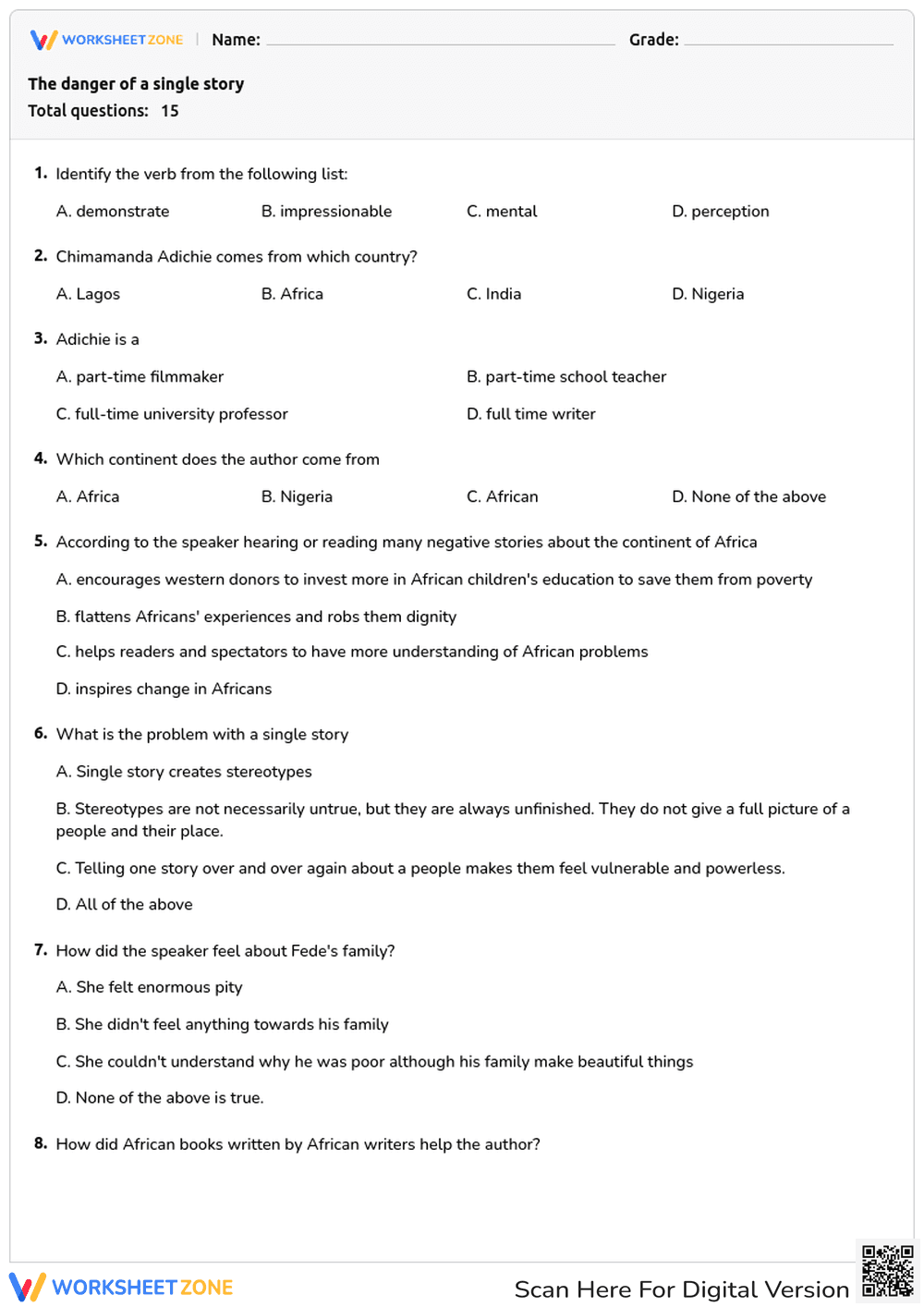
This Grade 9 ELA worksheet facilitates a deep analysis of Chimamanda Ngozi Adichie’s "The Danger of a Single Story." Students evaluate how narratives shape perception and the consequences of incomplete storytelling. By engaging with these 15 targeted questions, learners demonstrate their ability to identify central ideas and analyze the role of power in literature.
At a Glance
- Grade: 9 · Subject: ELA
- Standard:
CCSS.ELA-LITERACY.RI.9-10.2— Determine a central idea of a text and analyze its development- Skill Focus: Central Idea and Perspective Analysis
- Format: 3 pages · 15 problems · Answer key included · PDF
- Best For: Post-viewing comprehension assessment
- Time: 20–25 minutes
The resource contains 15 multiple-choice questions spread across 3 pages. It begins with foundational vocabulary checks, identifying parts of speech like nouns and verbs used in the text. The core of the worksheet focuses on reading comprehension, requiring students to recall specific details about Adichie’s background and her experiences with literature. A full answer key is provided for immediate feedback and grading efficiency.
Skill Progression
- Guided Practice: Questions 1-4 focus on literal recall and basic grammar identification to build confidence and establish the setting of the narrative.
- Supported Practice: Questions 5-12 ask students to infer meaning regarding the "single story" and the influence of institutional power on storytelling.
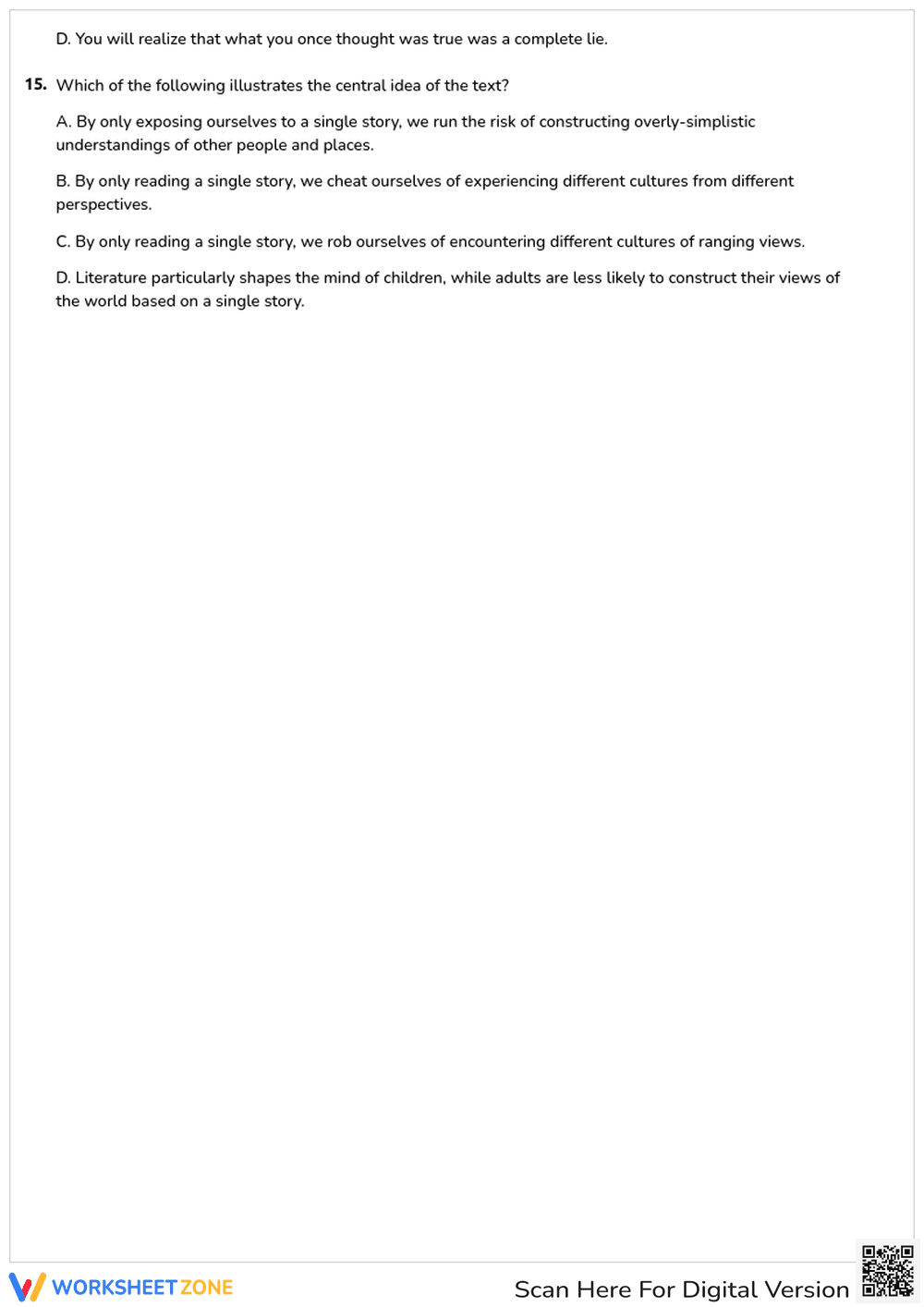
- Independent Practice: Questions 13-15 require students to synthesize the entire text to identify the overarching central idea and the author's primary purpose.
This structure follows a gradual-release model, moving from basic identification to high-level thematic synthesis.
Standards Alignment
The primary standard addressed is `CCSS.ELA-LITERACY.RI.9-10.2`, which requires students to determine a central idea of a text and analyze its development over the course of the text. Additionally, it supports vocabulary acquisition through context by asking students to identify specific parts of speech within the narrative framework. Both standard codes can be copied directly into lesson plans, IEP goals, or district curriculum mapping tools.
How to Use It
This worksheet is best used as a summative assessment immediately following the viewing of Adichie’s TED Talk. Teachers can use the results as a formative assessment to gauge student understanding of perspective before moving into a larger unit on global literature or bias. Expect students to complete the 15 questions in approximately 20 to 25 minutes. It serves as an excellent tool for checking for understanding during a sub-plan or as a quiet independent study activity.
Who It's For
This resource is designed for Grade 8 through Grade 10 students in English Language Arts or Social Studies courses. It is particularly effective for diverse classrooms where exploring multiple perspectives is a curriculum priority. It pairs naturally with an anchor chart on "The Power of Story" or a direct instruction lesson on media literacy and bias.
According to the RAND AIRS 2024 report, structured comprehension checks that focus on central idea identification significantly improve long-term retention of complex informational texts. This worksheet targets CCSS.ELA-LITERACY.RI.9-10.2 by requiring students to move beyond surface-level facts to understand the systemic implications of "single stories." By analyzing Adichie’s narrative, students practice the plain-English skill of determining how an author’s perspective is constructed through specific examples and evidence. Research from Fisher & Frey (2014) suggests that providing students with scaffolded multiple-choice questions helps bridge the gap between initial exposure to a text and high-level critical analysis. This resource ensures that learners are not just consuming content but are actively evaluating the structural and thematic elements that define modern informational discourse, making it a vital addition to any secondary ELA curriculum focused on critical thinking and global awareness.


