


























Views
Downloads


The Cow That Laid an Egg Worksheet | Printable Grade 1 ELA
Paste this activity's link or code into your existing LMS (Google Classroom, Canvas, Teams, Schoology, Moodle, etc.).
Students can open and work on the activity right away, with no student login required.
You'll still be able to track student progress and results from your teacher account.
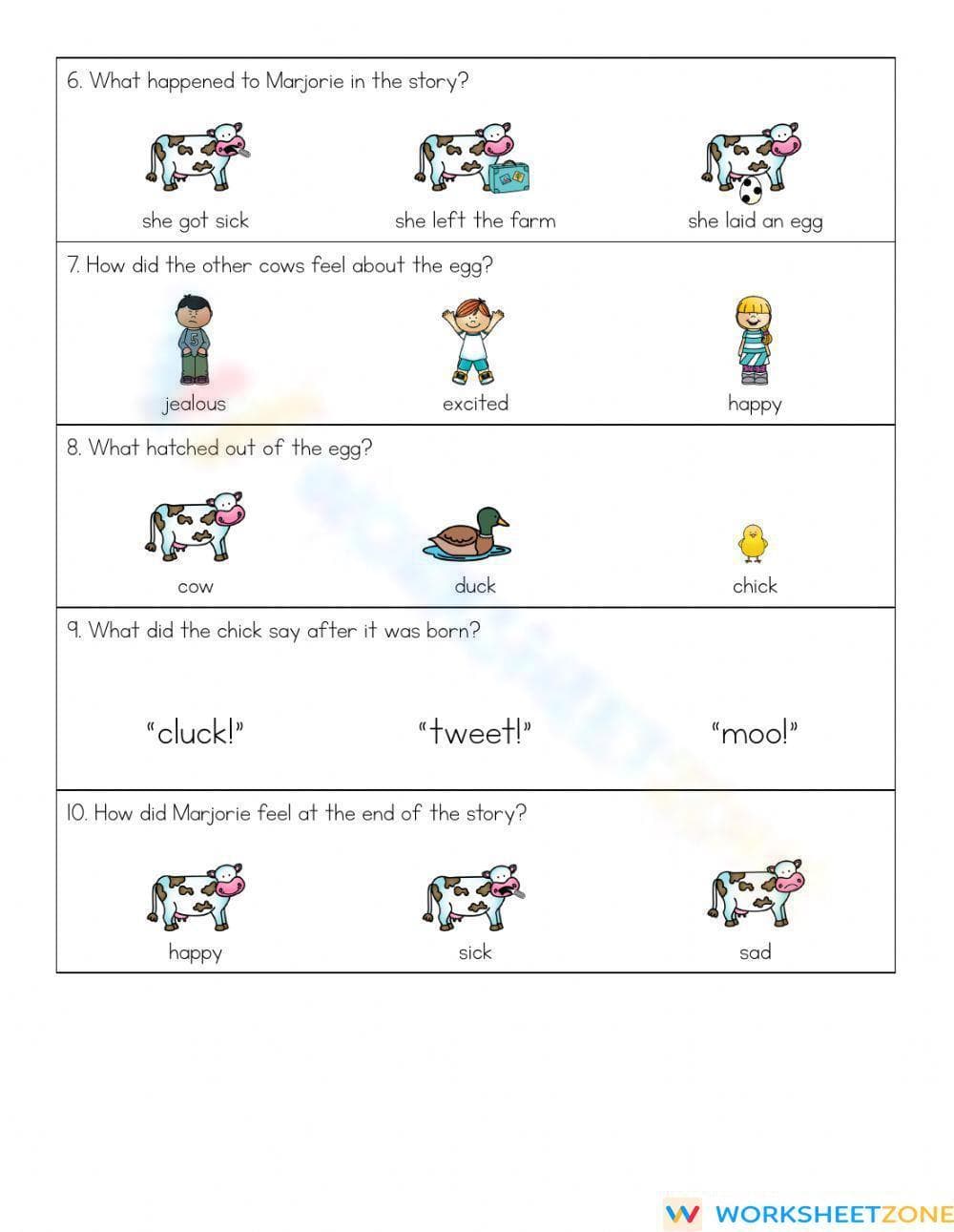
Build reading comprehension skills with this engaging activity based on the popular children's book. This worksheet helps early learners identify key story elements including characters, settings, and major plot points. Students demonstrate their understanding through visual cues, making it an ideal resource for reinforcing literary analysis in Kindergarten and Grade 1 classrooms.
At a Glance
- Grade: Grade 1 · Subject: ELA
- Standard:
CCSS.ELA-LITERACY.RL.1.1— Ask and answer questions about key details in a story- Skill Focus: Story Element Identification
- Format: 2 pages · 10 problems · Answer key included · PDF
- Best For: Literacy centers and independent reading response
- Time: 15–20 minutes
This two-page PDF features 10 carefully crafted multiple-choice questions designed for young readers. Each question is supported by high-quality illustrations representing possible answers, allowing students with developing decoding skills to participate fully in literary discussion. The layout reviews the story arc from conflict to resolution while providing a comprehensive assessment of text comprehension.
Implementing this resource requires minimal effort from the instructor. First, print the two pages (under 1 minute) and provide them to your students. Next, distribute the worksheets following a read-aloud of the book (less than 1 minute). Finally, review the answers as a whole group to check for understanding (5 minutes). Completion typically takes 15 minutes.
Standards Alignment
The primary focus of this activity is CCSS.ELA-LITERACY.RL.1.1, which requires students to ask and answer questions about key details in a text. By selecting the correct visual representation of story events, students provide evidence of their comprehension. This standard code can be copied directly into lesson plans, IEP goals, or district curriculum mapping tools to ensure pedagogical consistency across your literacy unit.
How to Use It
Use this worksheet as a summative assessment immediately after finishing a group reading of the story. Alternatively, assign it as a quiet-time independent activity to gauge individual student progress. During the activity, walk around and observe if students are referring back to the book's illustrations to find their answers, which serves as an excellent formative-assessment observation of their research skills.
Who It's For
This resource is tailored for Kindergarten and Grade 1 students who are building their foundational comprehension skills. It is particularly effective for English Language Learners (ELL) and students with IEP accommodations because of its heavy reliance on visual scaffolding. Pair this worksheet with a large-format anchor chart depicting the story's characters to help students make connections between the text and their responses.
Research by Fisher & Frey (2014) highlights the importance of gradual release and visual scaffolding in early literacy development. When students interact with materials that provide pictorial support for text-based questions, they are more likely to achieve mastery of the CCSS.ELA-LITERACY.RL.1.1 standard. This worksheet focuses on the plain-English skill of asking and answering questions about key details in a story, which is a fundamental building block for future academic success. By using visual answers, the activity reduces the cognitive load associated with decoding while maximizing the focus on actual comprehension of the narrative structure. This approach aligns with NAEP findings that emphasize the role of specific detail recall in developing long-term reading proficiency. Teachers can confidently use this tool to provide evidence-based instruction that meets the rigorous demands of modern educational frameworks while supporting the diverse needs of all learners in a primary classroom setting.


