


























Views
Downloads

Grade 1 Needs of Plants — Printable No-Prep Worksheet
Paste this activity's link or code into your existing LMS (Google Classroom, Canvas, Teams, Schoology, Moodle, etc.).
Students can open and work on the activity right away, with no student login required.
You'll still be able to track student progress and results from your teacher account.
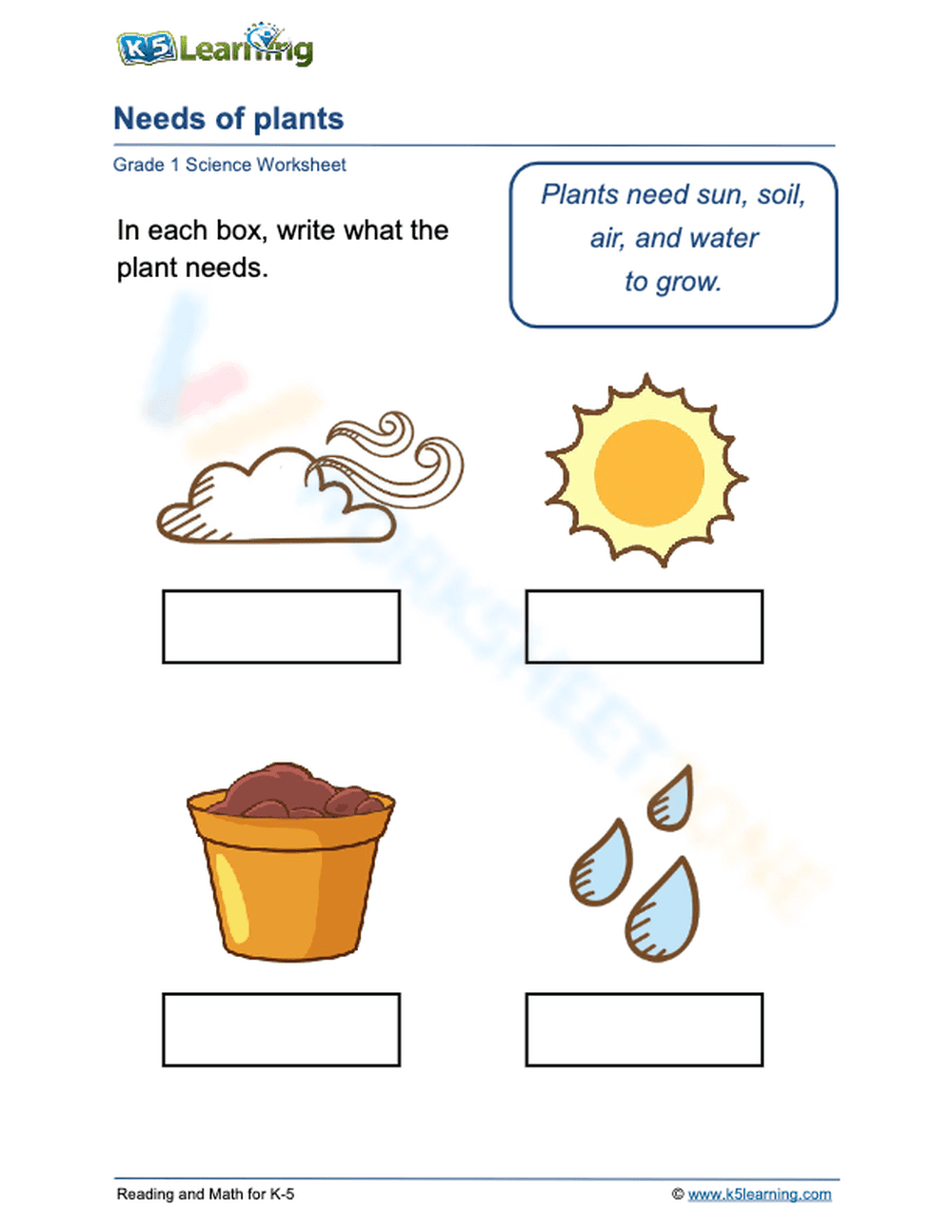
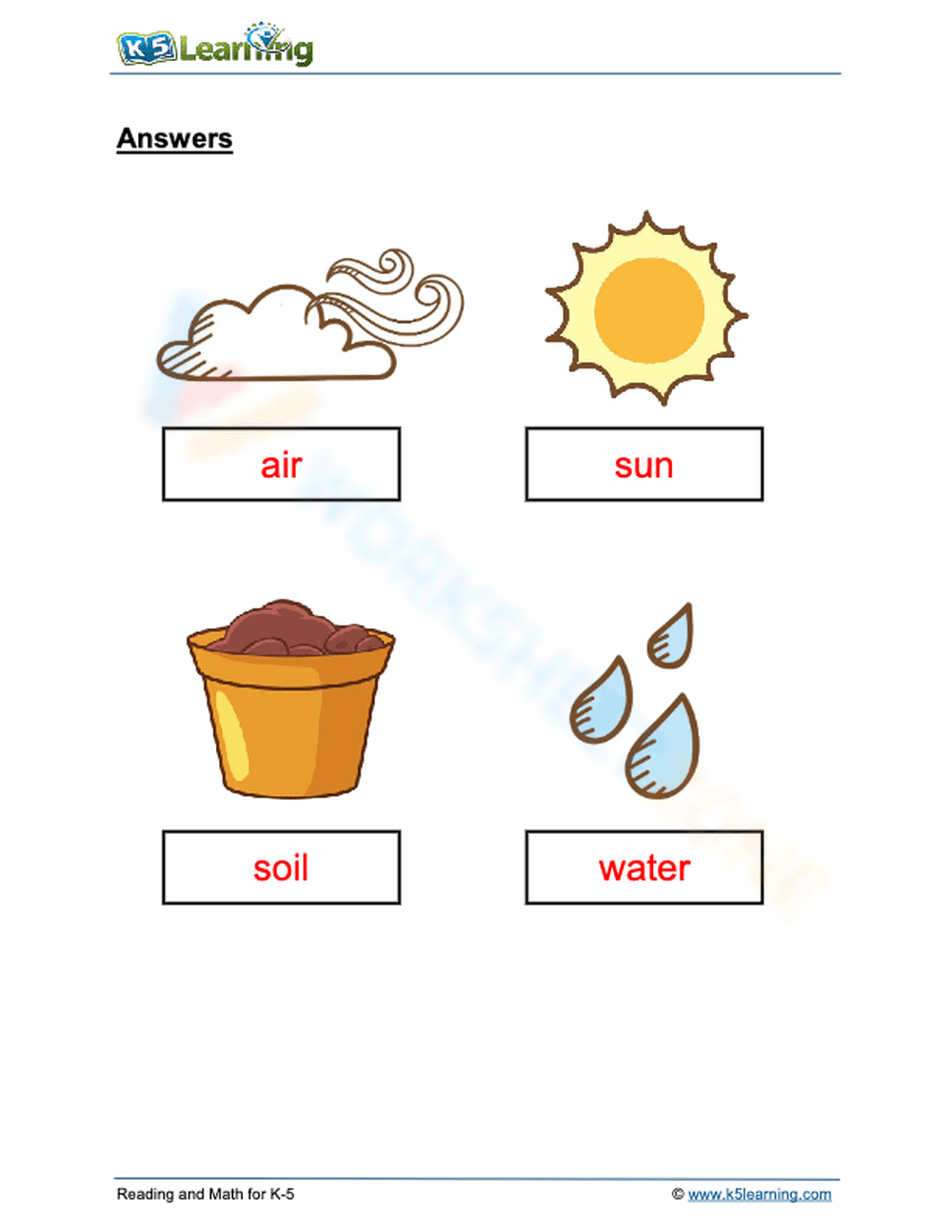
This Grade 1 science worksheet empowers students to identify and label the four fundamental requirements for plant survival: sun, soil, air, and water. Students will demonstrate their knowledge by completing a structured labeling exercise that reinforces essential vocabulary. This resource connects visual illustrations to specific biological needs for foundational understanding.
At a Glance
- Grade: 1 · Subject: Living Things
- Standard:
1-LS1-1— Identify the environmental factors that plants require to survive and grow- Skill Focus: Identifying basic plant needs
- Format: 1 page · 4 problems · Answer key included · PDF
- Best For: Independent practice or quick formative assessment
- Time: 5–10 minutes
This focused one-page resource features high-quality illustrations representing primary plant needs: a cloud for air, sun for light, a pot for soil, and raindrops for water. Below each image is a clear labeling box for student input. The worksheet includes a concise instructional header and a concept reference box. A complete answer key is provided to facilitate rapid grading or self-correction.
Implementing this resource into your science block requires less than two minutes of preparation. Simply print the single-page document (30 seconds), distribute it to your class with brief oral instructions (30 seconds), and facilitate a quick group review using the provided answer key (60 seconds). The print-and-go design makes it an ideal choice for emergency sub plans or transition activities between lessons.
Aligned to standard 1-LS1-1, this worksheet supports the Next Generation Science Standards (NGSS) by requiring students to recognize that plants need water and light to live and grow. It specifically targets Disciplinary Core Idea LS1.C. This standard code can be copied directly into lesson plans, IEP goals, or district curriculum mapping tools to ensure instructional compliance.
Use this worksheet as a formative assessment immediately following a direct instruction lesson on plant life cycles. As students work independently, circulate the room to observe if they correctly associate icons with scientific needs, providing an immediate check for understanding. Alternatively, use it as a "Ticket-out-the-Door" activity to gauge mastery before moving to plant structures. Completion typically ranges from five to ten minutes.
This resource is tailored for Grade 1 students but is suitable for Kindergarten enrichment or Grade 2 review. The visual nature of the tasks makes it accessible for English Language Learners (ELLs) and students with IEP accommodations requiring reduced text complexity. It pairs naturally with a hands-on seed-planting experiment or a read-aloud passage about plant growth and environmental survival.
The "Needs of Plants" worksheet is a scientifically grounded instructional tool designed to bridge the gap between abstract biological concepts and concrete student observation. By focusing on the four pillars of plant survival—sun, soil, air, and water—it aligns with the early childhood science learning trajectories identified in the ScienceDirect TpT Analysis. Research highlights that early exposure to categorization and labeling in life science facilitates long-term retention of more complex ecological systems. This Grade 1 resource utilizes clear, high-contrast imagery to reduce cognitive load, allowing students to focus on the semantic relationship between the environment and the organism. Aligned to standard 1-LS1-1, it serves as a reliable evidence-based artifact for measuring student proficiency in identifying what plants need to survive. The resource provides a standardized method for assessing foundational life science skills within primary education settings.


