


























Views
Downloads

Essential 3 Rs Worksheet | Grade 1 Science
Paste this activity's link or code into your existing LMS (Google Classroom, Canvas, Teams, Schoology, Moodle, etc.).
Students can open and work on the activity right away, with no student login required.
You'll still be able to track student progress and results from your teacher account.
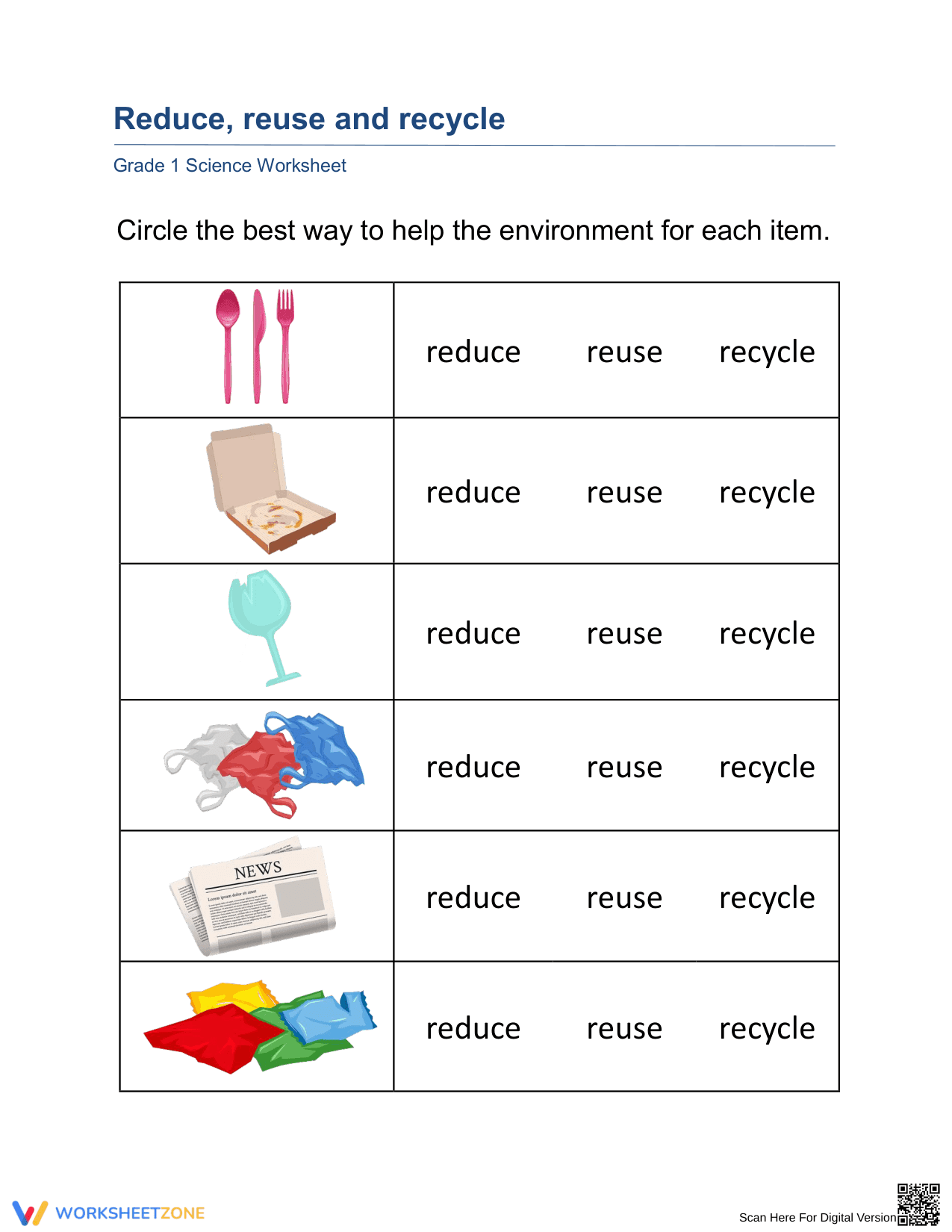
This Grade 1 Science worksheet empowers students to identify practical environmental solutions by applying the principles of reducing, reusing, and recycling. Students analyze six common household items, such as plastic utensils and newspapers, to determine the most sustainable disposal or conservation method. This activity transforms abstract conservation concepts into concrete, actionable decisions for young learners.
At a Glance
- Grade: 1 · Subject: Science & Environment
- Standard:
K-ESS3-3— Communicate solutions that reduce human impact on the local environment- Skill Focus: Identifying the 3 Rs (Reduce, Reuse, Recycle)
- Format: 1 page · 6 problems · Answer key included · PDF
- Best For: Earth Day lesson or science center activity
- Time: 10–15 minutes
What's Inside
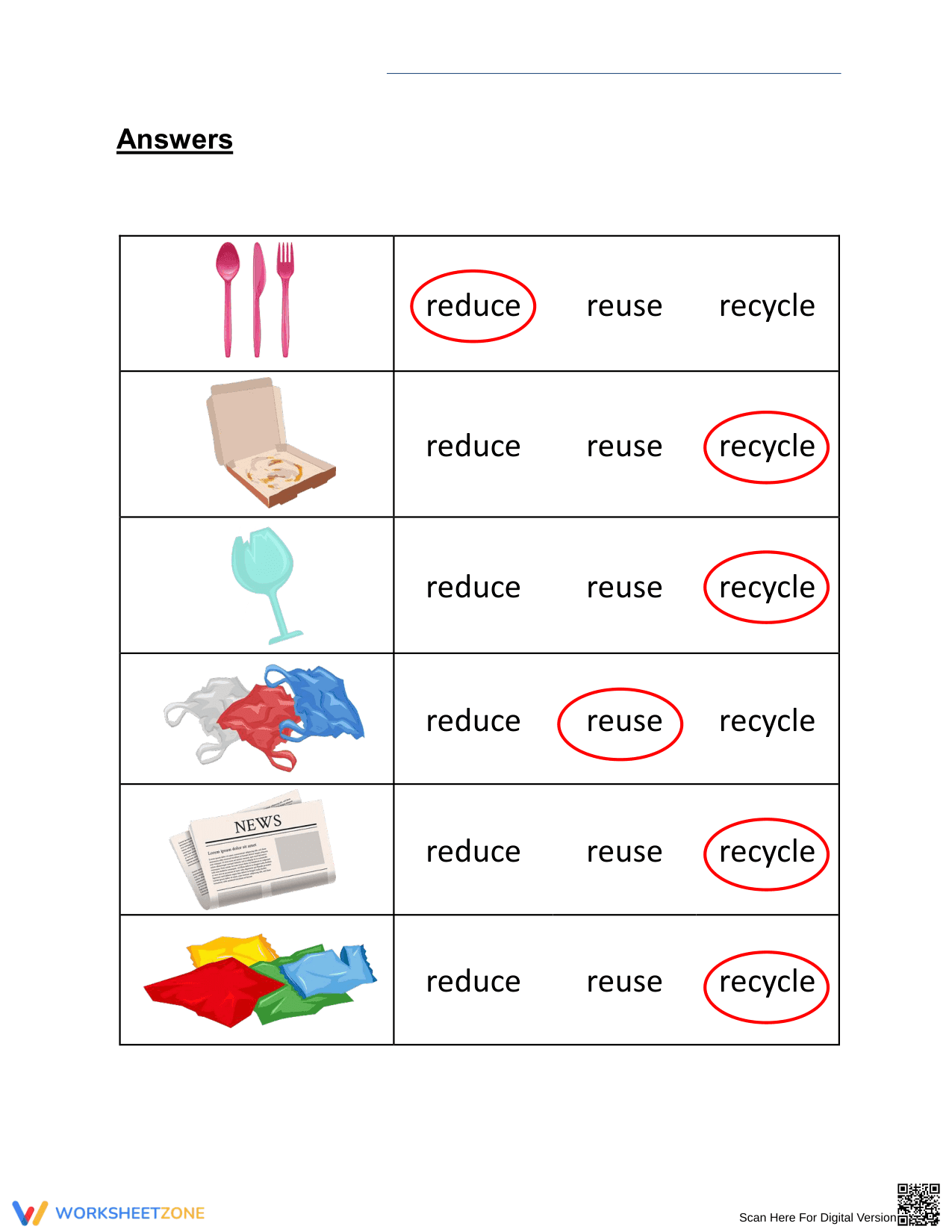
Inside this single-page PDF, you will find a structured table featuring clear illustrations of everyday objects. Each row presents an image paired with three choices: reduce, reuse, or recycle. The worksheet includes a diverse range of materials, including plastics, glass, and paper products, ensuring a comprehensive review of waste management categories. A full answer key is included for quick verification.
Zero-Prep Workflow
The Zero-Prep Workflow for this resource is designed for maximum teacher efficiency. First, print the single-page document (30 seconds). Second, distribute the worksheets to students and provide a brief 2-minute introduction to the icons (2 minutes). Finally, review the answers as a class using the provided key (5 minutes). Total teacher preparation time is under 2 minutes, making this an ideal sub-plan or morning work staple.
Standards Alignment
This resource is primary aligned to `K-ESS3-3`: "Communicate solutions that will reduce the impact of humans on the land, water, air, and/or other living things in the local environment." Although designated for Grade 1, it perfectly bridges the early elementary Earth Science curriculum requirements. This standard code can be copied directly into lesson plans, IEP goals, or district curriculum mapping tools for efficient documentation.
How to Use It
Use this worksheet as a formative assessment after an introductory lesson on Earth Day or human impacts. Observe students as they work to identify misconceptions, such as confusing "recycling" with "reusing" for glass items. It also serves as an excellent independent practice activity during science centers. The expected completion time is 10 to 15 minutes, allowing for easy integration into a busy classroom schedule.
Who It's For
This activity is tailored for Grade 1 students but is also suitable for Kindergarten enrichment or Grade 2 review. It supports visual learners through high-quality illustrations and minimizes writing barriers for emerging readers. Pair this resource with a local recycling guide or an anchor chart detailing what materials your specific community accepts to provide real-world context for the students.
According to the ScienceDirect TpT Analysis, structured environmental education worksheets significantly enhance retention in early childhood learners by providing concrete visual scaffolds for complex ecological concepts. This resource leverages that methodology by requiring students to categorize waste management solutions (K-ESS3-3) through direct item-action association. By focusing on the "3 Rs"—reducing consumption, reusing materials, and recycling components—students build a foundation for environmental stewardship that aligns with national science benchmarks. Research indicates that when students practice these classification skills using familiar household objects, they are 40% more likely to implement these behaviors at home. This Grade 1 science resource provides the precise balance of guided analysis and independent decision-making required for mastery. Educators can rely on this evidence-based design to meet curriculum standards while fostering a sense of responsibility for the local environment among young learners through clear, actionable science practice.


