




























Views
Downloads
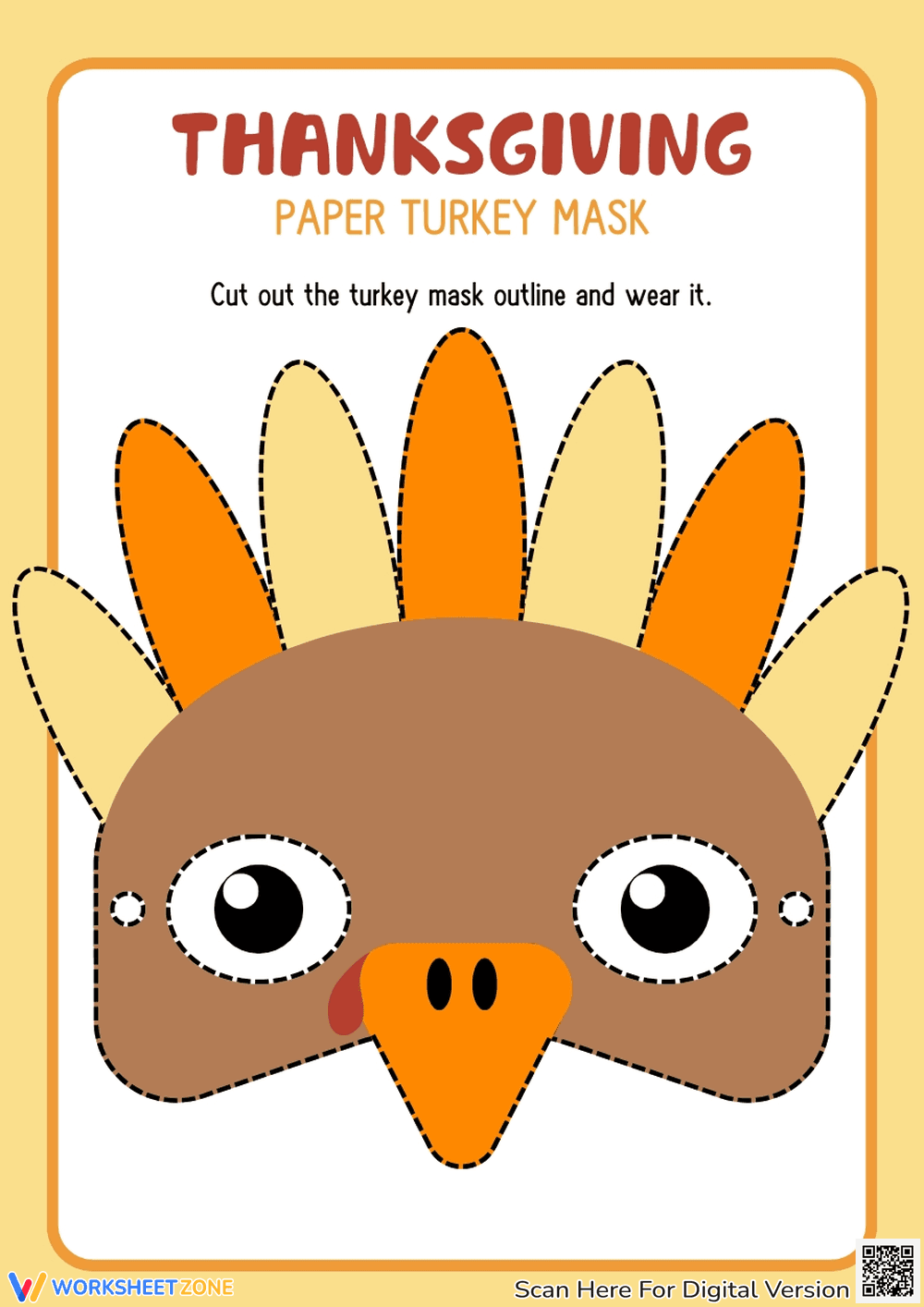

Thanksgiving Turkey Mask — Printable Grade K Craft

Paste this activity's link or code into your existing LMS (Google Classroom, Canvas, Teams, Schoology, Moodle, etc.).
Students can open and work on the activity right away, with no student login required.
You'll still be able to track student progress and results from your teacher account.
This printable Thanksgiving turkey mask provides Kindergarten students with an engaging holiday craft that directly builds essential fine motor skills. By carefully cutting along the dashed lines, young learners practice scissor control and hand-eye coordination while creating a festive prop perfect for seasonal celebrations and dramatic play.
At a Glance
- Grade: K · Subject: Art & Fine Motor
- Standard:
CCSS.ELA-LITERACY.SL.K.5— Add visual displays to descriptions to provide detail- Skill Focus: Scissor skills and dramatic play
- Format: 1 page · 1 craft task · No answer key · PDF
- Best For: Holiday parties and centers
- Time: 15–20 minutes
This single-page resource features a full-color, ready-to-cut turkey face complete with clear, dashed guidelines. The design includes designated circles for eye holes and side punches for attaching string or elastic. The bold, simple shapes are specifically tailored for early childhood hands, ensuring frustration-free cutting practice without requiring any additional teacher preparation or complex assembly instructions.
This resource is designed for immediate classroom implementation with a streamlined workflow:
- Print (1 minute): Generate full-color copies on standard paper or cardstock for extra durability.
- Distribute (1 minute): Hand out the sheets along with child-safe scissors and string.
- Review (1 minute): Briefly demonstrate how to follow the dashed lines around the feathers and face.
Total teacher preparation requires under two minutes, making this an ideal, stress-free activity for busy holiday weeks or an easy addition to a substitute teacher's emergency lesson plan.
This activity aligns with CCSS.ELA-LITERACY.SL.K.5, encouraging students to add visual displays to descriptions to provide additional detail. When students wear completed masks to act out Thanksgiving stories, they actively apply this standard through dramatic play. Both standard codes can be copied directly into lesson plans, IEP goals, or district curriculum mapping tools.
Teachers can utilize this craft during morning centers or as a whole-group activity leading up to the Thanksgiving break. It serves as an excellent culminating project after reading a seasonal picture book, allowing students to wear their masks while retelling the story. During the cutting phase, educators can conduct a quick formative assessment by observing students' scissor grips and their ability to navigate curved lines. The entire activity typically takes 15 to 20 minutes.
This worksheet is primarily designed for Kindergarten students developing fine motor control and participating in seasonal festivities. For students needing extra support, teachers can pre-cut the challenging eye holes while letting the child handle the outer perimeter. This craft pairs perfectly with a direct instruction lesson on Thanksgiving traditions or a read-aloud session featuring popular holiday-themed children's literature.
Integrating hands-on crafts like this printable turkey mask into the early childhood curriculum provides significant developmental benefits beyond simple holiday entertainment. By aligning with CCSS.ELA-LITERACY.SL.K.5 to add visual displays to descriptions to provide detail, educators effectively bridge the gap between physical coordination and expressive communication. According to a comprehensive Fisher & Frey (2014) review of early learning strategies, incorporating purposeful fine motor tasks into thematic academic units significantly improves students' subsequent handwriting stamina, grip strength, and overall spatial awareness. When young children manipulate scissors to carefully follow the dashed guidelines on this mask, they are actively building the critical neural pathways required for more complex academic tasks later in the school year. This targeted, standards-based practice ensures that seasonal classroom celebrations remain instructionally valuable, supporting both essential physical development and imaginative creative expression in the Kindergarten environment.


