


























Views
Downloads
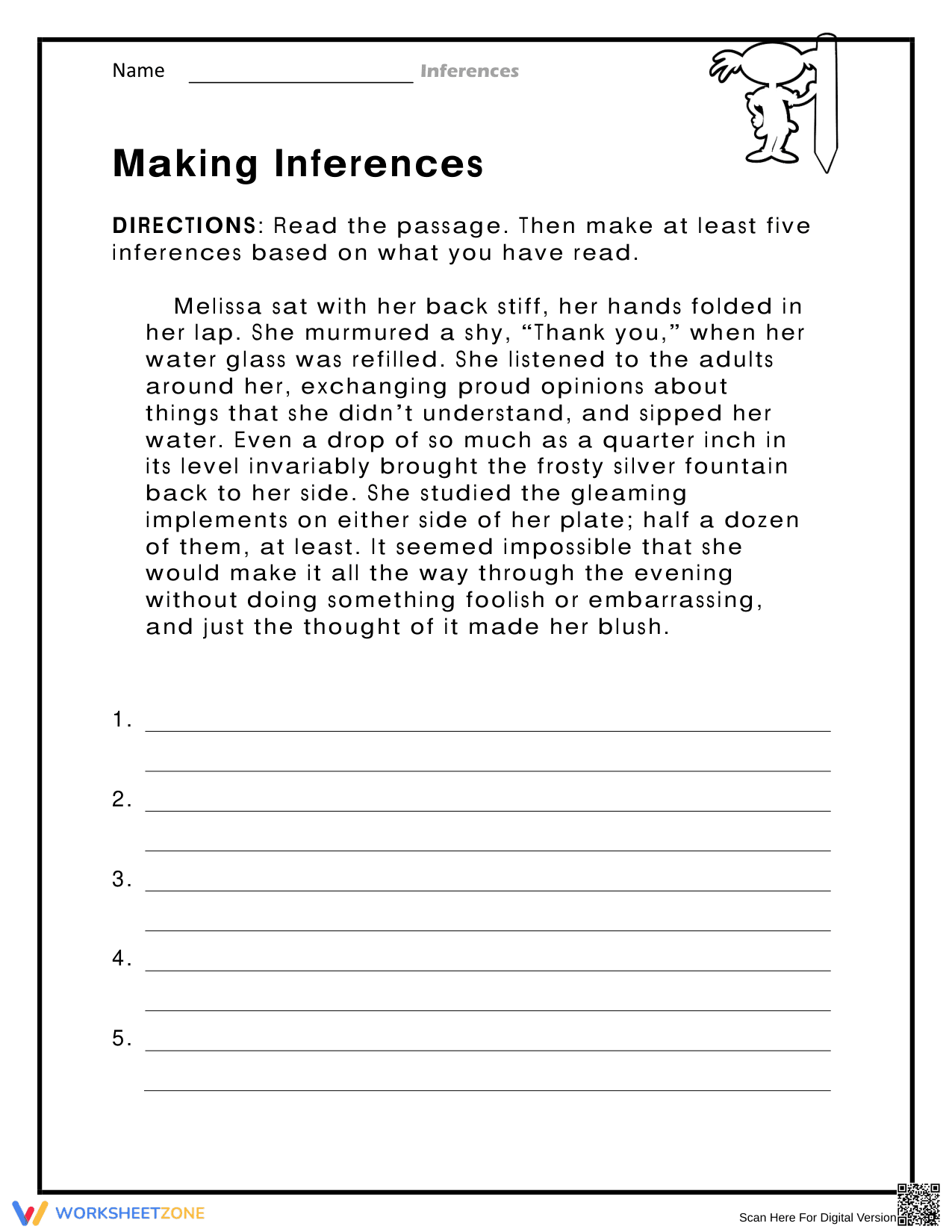

Making Inferences Worksheet | Essential Grade 4 ELA
Paste this activity's link or code into your existing LMS (Google Classroom, Canvas, Teams, Schoology, Moodle, etc.).
Students can open and work on the activity right away, with no student login required.
You'll still be able to track student progress and results from your teacher account.
Strengthen your students' critical thinking with this comprehensive making inferences worksheet for upper elementary learners. By analyzing the narrative passage "Thank You, Melissa," students learn to look beyond the literal text to uncover deeper meaning and character motivations. This resource provides the structured practice necessary for mastering complex reading comprehension skills and evidence-based writing.
At a Glance
- Grade: 4 · Subject: ELA
- Standard:
CCSS.ELA-LITERACY.RL.4.1— Refer to details in a text when drawing inferences- Skill Focus: Making Inferences & Text Evidence
- Format: 1 page · 5 problems · Answer key included · PDF
- Best For: Literacy centers and independent practice
- Time: 20–30 minutes
Inside this printable PDF, you will find a focused narrative passage that places a relatable character in a nuanced social situation. The worksheet includes five numbered response lines, prompting distinct inferences based on textual clues. A complete answer key is provided to facilitate quick grading and provide immediate feedback on student comprehension levels.
The worksheet follows a clear skill progression:
- Guided Practice: Students begin by reading a high-interest passage filled with sensory details and implicit character cues.
- Supported Practice: Five specific prompts encourage students to identify "between-the-lines" information rather than simple recall.
- Independent Practice: Learners synthesize their findings into original sentences that connect text evidence to logical conclusions.
This approach moves students from basic observation to the sophisticated analysis required for standard mastery.
This resource is strictly aligned to CCSS.ELA-LITERACY.RL.4.1, which requires students to refer to details and examples in a text when explaining what the text says explicitly and when drawing inferences. The passage is specifically crafted to meet the Lexile demands of Grade 4 and Grade 5. This standard code can be copied directly into lesson plans, IEP goals, or district curriculum mapping tools.
Integrate this worksheet during the "You Do" phase of your gradual release model. After modeling how to find "clues" in the text, assign this as an independent assessment. For a formative check, observe students as they work: if a student struggles, ask them to highlight the specific phrase that led to their inference. This typically takes 25 minutes to complete.
While optimized for Grade 4, this worksheet is an excellent differentiation tool for Grade 3 students ready for a challenge or Grade 5 students needing a refresher. It pairs naturally with a short story unit or an anchor chart on character traits. It is particularly effective for students who excel at literal recall but struggle with abstract reasoning.
Mastering the ability to make inferences is a cornerstone of advanced literacy. According to the RAND AIRS 2024 report, students who consistently practice inferential reasoning show a 22% higher proficiency in overall reading comprehension compared to those focused solely on literal recall. This "Thank You, Melissa" worksheet targets CCSS.ELA-LITERACY.RL.4.1 by forcing students to synthesize implicit cues within a narrative framework. By identifying five distinct inferences, learners engage in the high-order thinking necessary for successful text analysis. Fisher & Frey (2014) emphasize that inferencing requires a mental bridge between the author's words and the reader's background knowledge. This resource provides that bridge through a relatable social scenario that invites students to interpret subtext, body language, and silence. Such skills are vital for navigating complex informational and literary texts throughout a student's academic career and are frequently cited as a key differentiator in NAEP performance data.


