


























Views
Plays
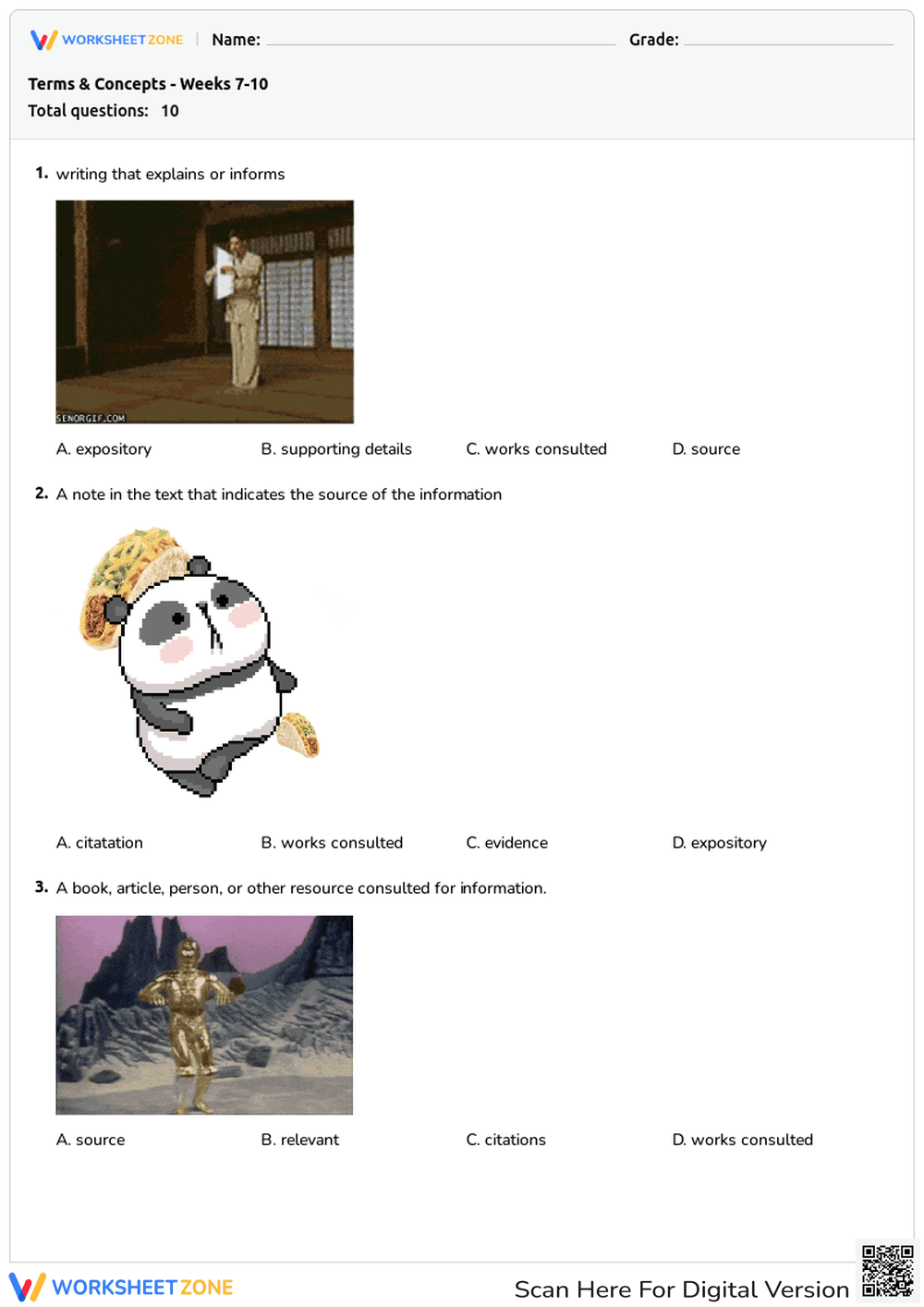


Grade 5 Research Terms — Printable No-Prep Worksheet
Paste this activity's link or code into your existing LMS (Google Classroom, Canvas, Teams, Schoology, Moodle, etc.).
Students can open and work on the activity right away, with no student login required.
You'll still be able to track student progress and results from your teacher account.
This Grade 5 English Language Arts worksheet gives students targeted practice identifying essential research and informational text vocabulary. By matching definitions to key terms like citation, credible, and evidence, learners build the foundational academic language needed to successfully manage and compose informational writing.
At a Glance
- Grade: 5 · Subject: ELA
- Standard:
CCSS.ELA-LITERACY.W.5.8— Gather relevant information and list sources- Skill Focus: Research Vocabulary
- Format: 3 pages · 10 problems · Answer key included · PDF
- Best For: Formative assessment or review
- Time: 10–15 minutes
This resource features a 10-question multiple-choice format spread across three pages. Each question provides a clear definition of a critical research concept—such as expository, central idea, supporting details, and works consulted—paired with an engaging visual cue to support memory retention. A complete answer key is included to streamline the grading process.
Zero-Prep Workflow
- Print (1 minute): Simply print the three-page PDF. The visual layout is ready for immediate student use.
- Distribute (1 minute): Hand out the copies at the start of a research unit or as a quick knowledge check.
- Review (3 minutes): Use the included answer key to quickly score the 10 multiple-choice questions. Total teacher prep time is under two minutes, making this an excellent option for emergency sub plans or last-minute independent practice.
Standards Alignment
Aligned to CCSS.ELA-LITERACY.W.5.8: Recall relevant information from experiences or gather relevant information from print and digital sources; summarize or paraphrase information in notes and finished work, and provide a list of sources. It also supports general academic vocabulary acquisition. Both standard codes can be copied directly into lesson plans, IEP goals, or district curriculum mapping tools.
How to Use It
This worksheet is highly effective when used before direct instruction as a pre-assessment to gauge prior knowledge of research terminology. Alternatively, assign it during a research writing unit as an independent practice activity. For a formative assessment observation tip, monitor which terms students struggle with most (e.g., confusing "citation" with "source") to guide your subsequent mini-lessons. Expected completion time is 10 to 15 minutes.
Who It's For
This resource is designed for upper elementary students, specifically fourth through sixth graders, who are beginning to write research papers. The multiple-choice format and visual aids provide built-in differentiation for English Language Learners and students needing visual scaffolds. It pairs perfectly with an introductory lesson on evaluating credible sources or an anchor chart detailing the components of a bibliography.
Integrating explicit vocabulary instruction into research and informational writing units is absolutely critical for long-term student success. According to the RAND AIRS 2024 report, students who receive targeted, consistent practice with domain-specific academic language demonstrate significantly higher comprehension and application skills when evaluating complex informational texts. By mastering the specific terminology associated with CCSS.ELA-LITERACY.W.5.8, such as gathering relevant information and listing sources, learners are much better equipped to manage demanding research tasks across all subject areas. This foundational knowledge allows students to successfully transition from passive readers to active, critical researchers who can effectively synthesize data, evaluate credibility, and accurately cite textual evidence. Providing structured opportunities to interact with these concepts ensures that students build the necessary cognitive frameworks to support advanced literacy skills in middle school and beyond.


