


























Views
Downloads

Ten-Frame Counting Worksheet | Grade K Math Printable
Paste this activity's link or code into your existing LMS (Google Classroom, Canvas, Teams, Schoology, Moodle, etc.).
Students can open and work on the activity right away, with no student login required.
You'll still be able to track student progress and results from your teacher account.
This Grade K math worksheet builds number sense and one-to-one correspondence by linking touch-dot numerals to ten-frame representations. Students master numbers 0 through 9 by filling frames and matching quantities, establishing strong foundations for early addition and place-value comprehension.
At a Glance
- Grade: Kindergarten · Subject: Mathematics
- Standard:
CCSS.MATH.CONTENT.K.CC.B.4— Connect counting to cardinality by matching numerals to visual quantities- Skill Focus: Touch-dot counting and ten-frame representation (0–9)
- Format: 2 pages · 16 problems · Answer key included · PDF
- Best For: Small group math intervention
- Time: 15–20 minutes
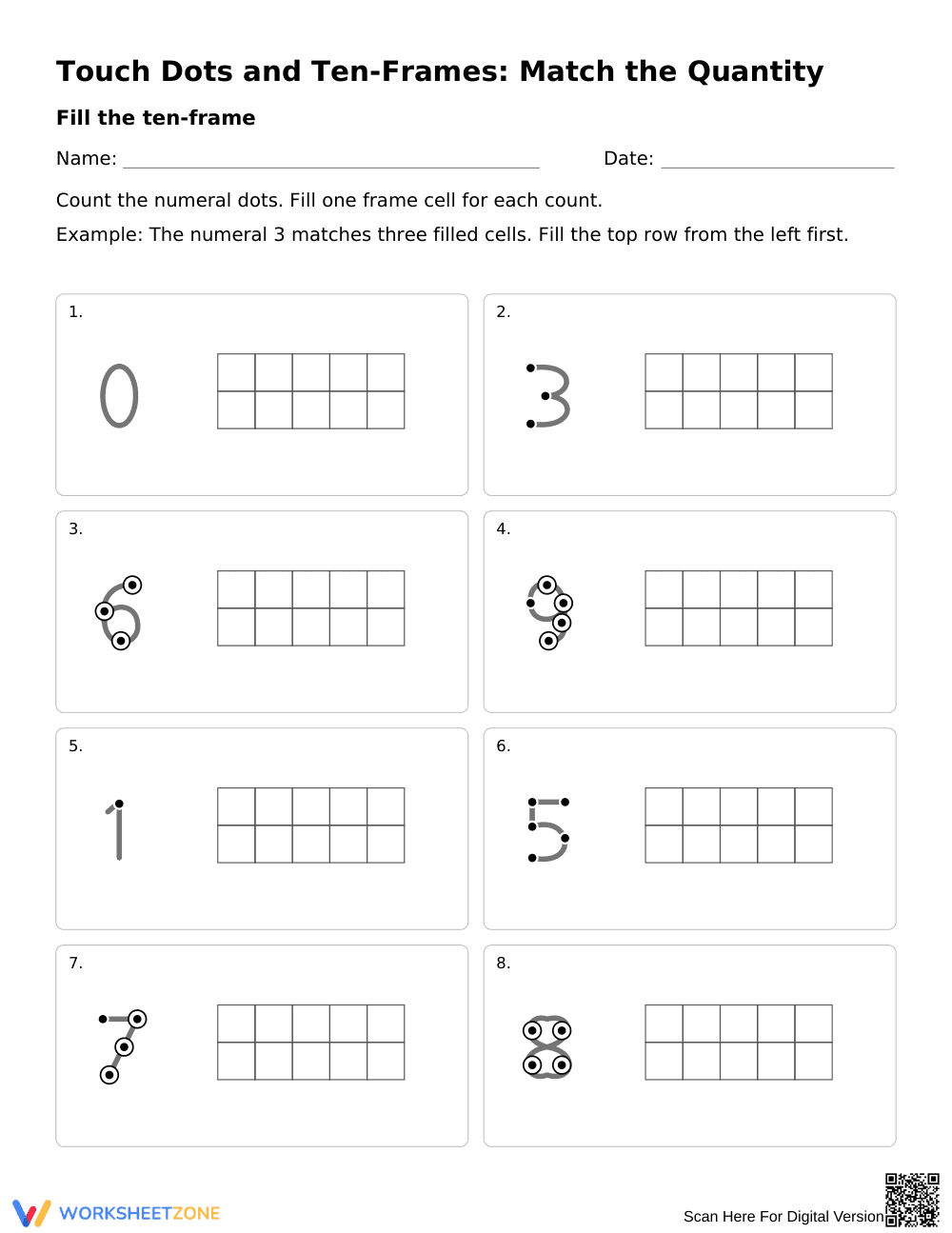
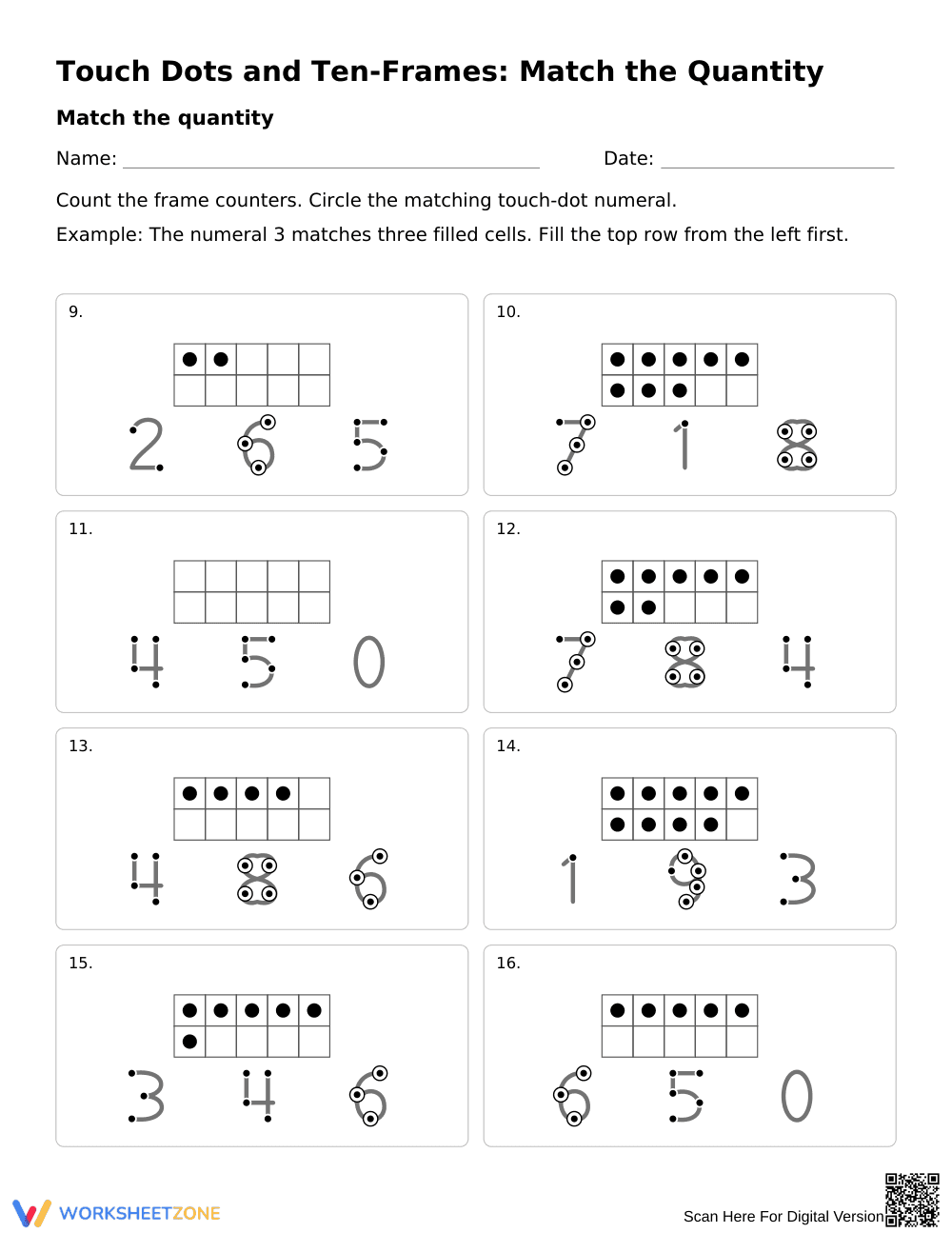
What's Inside: The two-page worksheet contains 16 structured problems. Page 1 features eight problems where students count touch dots on numerals 0 through 9 and fill matching cells in a ten-frame. Page 2 includes eight problems where students count filled ten-frame cells and circle the correct touch-dot numeral from three choices. A full visual answer key provides instant verification.
Skill Progression
- Guided practice (Problems 1–4): Students model quantities 0, 3, 6, and 9 by counting dots and filling ten-frame cells from top-left.
- Supported practice (Problems 5–8): Learners independently complete ten-frames for numbers 1, 5, 7, and 8, applying established counting patterns.
- Independent practice (Problems 9–16): Students examine completed ten-frames and discriminate between three numeral choices to verify quantity.
This sequence follows the gradual-release framework (I Do, We Do, You Do), advancing students from assisted frame filling to independent visual identification.
Standards Alignment
This resource aligns with `CCSS.MATH.CONTENT.K.CC.B.4`, which requires students to connect number names to quantities and demonstrate cardinality. It also supports `CCSS.MATH.CONTENT.K.CC.B.5` by engaging students in counting organized ten-frame arrays up to 10. Both standard codes can be copied directly into lesson plans, IEP goals, or district curriculum mapping tools.
How to Use It
Use this worksheet after direct instruction on ten-frame configurations to reinforce one-to-one correspondence. It also serves effectively as a station check during math rotations. Observe whether students touch each dot once or skip points during counts. Plan for a 15 to 20 minute completion window.
Who It's For
Designed for kindergarten students developing early numeracy, this worksheet also supports Tier 2 interventions and foundational special education instruction. Multi-sensory touch dots aid tactile learners who struggle with standard numeral forms. Pair this activity with physical ten-frame trays and two-color counters for concrete modeling.
According to EdReports 2024 foundational numeracy analyses, sustained mathematical proficiency in primary grades relies on deliberate visual structuring that bridges discrete concrete counting and abstract symbolic notation. Early childhood educators must ground symbolic numerals in structured spatial models, such as ten-frames, to cultivate robust number sense before formal addition begins. This resource targets standard CCSS.MATH.CONTENT.K.CC.B.4, which instructs kindergarten students to pair each spoken number name with exactly one object and recognize that the final count denotes total quantity. By pairing tactile touch dots with ten-frame arrays across 16 focused problems, the worksheet provides systematic dual-coding scaffolds that reduce cognitive load during initial number acquisition. Teachers using this structured format ensure learners develop fluent cardinality, spatial grouping, and reliable counting strategies that form the bedrock for subsequent base-ten place-value mastery in elementary mathematics.


