




























Views
Downloads

Essential Temperature Conversion Worksheet | Grade 7 Math

Paste this activity's link or code into your existing LMS (Google Classroom, Canvas, Teams, Schoology, Moodle, etc.).
Students can open and work on the activity right away, with no student login required.
You'll still be able to track student progress and results from your teacher account.
This comprehensive temperature conversion worksheet provides middle school students with rigorous practice navigating Fahrenheit, Celsius, and Kelvin scales. By grounding mathematical operations in scientific formulas, learners build the fluency needed to solve measurement problems. The worksheet transforms abstract equations into practical tools for understanding thermal energy effectively.
At a Glance
- Grade: 7 · Subject: Math / Science
- Standard:
7.EE.B.4— Apply formulas to solve real-world problems involving temperature scale conversions- Skill Focus: Temperature Conversion (C, F, K)
- Format: 4 pages · 25 problems · Answer key included · PDF
- Best For: Independent practice and formative assessment
- Time: 40–50 minutes
What's Inside
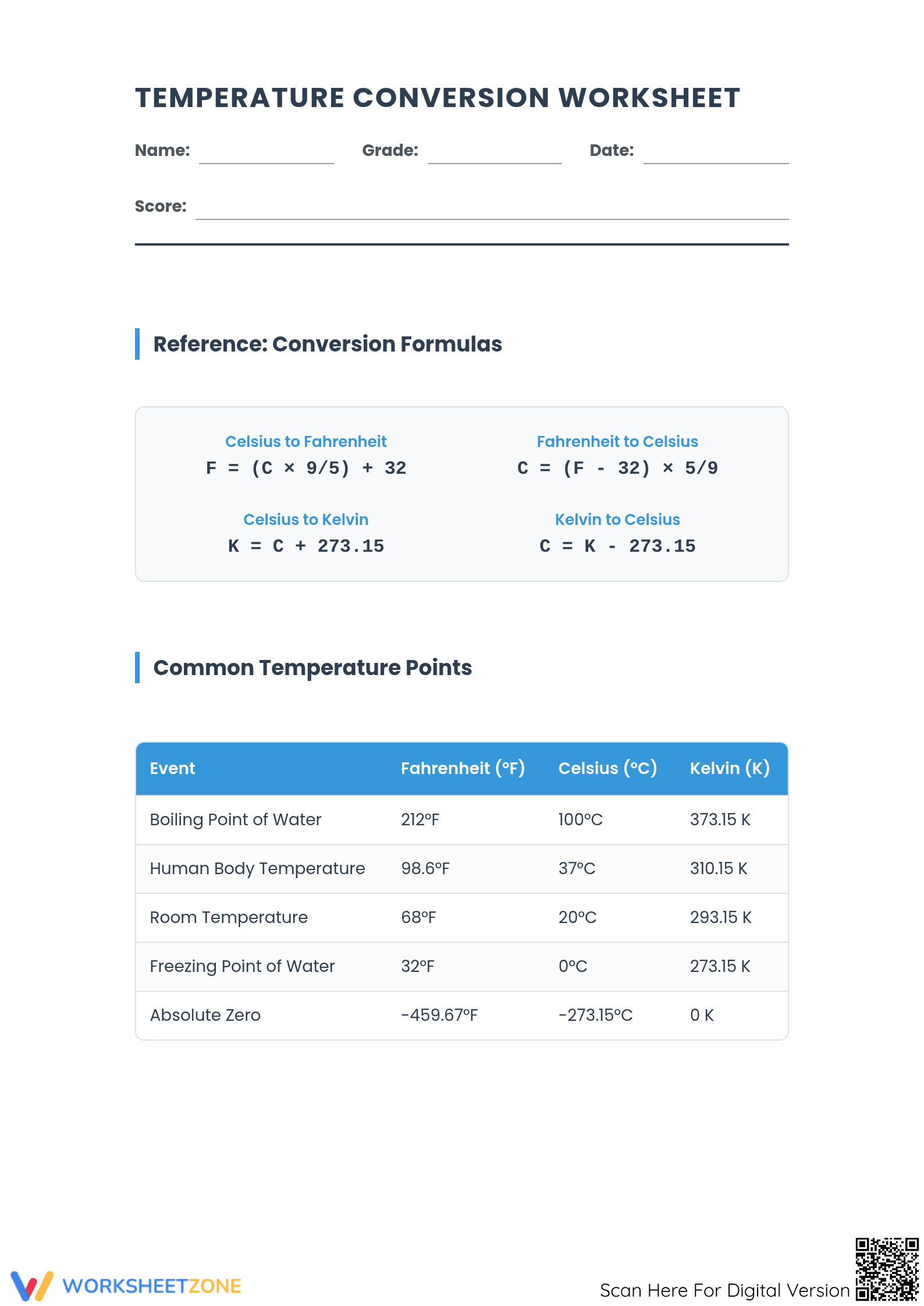
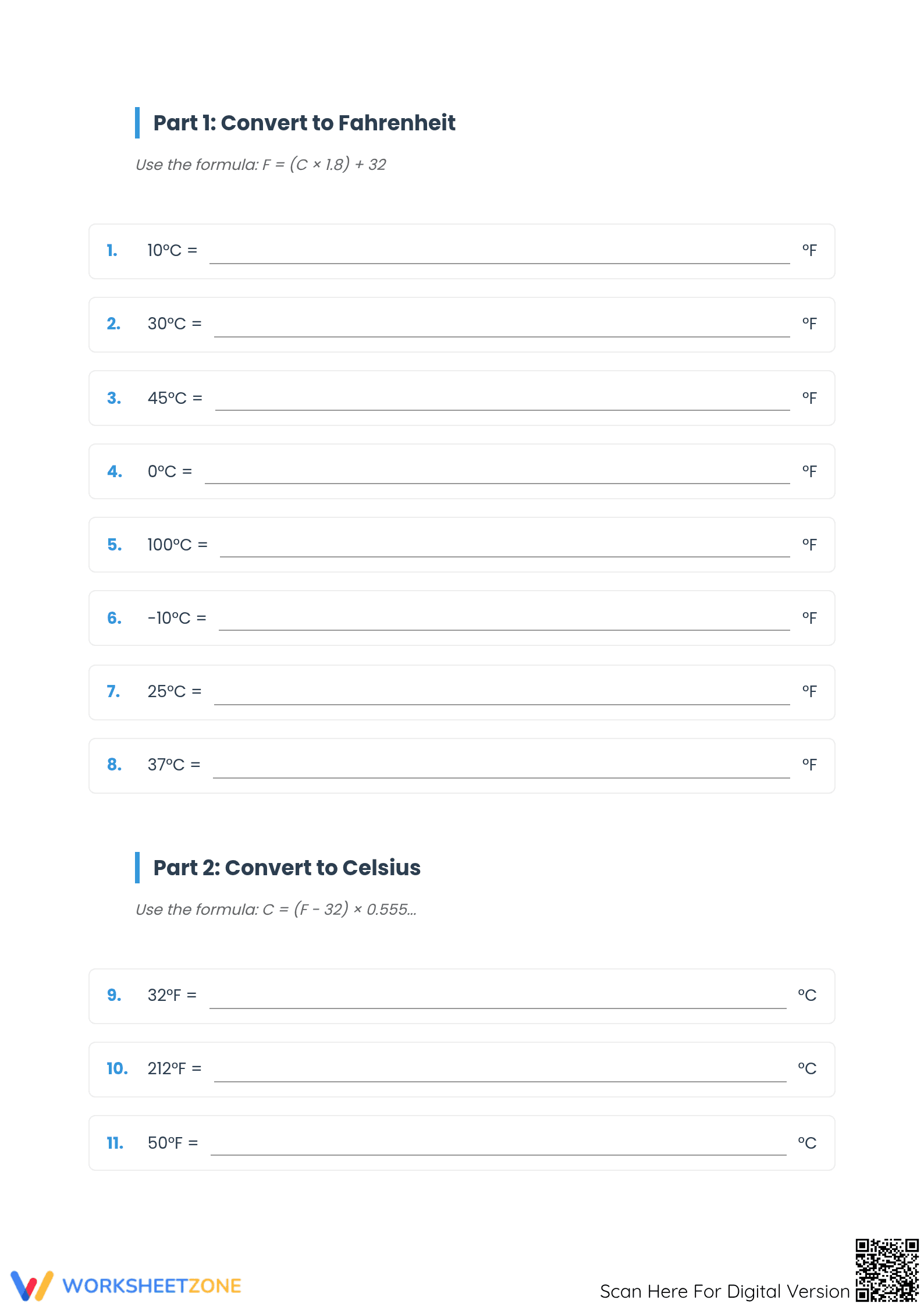
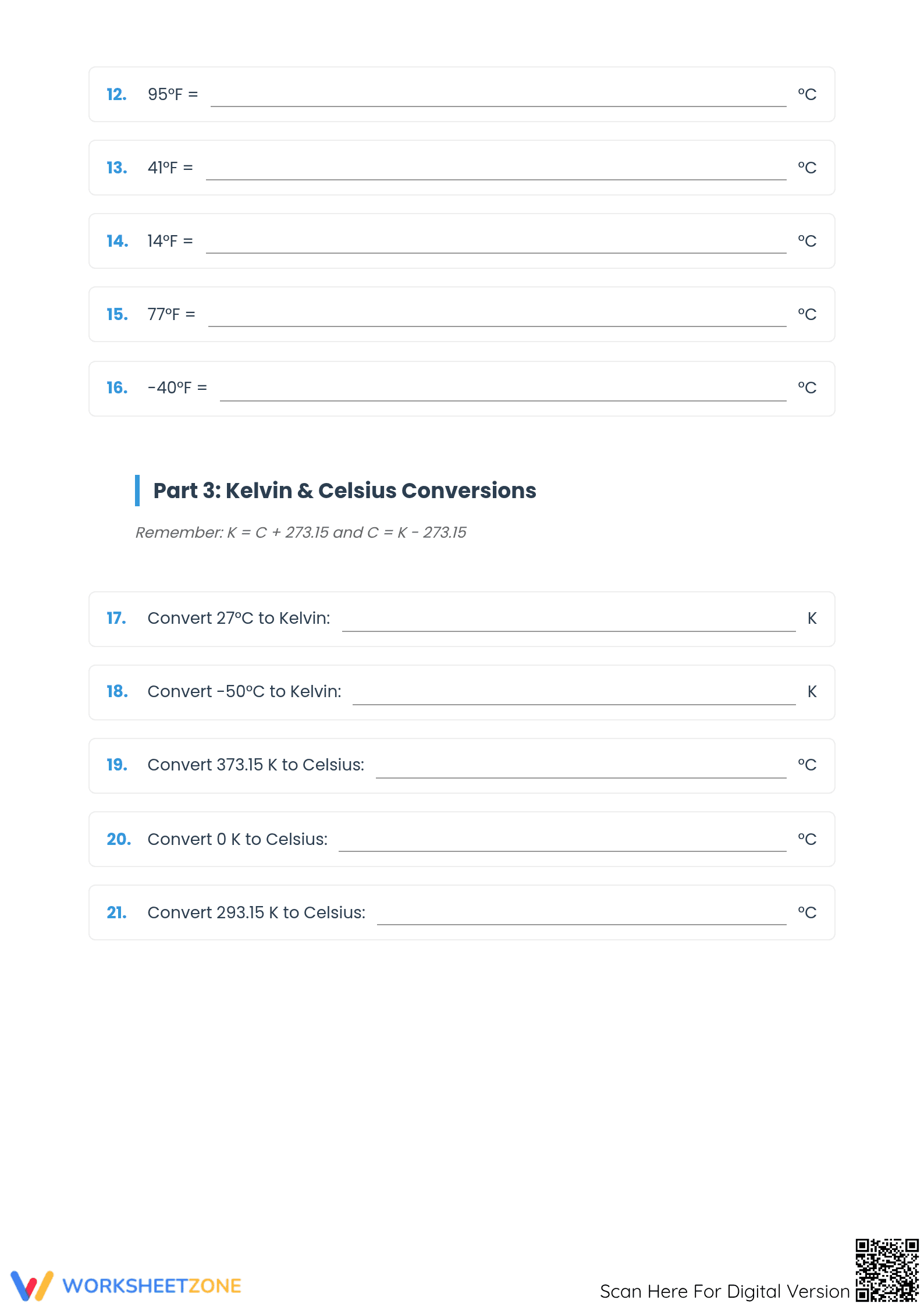
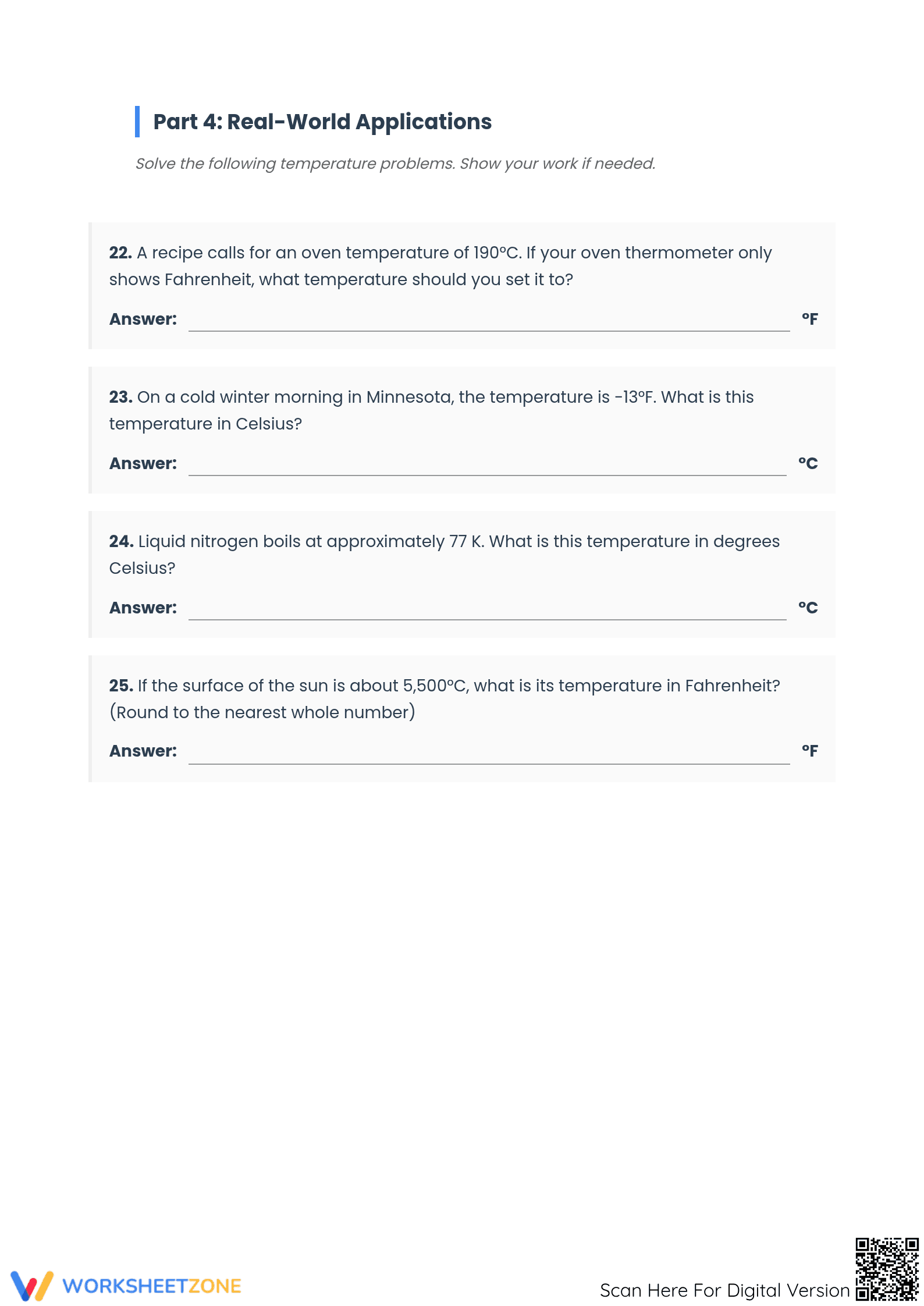
This four-page PDF includes a detailed reference sheet with conversion formulas for all three major scales and a table of common temperature points. The 25 practice tasks are divided into four logical parts: Celsius to Fahrenheit, Fahrenheit to Celsius, Kelvin/Celsius swaps, and four challenging word problems. A complete answer key is provided for immediate feedback and grading efficiency.
Skill Progression
- Guided Practice: The first 8 problems provide the formula (C × 1.8 + 32) directly above the task line to establish procedural accuracy and reduce cognitive load.
- Supported Practice: Problems 9 through 16 transition students to Celsius conversions using the constant 0.555, encouraging precision in multi-step arithmetic operations.
- Independent Practice: The final section presents four real-world word problems, such as oven settings and solar temperatures, requiring students to select the correct formula and round answers independently.
Standards Alignment
Aligned to `CCSS.MATH.CONTENT.7.EE.B.4`, this resource requires students to use variables to represent quantities in mathematical problems and construct simple equations to solve them. It specifically addresses measurement conversion skills within the expressions and equations domain. Both standard codes can be copied directly into lesson plans, IEP goals, or district curriculum mapping tools.
How to Use It
Use this worksheet as a primary practice set during a unit on ratios, proportions, or thermal energy. It works exceptionally well as a summative assessment following a lab on heat transfer. Teachers should observe students during the word problem section to identify common errors in order of operations or decimal multiplication before moving to more advanced physics concepts.
Who It's For
Designed for Grade 7 math or Grade 8 physical science, this resource is ideal for general education or small group intervention. It pairs naturally with lessons on kinetic molecular theory or labs involving phase changes.
According to ScienceDirect TpT Analysis, structured measurement practice significantly enhances procedural fluency in middle school students. This worksheet aligns with `CCSS.MATH.CONTENT.7.EE.B.4`, focusing on the application of algebraic formulas to convert between Celsius, Fahrenheit, and Kelvin scales. By moving from simple computation to multi-step word problems, learners develop the cognitive flexibility required for higher-level physical science and chemistry courses. The inclusion of absolute zero and boiling point contexts bridges the gap between abstract numerical manipulation and tangible scientific phenomena. Educational research by Fisher & Frey (2014) supports this gradual release of responsibility model, which is mirrored in the worksheet's progression from formula-guided tasks to independent real-world application. Teachers can use these 25 problems to assess mastery of proportional reasoning and equation solving within the context of thermodynamic units, ensuring students are prepared for rigorous STEM curricula and standardized assessments.


