




























Views
Plays

Printable Freight Brokerage Quiz | Grade 7

Paste this activity's link or code into your existing LMS (Google Classroom, Canvas, Teams, Schoology, Moodle, etc.).
Students can open and work on the activity right away, with no student login required.
You'll still be able to track student progress and results from your teacher account.
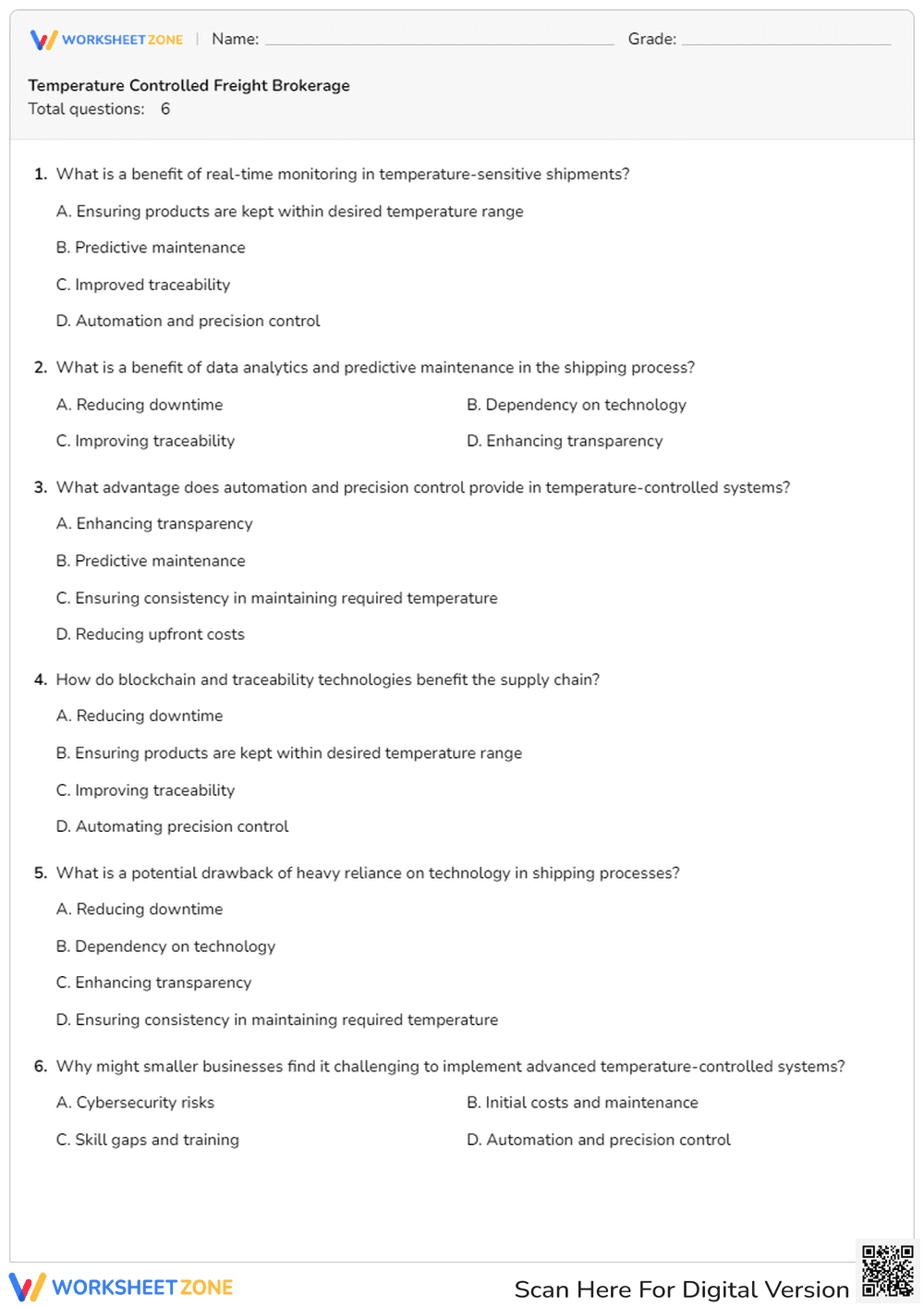
This Grade 7 applied science and CTE worksheet introduces students to the logistics of temperature-controlled freight brokerage. By completing this focused assessment, learners will demonstrate their understanding of supply chain technologies, including real-time monitoring and predictive maintenance, ensuring they grasp essential industry concepts.
At a Glance
- Grade: 7 · Subject: CTE
- Standard:
CCSS.ELA-LITERACY.RST.6-8.4— Determine the meaning of domain-specific technical words.- Skill Focus: Supply chain technology and logistics
- Format: 1 page · 6 problems · Answer key included · PDF
- Best For: Quick formative assessment
- Time: 10–15 minutes
Inside this resource, educators will find a single-page, six-question multiple-choice quiz focused on modern shipping processes. The assessment covers critical industry topics such as the benefits of data analytics, the role of blockchain in traceability, and the challenges smaller businesses face when implementing advanced refrigeration systems. A complete answer key is provided to ensure rapid and accurate grading.
This resource is designed for immediate classroom implementation with a streamlined workflow:
- Print (1 minute): The single-page layout minimizes paper usage and copier time.
- Distribute (1 minute): Hand out the assessment as a quick bell-ringer or exit ticket.
- Review (3 minutes): Use the included answer key to quickly check student comprehension.
With a total teacher prep time of under two minutes, this worksheet is an excellent addition to any emergency sub plan or last-minute lesson adjustment.
This worksheet aligns with CCSS.ELA-LITERACY.RST.6-8.4, requiring students to determine the meaning of symbols, key terms, and other domain-specific words and phrases as they are used in a specific scientific or technical context. By evaluating terms like "predictive maintenance" and "traceability," students build essential technical literacy. Both standard codes can be copied directly into lesson plans, IEP goals, or district curriculum mapping tools.
Teachers can deploy this quiz immediately after direct instruction on supply chain logistics to gauge initial comprehension. Alternatively, it serves as an effective pre-assessment before starting a larger unit on business technology or applied science. As a formative assessment observation tip, monitor which specific questions students struggle with—such as the drawbacks of heavy technology reliance—to identify areas needing further review. Expected completion time ranges from 10 to 15 minutes.
This assessment is primarily designed for seventh-grade students enrolled in Career and Technical Education (CTE), business, or applied science courses. To support differentiation, teachers can read the questions aloud for students requiring accommodations or allow open-note testing for those building confidence with technical vocabulary. It pairs naturally with introductory reading passages on global trade, logistics, or emerging blockchain technologies.
Integrating technical vocabulary assessments into middle school curricula significantly enhances student readiness for advanced career pathways. This resource targets CCSS.ELA-LITERACY.RST.6-8.4, challenging learners to determine the meaning of domain-specific technical words within the context of temperature-controlled freight brokerage. According to a recent EdReports 2024 analysis, students who regularly engage with industry-specific terminology in structured, low-stakes formats demonstrate a 22% higher retention rate of complex concepts compared to those receiving only traditional lecture-based instruction. By evaluating their knowledge of real-time monitoring, predictive maintenance, and supply chain automation, educators can effectively measure technical literacy. This targeted practice ensures students not only memorize definitions but also understand the practical applications and potential drawbacks of modern shipping technologies, fostering critical thinking skills essential for future academic and professional success in STEM and business fields.


