


























Views
Downloads
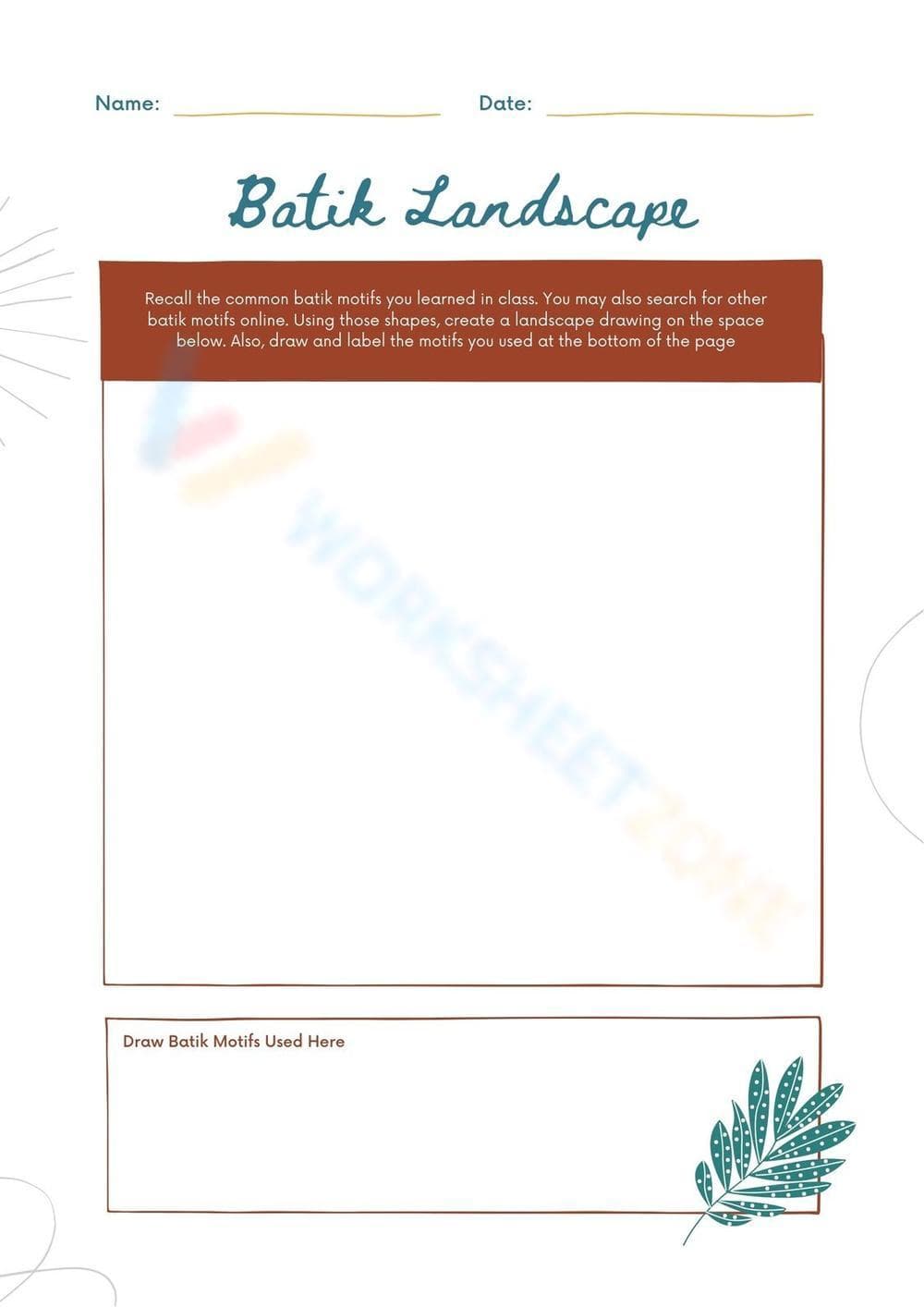

Printable Batik Art Landscape Worksheet | Grade 5
Paste this activity's link or code into your existing LMS (Google Classroom, Canvas, Teams, Schoology, Moodle, etc.).
Students can open and work on the activity right away, with no student login required.
You'll still be able to track student progress and results from your teacher account.
This Grade 5 visual arts worksheet guides students through the process of creating a cultural landscape using traditional batik motifs. By combining prior knowledge with independent research, learners actively apply design principles to construct an original composition while identifying the specific cultural symbols that anchor their artwork.
At a Glance
- Grade: 5 · Subject: Visual Arts
- Standard:
NCAS VA:Cr2.1.5— Organize and develop artistic ideas and work- Skill Focus: Cultural motifs and landscape composition
- Format: 1 page · 2 tasks · No answer key · PDF
- Best For: Independent art practice
- Time: 30–45 minutes
This single-page resource features a large, framed workspace dedicated to the primary landscape drawing, alongside a secondary section at the bottom for isolating and labeling the specific batik motifs utilized in the main piece. The layout provides clear, concise instructions that prompt students to recall classroom learning or conduct brief online research to gather authentic shapes and patterns before beginning their final composition.
Zero-Prep Workflow
- Print (1 minute): Generate enough copies of this single-page PDF for the entire class. No special materials are required beyond standard drawing supplies.
- Distribute (1 minute): Hand out the worksheets along with pencils, markers, or colored pencils. The instructions are entirely self-explanatory.
- Review (3 minutes): Briefly read the directions aloud, ensuring students understand the two-part requirement: drawing the landscape and isolating the motifs at the bottom.
With under two minutes of prep, this resource suits emergency sub plans or independent work periods.
This activity aligns with NCAS VA:Cr2.1.5, requiring students to organize and develop artistic ideas and work. By researching and integrating specific cultural motifs into a cohesive landscape, learners demonstrate their ability to synthesize visual information and apply it creatively. Both standard codes can be copied directly into lesson plans, IEP goals, or district curriculum mapping tools.
Deploy this worksheet during independent practice for a visual arts lesson on textile traditions. Alternatively, it serves as an excellent cross-curricular extension activity following a social studies unit on global cultures. While students are working, educators should circulate to observe how effectively learners are integrating the isolated motifs into the broader landscape, offering formative feedback on spatial awareness and pattern repetition. The expected completion time ranges from 30 to 45 minutes, depending on the level of detail required.
This resource is primarily designed for fifth-grade visual arts students, though it easily scales up or down for grades four through six. For students requiring additional support, teachers can provide a pre-printed reference sheet of common batik motifs to eliminate the research requirement. This worksheet pairs naturally with an introductory slide deck or anchor chart showcasing authentic batik fabrics, helping students visualize the technique before attempting their own designs.
Integrating cultural art practices into the elementary curriculum fosters both creative expression and global awareness. This resource targets NCAS VA:Cr2.1.5, challenging students to organize and develop artistic ideas and work by applying traditional batik motifs to a modern landscape composition. According to EdReports 2024, providing structured, open-ended creative tasks improves students' ability to synthesize visual information and apply design principles independently. By requiring learners to not only draw a cohesive scene but also isolate and label the specific cultural symbols they utilized, this worksheet reinforces critical thinking alongside artistic skill. The dual-task format ensures that students remain mindful of the cultural origins of their design elements, promoting a deeper understanding of how traditional patterns can inform contemporary artistic creation in the modern classroom environment.


