


























Views
Downloads

Symmetry in Biology Essential Practice | Grade 6-12
Paste this activity's link or code into your existing LMS (Google Classroom, Canvas, Teams, Schoology, Moodle, etc.).
Students can open and work on the activity right away, with no student login required.
You'll still be able to track student progress and results from your teacher account.
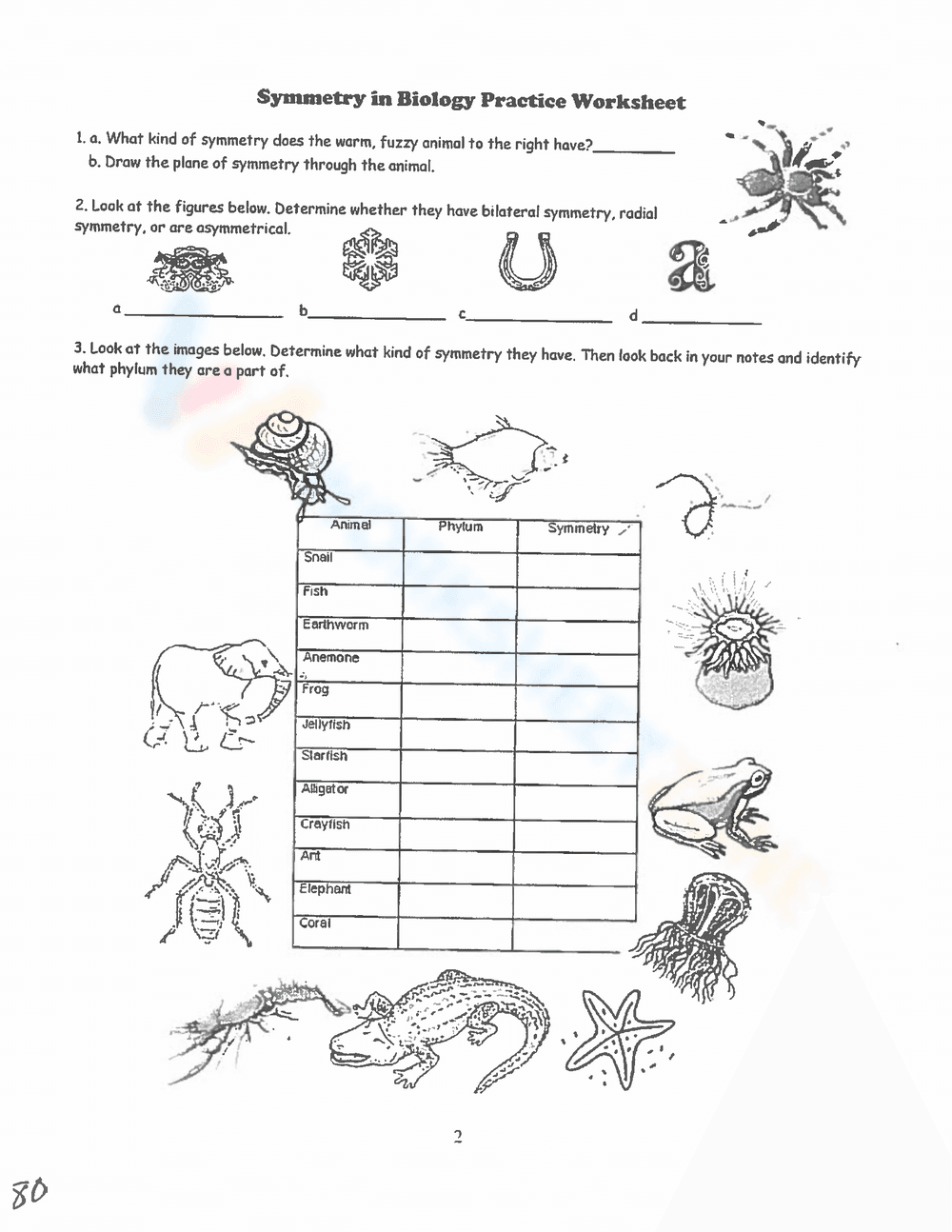
This biology worksheet helps students master the concepts of radial, bilateral, and asymmetrical body plans. By connecting physical symmetry to specific animal phyla, learners develop a deeper understanding of evolutionary biology and classification. Students will analyze visual diagrams and categorize organisms to demonstrate their grasp of comparative anatomy and structural organization.
At a Glance
- Grade: 6-12 · Subject: Biology
- Standard:
MS-LS4-2— Apply scientific ideas to construct an explanation for anatomical similarities and differences- Skill Focus: Animal Symmetry and Phyla Classification
- Format: 2 pages · 17 problems · Answer key included · PDF
- Best For: Middle and high school biology units
- Time: 20–30 minutes
The resource contains 17 distinct tasks spread across two pages. It begins with visual identification of symmetry planes in complex organisms like spiders and geometric figures. The core of the worksheet is a comprehensive classification table where students must identify the phylum and symmetry type for 12 different animals, including snails, anemones, and amphibians. A full answer key is provided to facilitate quick grading.
This resource is designed for a zero-prep workflow. Teachers can print the PDF in under 1 minute. Distribution to a standard class takes approximately 30 seconds. Reviewing the completed table using the provided answer key requires less than 5 minutes of instructional time. This efficiency makes it an ideal choice for emergency sub plans or quick formative checks during a busy lab week.
Aligned to MS-LS4-2, students apply scientific ideas to construct an explanation for the anatomical similarities and differences among modern organisms. By identifying symmetry patterns, students gather evidence for evolutionary relationships. This standard code can be copied directly into lesson plans, IEP goals, or district curriculum mapping tools to ensure compliance with state and national frameworks.
Use this worksheet as a mid-unit check after introducing the major animal phyla. It works effectively as a guided practice activity where students use their notes to populate the classification table. For formative assessment, observe if students can correctly distinguish between radial symmetry in cnidarians and bilateral symmetry in chordates. Completion typically takes 25 minutes for most secondary learners.
This is designed for middle and high school life science students. It provides necessary scaffolding through visual aids and a structured table format. It pairs naturally with an animal kingdom anchor chart or a direct instruction lesson on invertebrate and vertebrate characteristics. The clear layout ensures that students with diverse learning needs can focus on the biological content without distraction.
According to the RAND AIRS 2024 report on secondary science instruction, the use of structured classification tasks significantly improves student retention of complex biological hierarchies. This worksheet addresses the MS-LS4-2 standard by requiring students to identify symmetry—a fundamental morphological trait used in phylogenetic analysis. By engaging with 17 specific identification tasks, learners move beyond rote memorization toward an application-based understanding of how body plans define animal phyla. Research indicates that visual-to-textual data transfer, such as filling out a phylum table based on animal images, strengthens the neural pathways associated with scientific categorization. This resource provides the necessary repetition and variety of examples to ensure students can independently recognize radial and bilateral patterns in diverse biological contexts. The inclusion of an answer key further supports self-directed learning and immediate feedback loops in the classroom.


