


























Views
Plays


History of Banking Quiz | Printable High School Worksheet
Paste this activity's link or code into your existing LMS (Google Classroom, Canvas, Teams, Schoology, Moodle, etc.).
Students can open and work on the activity right away, with no student login required.
You'll still be able to track student progress and results from your teacher account.
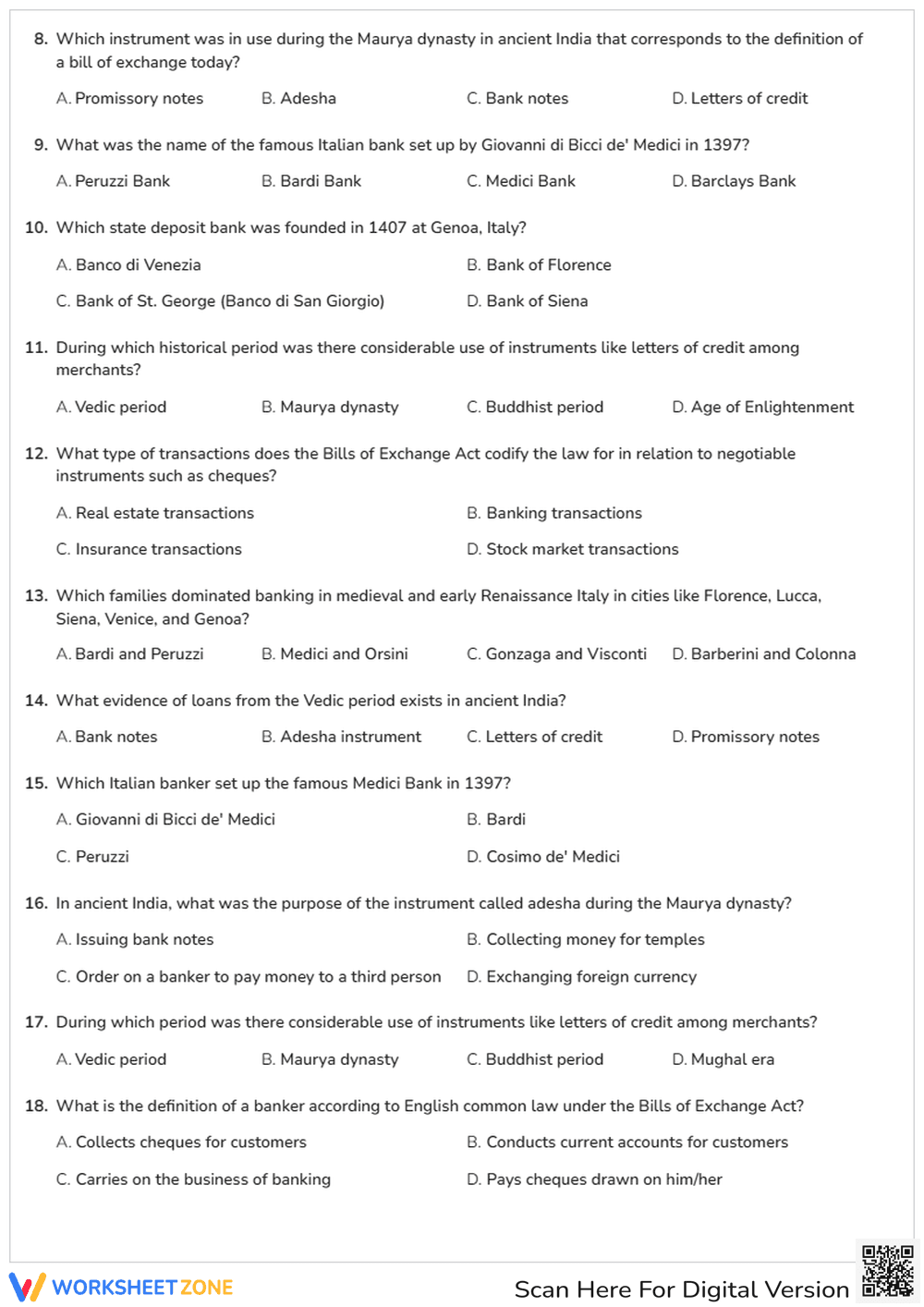
This high school economics worksheet provides a comprehensive review of banking history. By completing this reading comprehension quiz, students demonstrate their understanding of early financial systems, from the Medici family in Renaissance Italy to ancient Indian banking practices and English common law.
At a Glance
- Grade: 9-12 · Subject: Economics
- Standard:
CCSS.ELA-LITERACY.RH.9-10.2— Determine the central ideas or information of a secondary source- Skill Focus: History of Banking
- Format: 2 pages · 18 problems · Answer key included · PDF
- Best For: Reading checks and sub plans
- Time: 15–20 minutes
Inside this resource, educators will find a straightforward, two-page multiple-choice assessment containing 18 targeted questions. The tasks focus on factual recall and historical comprehension, covering key terms and foundational banking legislation. A complete answer key is included to ensure rapid grading and immediate student feedback.
Zero-Prep Workflow
This resource is designed for immediate classroom implementation:
- Print (1 minute): Download the PDF and print the two-page assessment.
- Distribute (1 minute): Hand out the quiz as a quick reading check.
- Review (3 minutes): Use the provided answer key to quickly grade submissions.
With a total teacher prep time of under two minutes, this worksheet is an ideal, self-explanatory resource for emergency sub plans.
Standards Alignment
This worksheet is aligned to primary standard CCSS.ELA-LITERACY.RH.9-10.2, requiring students to determine the central ideas or information of a secondary source. By answering these questions, students summarize the evolution of banking institutions. Both standard codes can be copied directly into lesson plans, IEP goals, or district curriculum mapping tools.
How to Use It
This assessment can be deployed in multiple instructional moments. First, it serves as an excellent reading check after direct instruction. Assign this 15-minute quiz to measure retention of key concepts. Second, it functions perfectly as an independent homework assignment. As a formative assessment observation tip, monitor which historical eras students struggle with to guide subsequent review sessions.
Who It's For
This worksheet is designed for high school students studying economics or world history. The multiple-choice format provides built-in differentiation for students who benefit from structured recall tasks. It pairs naturally with introductory textbook chapters on financial systems or direct instruction lessons covering the origins of modern capitalism.
Integrating structured reading checks into secondary social studies curricula significantly enhances retention of complex historical concepts. Aligned with CCSS.ELA-LITERACY.RH.9-10.2, this resource helps students determine the central ideas or information of a secondary source by reviewing the history of banking. According to Fisher & Frey (2014), utilizing frequent, low-stakes formative assessments allows educators to rapidly identify learning gaps and adjust instruction. When students recall specific details about the Medici family or the Bills of Exchange Act, they actively reinforce their foundational knowledge base. This targeted retrieval practice solidifies their understanding of early financial systems and builds the academic stamina required for advanced economic analysis. By providing a clear, standard-aligned evaluation tool, teachers ensure that essential historical narratives are firmly grasped before moving on to complex modern economic theories.


