


























Views
Downloads

Printable Subject and Predicate Worksheet | Grade 4 Aligned
Paste this activity's link or code into your existing LMS (Google Classroom, Canvas, Teams, Schoology, Moodle, etc.).
Students can open and work on the activity right away, with no student login required.
You'll still be able to track student progress and results from your teacher account.
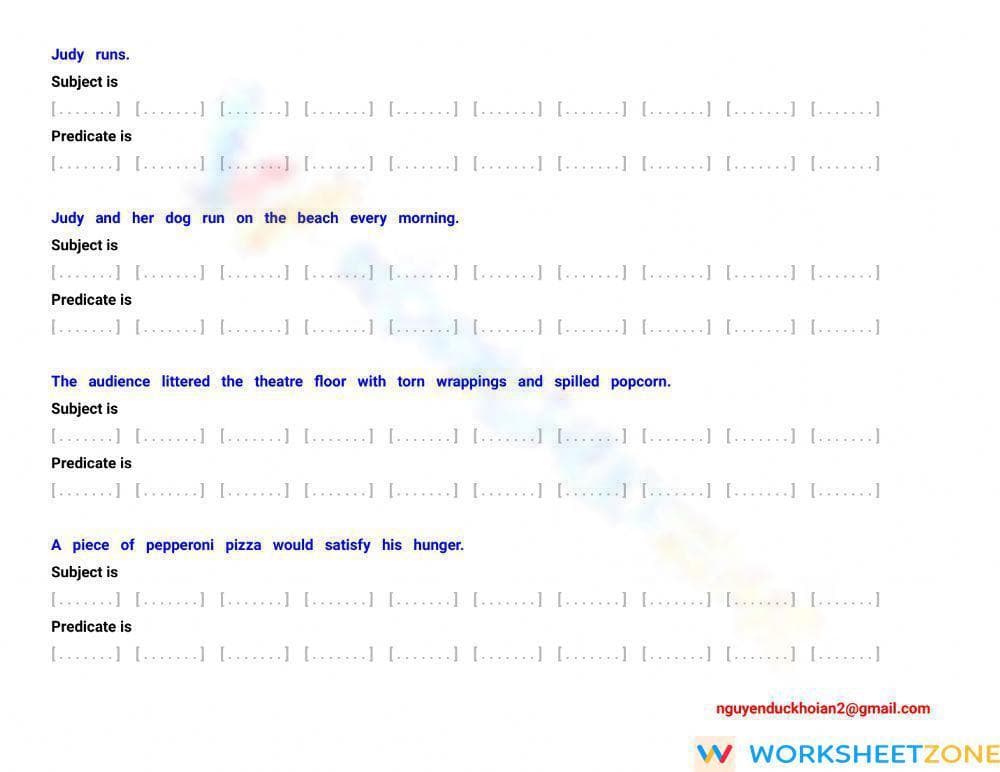
This Grade 4 subject and predicate worksheet provides students with targeted practice identifying the core components of a sentence. By distinguishing between who or what the sentence is about and what they are doing, learners strengthen their grasp of sentence structure and syntax. This resource is essential for developing writing clarity and recognizing complete thoughts in English.
At a Glance
- Grade: 4 · Subject: English Language Arts (ELA)
- Standard:
CCSS.ELA-LITERACY.L.4.1.f— Recognize and correct sentence fragments and run-on sentences in writing tasks- Skill Focus: Subject and Predicate identification
- Format: 1 page · 4 problems · No-prep · PDF
- Best For: Independent practice, bell-ringers, or quick assessment
- Time: 5–10 minutes
What's Inside
This printable PDF features a focused layout containing four distinct sentences of increasing complexity. Students are prompted to identify the complete subject and the complete predicate for each example, ranging from simple noun-verb pairs to sentences with prepositional phrases and complex objects. The clear, uncluttered design ensures that students remain focused on the grammatical task without unnecessary distractions.
Zero-Prep Workflow
The zero-prep workflow for this resource follows three efficient steps: Print (30 seconds), Distribute (1 minute), and Review (5 minutes). This sequence requires less than 2 minutes of active teacher preparation time. Because the instructions are embedded directly into the task, students can begin working immediately. This simplicity makes the worksheet a reliable choice for emergency sub plans or transition activities.
Standards Alignment
This worksheet aligns directly with CCSS.ELA-LITERACY.L.4.1.f, which requires students to produce complete sentences and recognize inappropriate fragments. Mastering the identification of subjects and predicates is a prerequisite for achieving this standard and preventing run-on sentences. This standard code can be copied directly into lesson plans, IEP goals, or district curriculum mapping tools.
How to Use It
Use this worksheet as a formative assessment during a unit on sentence structure to gauge student mastery. Assign it as a "Ticket out the Door" to verify that learners can identify sentence parts before moving on to compound subjects. Educators should observe whether students can identify the entire subject phrase (e.g., "A piece of pepperoni pizza") or if they only select the main noun, providing immediate feedback.
Who It's For
This resource is designed for Grade 4 students but is highly effective for Grade 3 enrichment or Grade 5 remediation. It is particularly useful for English Language Learners (ELLs) who are developing their understanding of English sentence order and functional word classes. Pair this worksheet with a short reading passage to have students identify subjects and predicates in a narrative context.
Effective sentence structure instruction relies on the explicit identification of grammatical roles to improve writing outcomes. According to Fisher & Frey (2014), the gradual release of responsibility begins with focused identification tasks that build the foundational knowledge necessary for complex synthesis. This Grade 4 worksheet targets CCSS.ELA-LITERACY.L.4.1.f by isolating the subject and predicate, allowing students to practice the essential skill of identifying complete thoughts. Research from EdReports (2024) emphasizes that "high-quality instructional materials must provide systematic practice in foundational grammar to support long-term literacy success." By engaging with these 4 structured problems, students internalize the mechanics of sentence construction, leading to a measurable reduction in fragments and run-ons. This approach ensures that learners are fully prepared for the rigorous demands of upper-elementary writing and succeed on multi-paragraph standardized ELA assessments throughout the academic school year.


