




























Views
Downloads
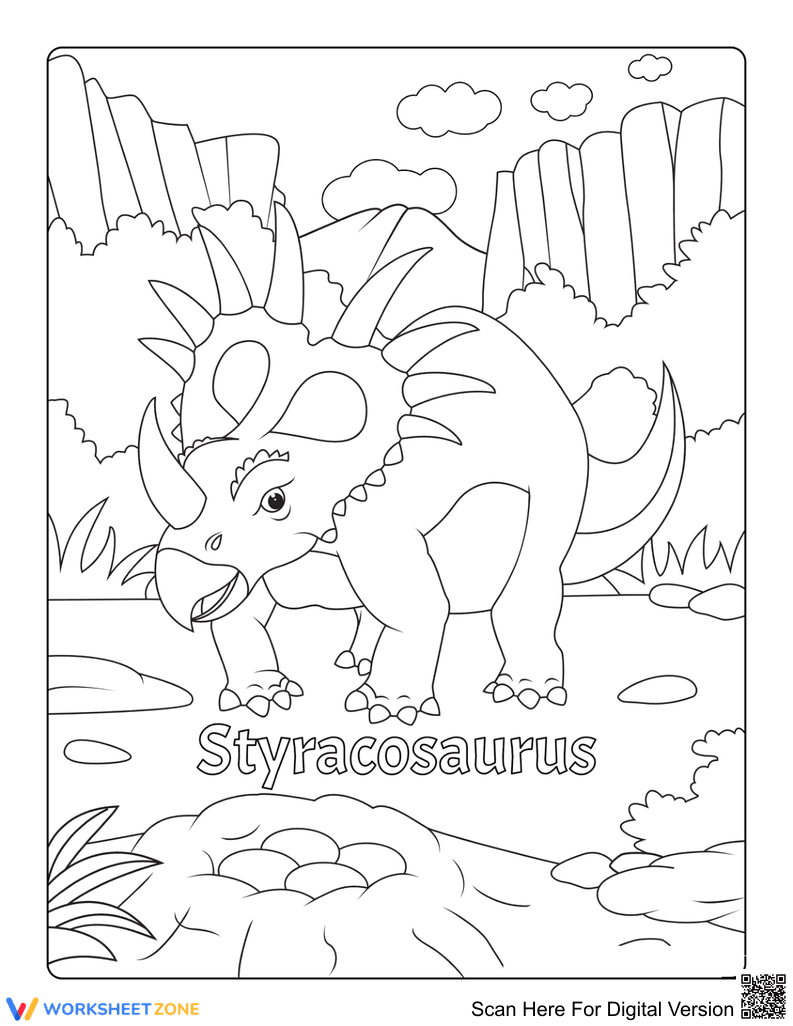

Styracosaurus Dinosaur Coloring Page | Essential Grade K

Paste this activity's link or code into your existing LMS (Google Classroom, Canvas, Teams, Schoology, Moodle, etc.).
Students can open and work on the activity right away, with no student login required.
You'll still be able to track student progress and results from your teacher account.
This Kindergarten Styracosaurus coloring page provides a creative way for students to explore prehistoric life while developing essential fine motor control. By focusing on the detailed illustration of a dinosaur with its nest, children engage in observational learning about animal life cycles and habitats. It serves as a perfect supplemental activity for early science or art units.
At a Glance
- Grade: Kindergarten · Subject: Arts & Science
- Standard:
K-LS1-1— Observe and describe patterns of what plants and animals need to survive- Skill Focus: Fine motor development and dinosaur identification
- Format: 1 page · 1 task · No answer key required · PDF
- Best For: Early finishers or science center activity
- Time: 15–20 minutes
This single-page PDF features a high-quality line art illustration of a Styracosaurus guarding a nest of four eggs. The background includes environmental elements like cliffs, clouds, and foliage, providing multiple textures for students to color. The clear, bold outlines are designed specifically for young learners who are still mastering grip and spatial awareness within boundaries.
The workflow for this resource is designed for maximum efficiency in a busy classroom. Teachers can print the single-page PDF in less than 30 seconds. Distribution takes only a minute, and because the task is self-explanatory, students can begin immediately without complex verbal instructions. This makes it an ideal choice for emergency sub plans or transition periods between core subjects.
This resource aligns with `K-LS1-1`, focusing on the observation of living things and their offspring. By depicting a dinosaur with eggs, it prompts discussions about how animals reproduce and protect their young. This standard code can be copied directly into lesson plans, IEP goals, or district curriculum mapping tools to document cross-curricular art and science integration.
Use this worksheet during a dinosaur unit after reading a story about prehistoric life. It works well as a formative assessment tool; observe how students choose colors for different elements to gauge their understanding of natural environments. Expect completion within 15 to 20 minutes depending on the student's focus on detail and color variety.
This activity is tailored for Kindergarten students but is suitable for Grade 1 learners needing fine motor practice. It is particularly effective for English Language Learners (ELLs) to build vocabulary related to nature and animals. Pair this with a dinosaur fact sheet or a classroom anchor chart about herbivores for a complete learning experience.
Research from Fisher & Frey (2014) emphasizes the importance of visual literacy and fine motor engagement in early childhood development. This Styracosaurus coloring page supports these goals by requiring precise hand-eye coordination while reinforcing scientific concepts related to the K-LS1-1 standard. According to the NAEP, integrating creative arts with core subjects like science helps solidify memory retention in young learners. By identifying the physical characteristics of the Styracosaurus—such as its unique frill and horns—students practice the observe and describe component of early inquiry. This 1-page printable provides a low-stakes environment for students to express creativity while the teacher gathers observational data on their developmental progress. It is a practical, research-backed tool for any early elementary classroom looking to blend art with biological science themes without increasing teacher workload.


