


























Views
Plays
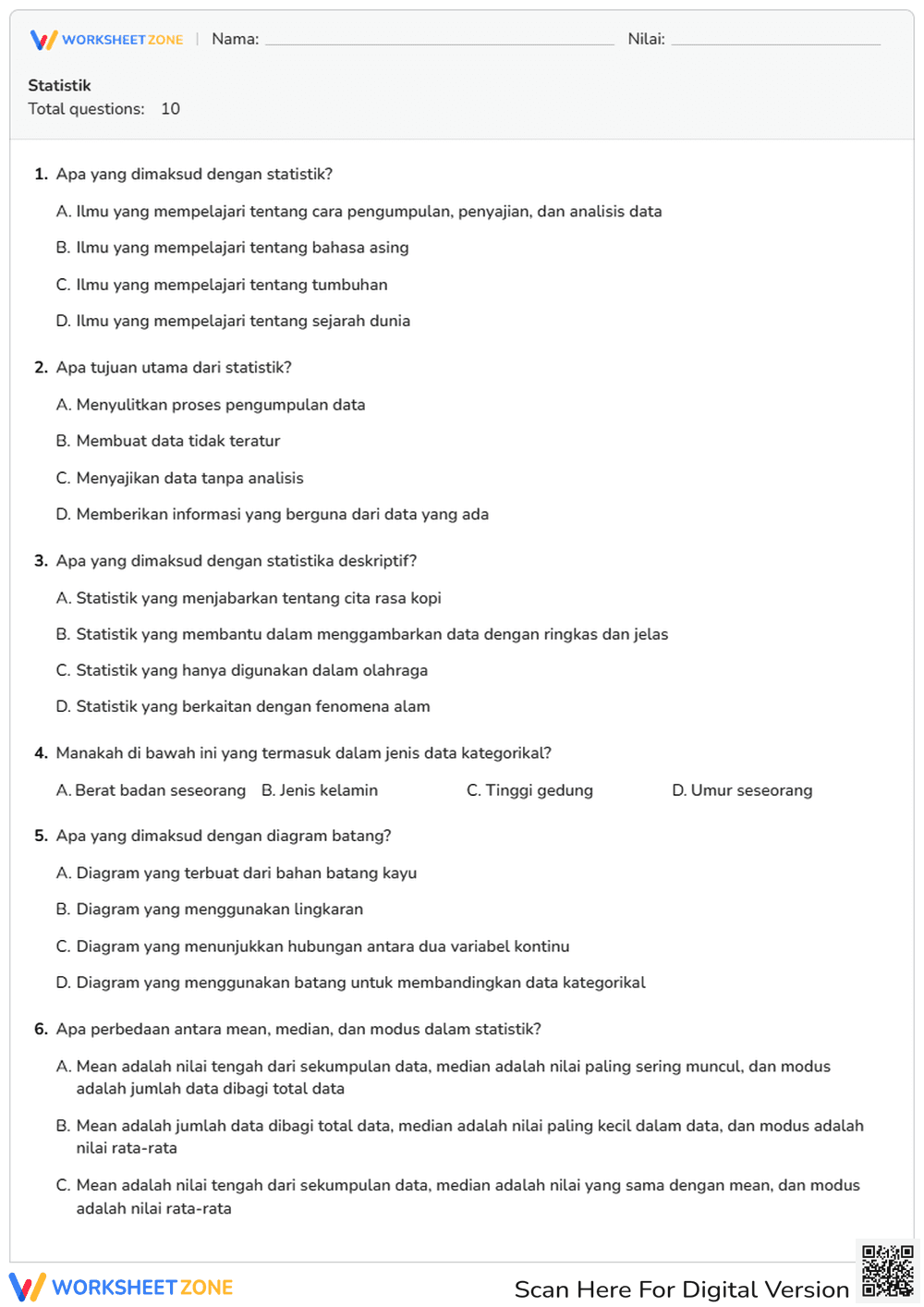


Essential Statistics Quiz | Grade 10-12 Math
Paste this activity's link or code into your existing LMS (Google Classroom, Canvas, Teams, Schoology, Moodle, etc.).
Students can open and work on the activity right away, with no student login required.
You'll still be able to track student progress and results from your teacher account.
This Grade 10-12 statistics worksheet provides a comprehensive review of foundational data analysis concepts. Students will identify key terminology and distinguish between various statistical methods to build a strong mathematical base. By engaging with these 10 targeted questions, learners demonstrate their understanding of how data is collected, organized, and interpreted in real-world contexts.
At a Glance
- Grade: 10-12 · Subject: Math
- Standard:
HSS-IC.A.1— Understand statistics as a process for making inferences about population parameters- Skill Focus: Statistics Vocabulary
- Format: 2 pages · 10 problems · Answer key included · PDF
- Best For: Quick formative assessment
- Time: 15–20 minutes
What's Inside
This resource contains two pages of structured multiple-choice questions designed to test conceptual clarity. The worksheet covers ten distinct topics, including measures of central tendency, data types, and linear regression. Each question is formatted with four clear options, making it easy for students to navigate the assessment. A full answer key is provided to facilitate rapid grading and immediate student feedback.
Zero-Prep Workflow
The zero-prep design allows for an efficient classroom workflow. First, print the two-page PDF in under 30 seconds. Next, distribute the copies to your Grade 10, 11, or 12 students for a quiet individual assessment lasting approximately 15 minutes. Finally, use the included answer key to review the results together or collect them for a quick formative grade in less than 2 minutes.
Standards Alignment
This worksheet is aligned with CCSS.MATH.CONTENT.HSS-IC.A.1, which requires students to understand statistics as a process for making inferences about population parameters based on a random sample from that population. It also touches upon descriptive statistics and data representation. Both standard codes can be copied directly into lesson plans, IEP goals, or district curriculum mapping tools.
How to Use It
Use this worksheet as a diagnostic pre-assessment before starting a unit on advanced probability or as an exit ticket to gauge mastery of basic terminology. During the activity, observe if students struggle with the distinction between population and sample or the specific definitions of mean, median, and mode. Completion typically takes between 15 and 20 minutes depending on prior knowledge.
Who It's For
This resource is ideal for high school students in Grades 10 through 12 who are beginning their statistics coursework. It is particularly useful for learners who benefit from clear, concise definitions and structured choices. Note: This resource is presented in Indonesian, making it an excellent choice for bilingual classrooms or international curriculum settings. Pair this with a graphic organizer for statistical terms to reinforce the vocabulary.
According to research by Fisher & Frey (2014), the use of structured checks for understanding, such as this 10-question statistics quiz, is vital for the gradual release of responsibility model. By isolating specific vocabulary terms like standard deviation and linear regression, educators can pinpoint exactly where student misconceptions lie before moving into complex calculations. This worksheet aligns with the HSS-IC.A.1 standard by focusing on the conceptual underpinnings of statistical inference. Data from EdReports 2024 suggests that high-quality, standards-aligned assessments significantly improve student outcomes in secondary mathematics by providing clear benchmarks for mastery. This resource serves as a reliable tool for measuring student progress in the Data and Graphing domain, ensuring that learners are prepared for the rigors of college-level statistics and data literacy requirements. By integrating these assessments, teachers can foster a more data-driven instructional environment that supports long-term retention of mathematical principles.


