




























Views
Downloads


Printable Star Coloring and Counting | Kindergarten Math

Paste this activity's link or code into your existing LMS (Google Classroom, Canvas, Teams, Schoology, Moodle, etc.).
Students can open and work on the activity right away, with no student login required.
You'll still be able to track student progress and results from your teacher account.
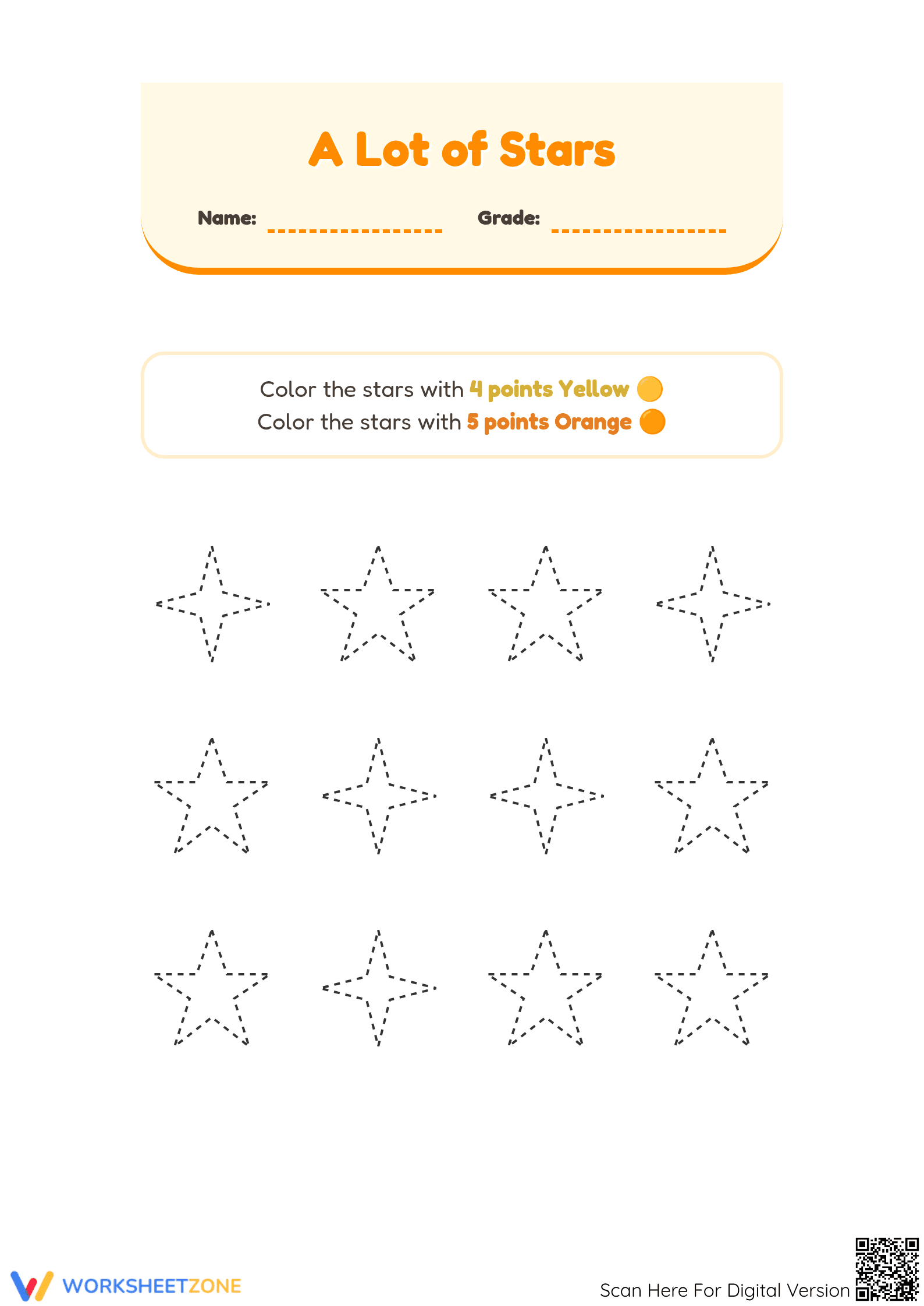
This Kindergarten star coloring worksheet helps young learners master shape discrimination and basic counting through an engaging, hands-on activity. Students identify stars based on their number of points, apply specific colors, and then quantify their findings. This dual-purpose task strengthens both fine motor control and mathematical reasoning in early childhood settings.
At a Glance
- Grade: Kindergarten · Subject: Math
- Standard:
K.MD.B.3— Classify objects into categories and count the number of objects in each- Skill Focus: Shape Recognition and Counting
- Format: 2 pages · 14 problems · Answer key included · PDF
- Best For: Independent math centers or morning work
- Time: 15–20 minutes
What's Inside
This 2-page PDF includes a primary worksheet featuring a grid of 12 distinct stars with varying point counts, specifically 4-point and 5-point designs. The second page provides a dedicated counting section where students record their totals for each star type. Clear visual cues and simple text instructions ensure that Preschool and Kindergarten students can follow the color-by-code prompts independently.
Zero-Prep Workflow
The zero-prep workflow for this resource allows teachers to integrate mathematical practice into their day with minimal effort. Simply print the two pages in under a minute, distribute the worksheets along with yellow and orange crayons, and review the final counts together as a class. This efficient structure makes it an ideal choice for emergency sub plans or quick transitions between subjects.
Standards Alignment
The primary focus is `CCSS.MATH.CONTENT.K.MD.B.3`, which requires students to classify objects into given categories and count the numbers of objects in each category. By sorting stars by their points, students practice the foundational logic of categorization. This standard code can be copied directly into lesson plans, IEP goals, or district curriculum mapping tools.
How to Use It
Use this worksheet during a geometry unit to emphasize the properties of shapes, or as a formative assessment to check one-to-one correspondence in counting. Teachers can observe students as they work to identify which children struggle with counting small points versus those who can accurately distinguish between 4 and 5 points. Completion typically takes 15 to 20 minutes.
Who It's For
This resource is designed for Kindergarten and Preschool students, particularly those developing fine motor skills and early numeracy. It is also an excellent tool for English Language Learners (ELLs) who benefit from the visual color-coding system. Pair this with a picture book about stars or a basic counting anchor chart to provide a comprehensive learning experience.
According to the RAND AIRS 2024 report on early childhood education, integrating multi-sensory activities like coloring with mathematical categorization significantly improves long-term retention of classification logic. This worksheet aligns with `K.MD.B.3` by requiring students to distinguish between geometric attributes—specifically the number of points on a star—and then translate those visual categories into numerical values. Research highlights that when students engage in active sorting combined with fine motor tasks, they develop more robust mental models for number sense. This printable provides exactly that scaffolded experience, moving from identification to quantification. By asking students to count their own coloring work, it introduces a layer of self-monitoring and accuracy checking that is crucial for Kindergarten mastery. Educators can rely on this structured approach to ensure students meet core geometry and counting benchmarks while maintaining high levels of engagement.


