


























Views
Plays

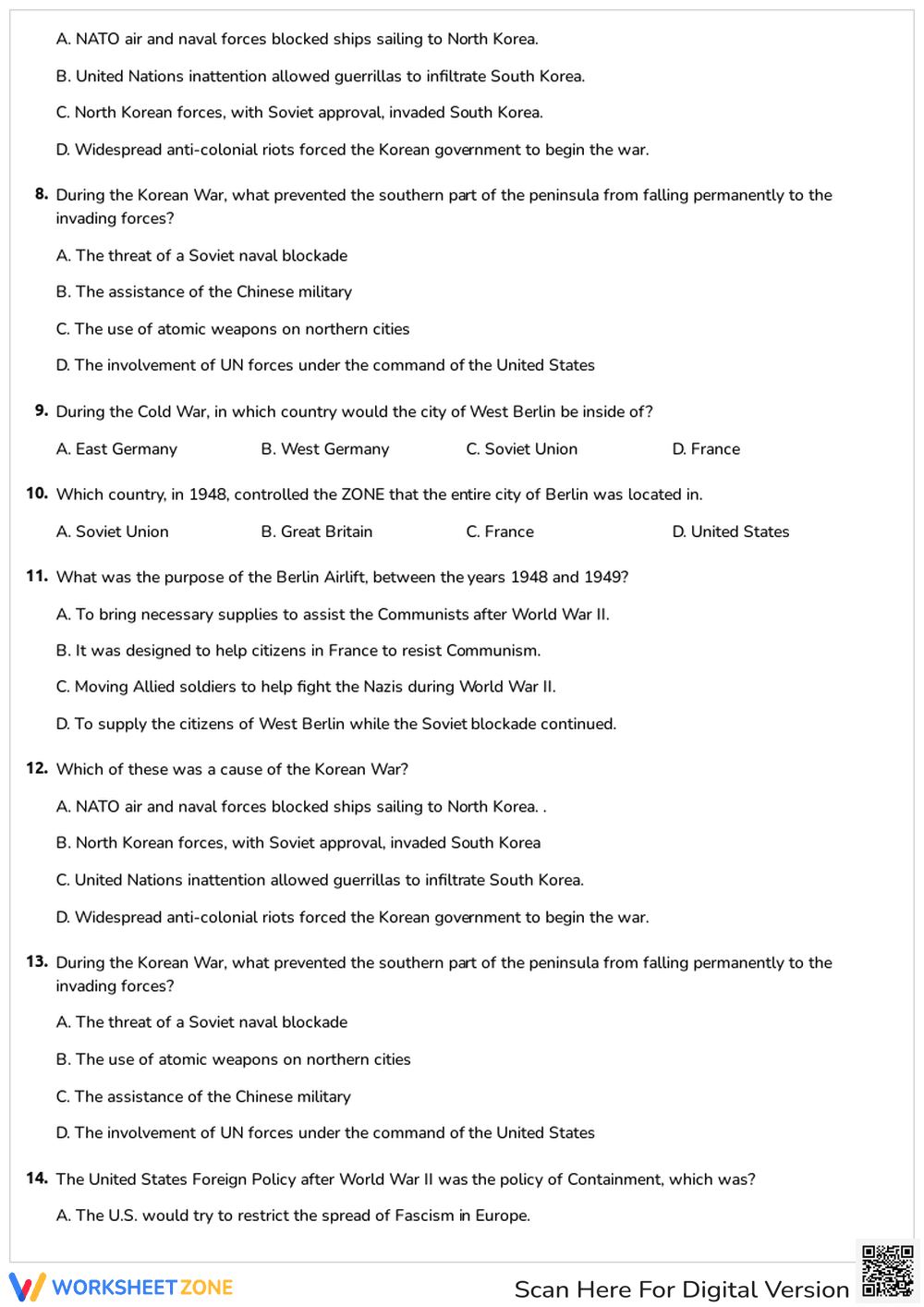


Printable Cold War Vocab Quiz | Grade 10 History
Paste this activity's link or code into your existing LMS (Google Classroom, Canvas, Teams, Schoology, Moodle, etc.).
Students can open and work on the activity right away, with no student login required.
You'll still be able to track student progress and results from your teacher account.
This high school history worksheet evaluates student understanding of essential Cold War terminology and events. By working through targeted multiple-choice questions, students demonstrate their grasp of key historical concepts like containment, the Marshall Plan, and the Truman Doctrine, ensuring they are prepared for advanced historical analysis.
At a Glance
- Grade: 10 · Subject: Social Studies
- Standard:
CCSS.ELA-LITERACY.RH.9-10.4— Determine the meaning of historical and political vocabulary- Skill Focus: Cold War History & Vocabulary
- Format: 3 pages · 16 problems · Answer key included · PDF
- Best For: End-of-unit assessment or review
- Time: 20–30 minutes
Inside this resource, educators will find a 16-question multiple-choice assessment spanning three pages. The questions cover critical post-WWII events, including the Korean War, the Berlin Airlift, and the Cuban Missile Crisis. A complete answer key is provided to streamline grading, making it easy to verify student comprehension of geopolitical shifts.
This resource offers a highly efficient workflow:
- Print (1 minute): Simply download the PDF and print the three-page assessment for each student.
- Distribute (1 minute): Hand out the copies at the beginning of the period or leave them in a designated folder for a substitute teacher.
- Review (3 minutes): Use the included answer key to quickly grade submissions or conduct a whole-class review session.
With under two minutes of teacher prep time, this is an excellent option for emergency sub plans.
This material is aligned to CCSS.ELA-LITERACY.RH.9-10.4, requiring students to determine the meaning of words and phrases as they are used in a text, including vocabulary describing political, social, or economic aspects of history/social science. It also supports general historical comprehension of the mid-twentieth century. Both standard codes can be copied directly into lesson plans, IEP goals, or district curriculum mapping tools.
This worksheet serves perfectly as a summative quiz after direct instruction on the early Cold War era. Alternatively, it can be used as a pre-assessment to gauge prior knowledge before starting a new unit on modern global conflicts. As a formative assessment tip, educators should monitor which specific questions students struggle with—such as distinguishing between the Truman Doctrine and the Marshall Plan—to guide subsequent review sessions. Students should be able to complete the task within 20 to 30 minutes.
This assessment is designed for 10th, 11th, and 12th-grade students studying US History or World History. It is highly effective for general education classrooms, and the multiple-choice format provides built-in scaffolding for students who benefit from structured options. It pairs exceptionally well with primary source document analysis activities.
Aligning instructional materials with rigorous standards like CCSS.ELA-LITERACY.RH.9-10.4 ensures that students can accurately determine the meaning of historical and political vocabulary. According to a comprehensive review by EdReports 2024, high school social studies curricula that integrate targeted vocabulary assessments significantly improve students' ability to analyze complex historical texts and primary sources. When learners are explicitly tested on domain-specific terminology, such as containment or the Marshall Plan, they develop a stronger foundational schema for understanding geopolitical conflicts. This structured practice reduces cognitive load during subsequent reading assignments, allowing students to focus on higher-order analytical tasks rather than basic comprehension. By utilizing standardized, multiple-choice formats for vocabulary acquisition, educators provide clear, measurable data on student progress while reinforcing the critical language skills necessary for civic literacy and advanced historical inquiry.


