


























Views
Downloads

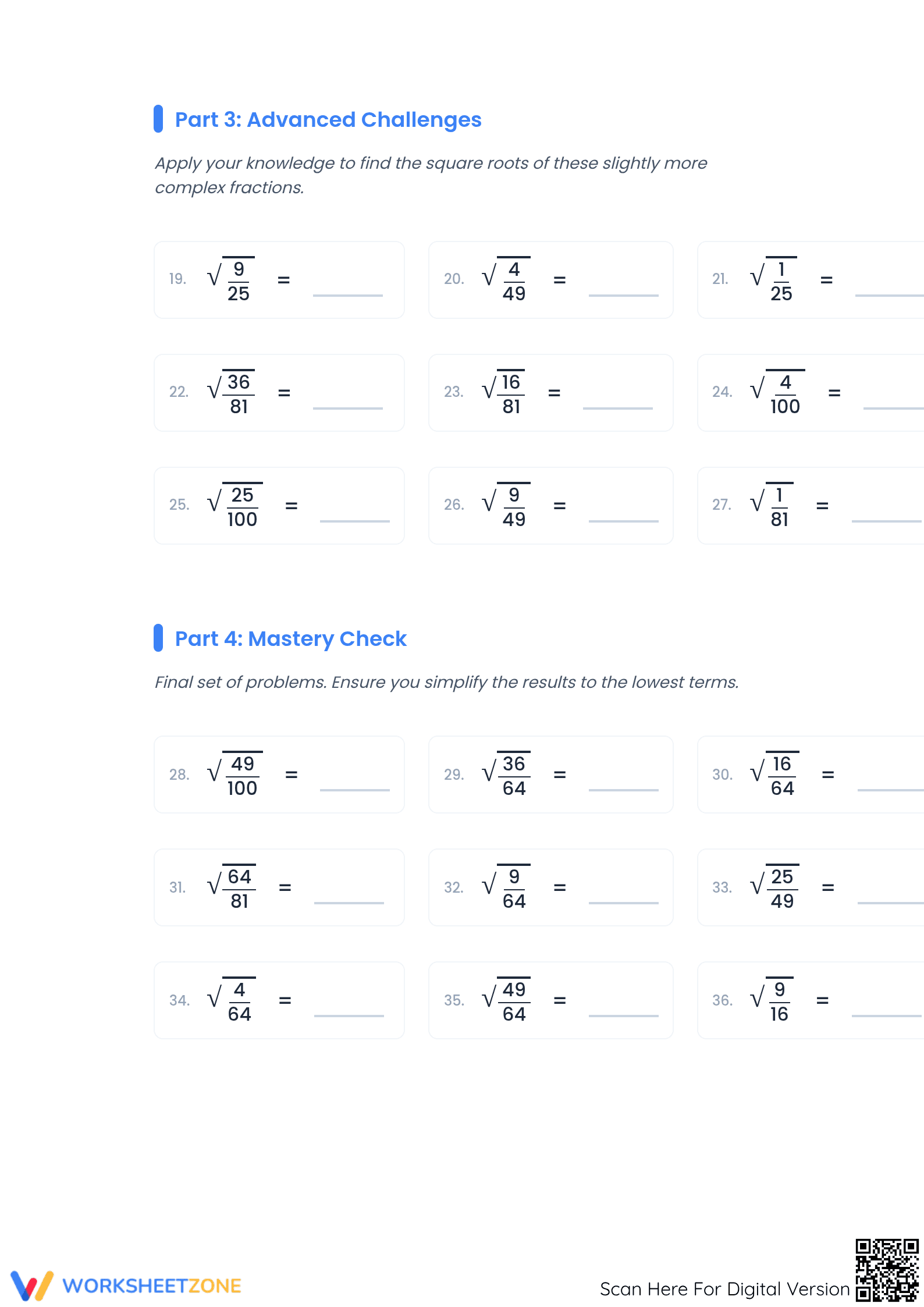

Grade 6-7 Square Roots Fractions — Printable No-Prep Worksheet
Paste this activity's link or code into your existing LMS (Google Classroom, Canvas, Teams, Schoology, Moodle, etc.).
Students can open and work on the activity right away, with no student login required.
You'll still be able to track student progress and results from your teacher account.
Master the essential pre-algebra skill of calculating square roots for rational numbers with this comprehensive practice set. This worksheet guides students through the process of simplifying fractional terms and finding perfect square roots, ensuring a solid foundation for more complex algebraic expressions. Students will achieve fluency in identifying square relationships within numerators and denominators.
At a Glance
- Grade: 6–7 · Subject: Math
- Standard:
CCSS.MATH.CONTENT.8.EE.A.2— Evaluate square roots of small perfect squares where the radicand is a positive rational number- Skill Focus: Rational Square Roots
- Format: 2 pages · 36 problems · Answer key included · PDF
- Best For: Independent practice or formative assessment
- Time: 25–35 minutes
This two-page resource features a structured progression of 36 distinct problems divided into four targeted sections: Basic, Intermediate, Advanced, and a Mastery Check. The layout provides ample workspace for students to simplify fractions before extraction. A full answer key is included, allowing for rapid grading or student-led self-correction during math rotations or homework review sessions.
Zero-Prep Workflow
This worksheet is designed for a seamless, zero-prep classroom experience through three simple steps:
- Print (30 seconds): Simply download the PDF and print copies for your entire class; the black-and-white design ensures high-quality reproduction.
- Distribute (1 minute): Pass out the two-page set as a standalone activity or a focused sub-plan component.
- Review (5 minutes): Use the included answer key for immediate feedback or to facilitate a quick peer-grading session at the end of the period.
The entire implementation requires under two minutes of total teacher preparation time.
Standards Alignment
This resource is primary aligned to CCSS.MATH.CONTENT.8.EE.A.2, which requires students to use square root symbols to represent solutions and evaluate square roots of small perfect squares. It also supports standards regarding rational number systems by requiring the simplification of fractions to their lowest terms before finding the root. Both standard codes can be copied directly into lesson plans, IEP goals, or district curriculum mapping tools.
How to Use It
Use this worksheet during the independent practice phase of a gradual release model following direct instruction on radical symbols. It serves as an excellent formative assessment tool; observe if students are simplifying the fraction before or after calculating the root to identify potential misconceptions. Students typically complete the 36-problem set within 30 minutes during a standard block period.
Who It's For
This resource is tailored for Grade 6 and Grade 7 students transitioning into pre-algebra. It provides necessary scaffolding for learners who benefit from repetitive practice with perfect squares. It pairs naturally with a number line anchor chart or a lesson on prime factorization to help students recognize the underlying patterns of square numbers.
According to the NAEP, student proficiency in early algebra depends heavily on the ability to manipulate rational numbers and understand the inverse relationship between squaring and square roots. This worksheet addresses that need by focusing on CCSS.MATH.CONTENT.8.EE.A.2, which emphasizes evaluating square roots of rational radicands. By providing 36 scaffolded tasks, the resource aligns with the "spaced practice" recommendations found in Fisher & Frey (2014), which suggest that frequent, low-stakes practice on specific numeric skills significantly improves long-term retention. The inclusion of a Mastery Check section allows educators to verify that students can apply simplification rules consistently across varying levels of complexity. This structured approach ensures that learners move beyond rote memorization of perfect squares toward a procedural understanding of how radicals interact with fractional structures, a critical prerequisite for high school algebra and geometry coursework.


