


























Views
Downloads


Essential Square Roots 1 to 20 Worksheet | Grade 7 Aligned
Paste this activity's link or code into your existing LMS (Google Classroom, Canvas, Teams, Schoology, Moodle, etc.).
Students can open and work on the activity right away, with no student login required.
You'll still be able to track student progress and results from your teacher account.
This comprehensive square roots worksheet provides Grade 7 students with focused practice on finding and comparing square roots from 1 to 20. By progressing through reference charts, radical expressions, and critical thinking word problems, learners develop the fluency needed for high-school algebra. This essential resource ensures students master the relationship between squares and radicals through structured, independent practice.
At a Glance
- Grade: 7 · Subject: Math
- Standard:
CCSS.MATH.CONTENT.8.EE.A.2— Use square root symbols to represent solutions to equations and evaluate square roots- Skill Focus: Calculating and comparing square roots (1-20)
- Format: 4 pages · 65 problems · Answer key included · PDF
- Best For: Middle school algebra introduction and remediation
- Time: 30–45 minutes
What's Inside
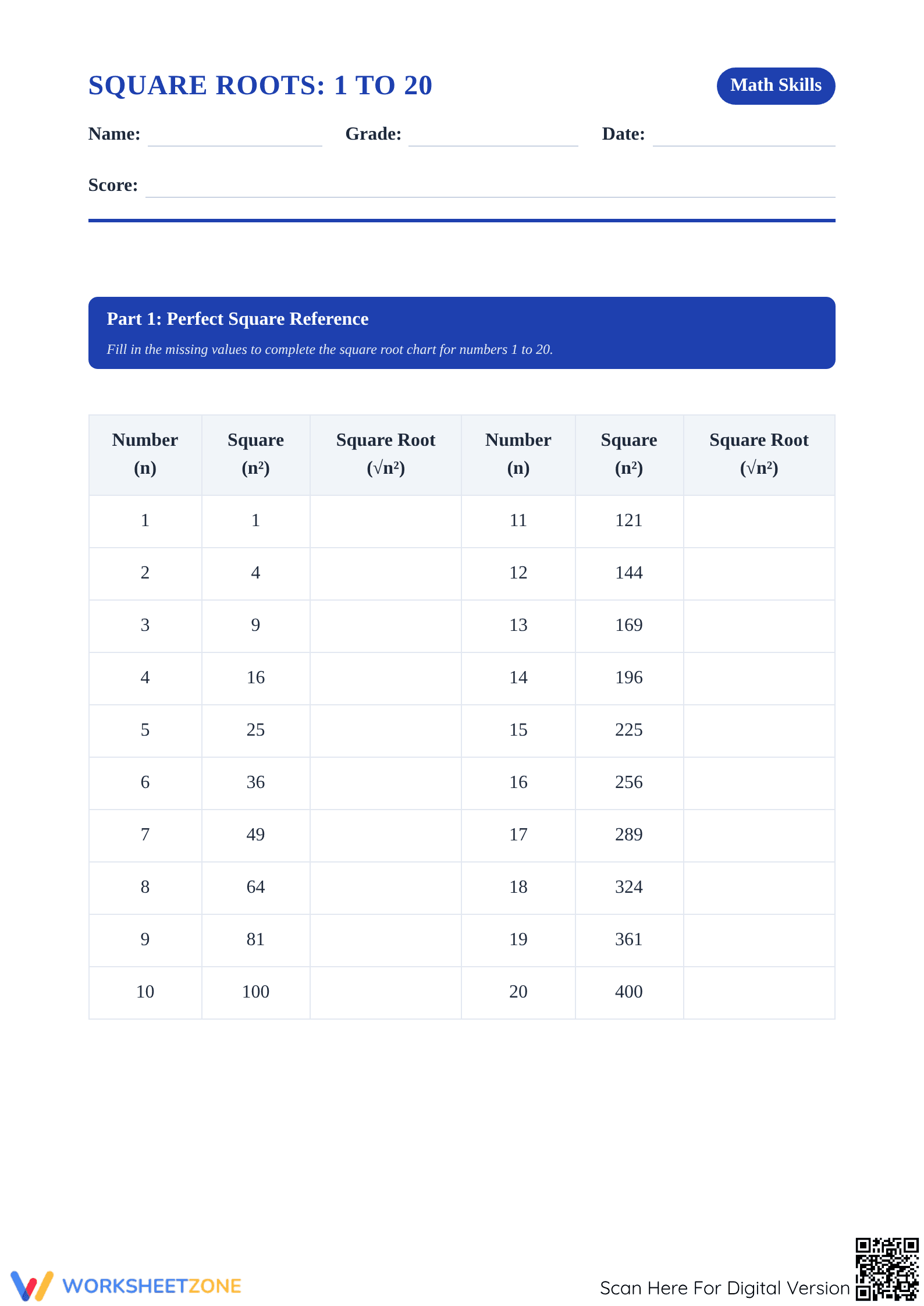
This four-page packet includes a perfect square reference chart for values up to 400, twenty radical expression evaluations, ten comparison tasks using inequality symbols, and twelve missing number equations. Structural features include a worked area-to-side-length example and a concluding multi-step word problem involving perimeter and area, providing a complete instructional arc from rote memory to application.
Zero-Prep Workflow
The zero-prep workflow for this resource follows three simple steps: Print the four-page packet (30 seconds), Distribute to students for independent or small-group work (1 minute), and Review using the provided comprehensive answer key (5 minutes). This sequence reduces teacher prep time to under two minutes, making it an ideal choice for substitute plans or immediate reinforcement.
Standards Alignment
This resource is aligned to CCSS.MATH.CONTENT.8.EE.A.2: "Use square root and cube root symbols to represent solutions to equations of the form x^2 = p and x^3 = p, where p is a positive rational number. Evaluate square roots of small perfect squares and cube roots of small perfect cubes." This standard code can be copied directly into lesson plans, IEP goals, or district curriculum mapping tools.
How to Use It
Use this worksheet during independent practice after an introductory lesson on perfect squares. It is particularly effective as a formative assessment tool; teachers should observe if students rely on the reference chart for Part 3 comparisons or if they can evaluate radicals mentally. The expected completion time is 30 to 45 minutes depending on student fluency.
Who It's For
This resource is designed for Grade 7 and 8 students beginning their algebra journey, as well as high school students requiring remedial support. It pairs naturally with a lesson on the Pythagorean Theorem or a visual anchor chart displaying perfect squares from 1 to 25 to support diverse learners.
According to the EdReports 2024 analysis, instructional materials that integrate procedural fluency with conceptual application—such as the transition from the radical evaluation tasks to the square garden word problem seen here—are critical for developing long-term mathematical retention. By utilizing standard CCSS.MATH.CONTENT.8.EE.A.2, this worksheet ensures that students do not just memorize values but understand how to evaluate square roots within the context of area and equations. Research from NAEP suggests that middle-school students who master basic radical operations early are significantly more likely to succeed in advanced quadratic functions. This worksheet provides sixty-five targeted tasks that build this foundational skill through a structured progression from guided reference to independent critical thinking. Furthermore, Fisher & Frey (2014) emphasize that providing students with reference charts before requiring independent evaluation supports the gradual release of responsibility, ensuring that learners have a reliable scaffolding mechanism to build confidence before attempting complex multi-step geometric calculations.


