


























Views
Plays

Spot the Letter O Worksheet | Grade K Essential
Paste this activity's link or code into your existing LMS (Google Classroom, Canvas, Teams, Schoology, Moodle, etc.).
Students can open and work on the activity right away, with no student login required.
You'll still be able to track student progress and results from your teacher account.
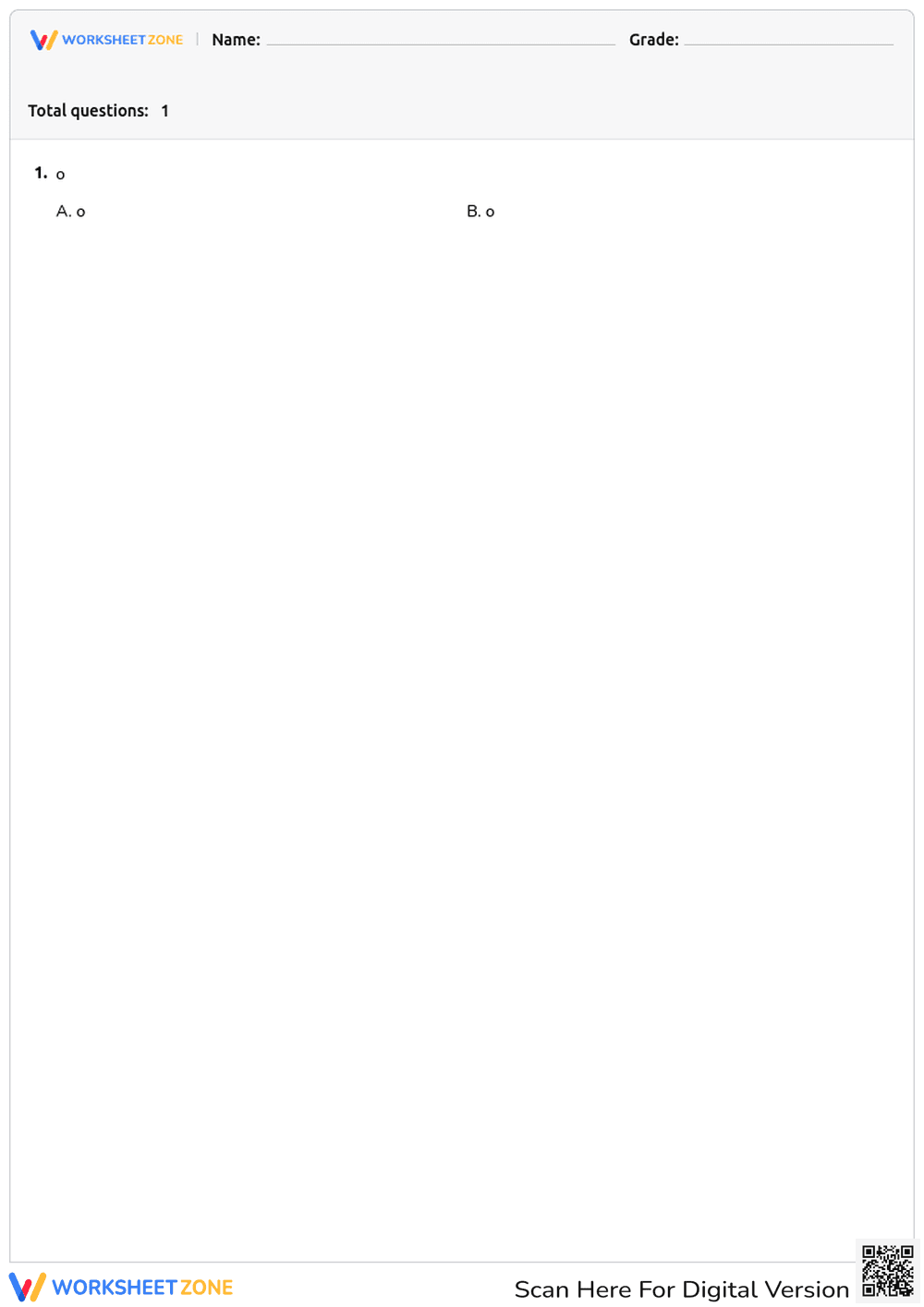
This Grade K letter recognition worksheet provides a targeted opportunity for early learners to identify the lowercase letter "o". By focusing on a single character, students build the visual discrimination skills necessary for fluent reading. This resource ensures young scholars can distinguish specific letter forms in a clear, distraction-free format.
At a Glance
- Grade: Kindergarten · Subject: ELA
- Standard:
CCSS.ELA-LITERACY.RF.K.1.D— Recognize and name all upper- and lowercase letters of the alphabet- Skill Focus: Lowercase letter recognition
- Format: 1 page · 1 problem · Answer key included · PDF
- Best For: Quick formative assessment or warm-up
- Time: 2–5 minutes
This single-page PDF features a focused identification task. It includes a clear prompt asking students to "Spot the Letter O" among similar choices. The layout is intentionally minimalist to support students with visual processing needs or those just beginning their literacy journey. A complete answer key is provided for rapid verification of student work.
The zero-prep workflow for this resource is designed for maximum efficiency in a busy classroom. First, print the single-page PDF (30 seconds). Second, distribute the sheet to students during a literacy center or as a "bell-ringer" activity (30 seconds). Third, review the correct identification as a whole group or individually (1 minute). Total teacher preparation time is under two minutes, making it an ideal choice for emergency sub plans or transition periods.
The primary focus is CCSS.ELA-LITERACY.RF.K.1.D: "Recognize and name all upper- and lowercase letters of the alphabet." This worksheet specifically targets the lowercase "o" to ensure mastery of high-frequency character shapes. Both standard codes can be copied directly into lesson plans, IEP goals, or district curriculum mapping tools to track student progress toward foundational literacy benchmarks.
Use this worksheet as an exit ticket after a direct instruction lesson on the letter "o" to gauge immediate student understanding. Alternatively, place it in a morning work folder for independent practice. Teachers should observe if students hesitate between the options, which may indicate a need for further tactile letter-tracing activities. Expected completion typically takes 3 minutes for most Kindergarten students.
This resource is designed for Kindergarten students, English Language Learners (ELLs) acquiring basic alphabet knowledge, and students receiving Tier 2 intervention for phonological awareness. It pairs naturally with an alphabet anchor chart or a "Letter of the Week" curriculum focused on vowel shapes and sounds to reinforce visual memory.
Research from the NAEP and Fisher & Frey (2014) emphasizes that early mastery of letter names and shapes is one of the strongest predictors of later reading success. This worksheet addresses CCSS.ELA-LITERACY.RF.K.1.D by isolating the lowercase "o" to prevent cognitive overload during the initial stages of print awareness. According to the RAND AIRS 2024 report, high-frequency, low-stakes practice helps solidify the neural pathways required for rapid visual character recognition. By providing a clear, singular task, this resource allows educators to identify specific gaps in a student's alphabetic knowledge without the interference of complex page layouts. This targeted approach is essential for building the foundational orthographic mapping skills that lead to fluent word recognition and decoding in subsequent grade levels. Consistent use of such focused tools ensures that no student falls behind in basic letter identification.


