


























Views
Downloads
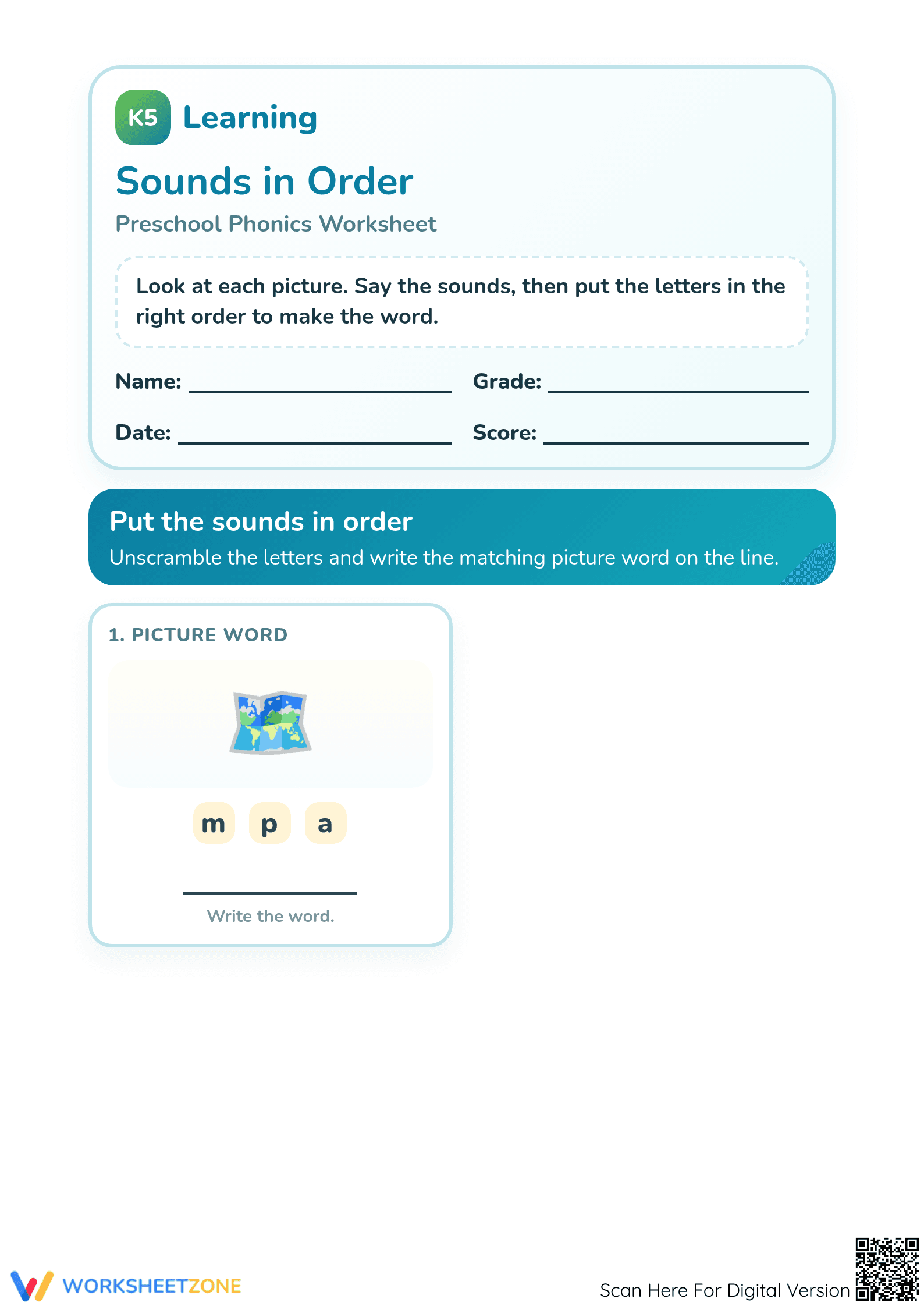


Preschool Sounds in Order Worksheet — Printable No-Prep ELA
Paste this activity's link or code into your existing LMS (Google Classroom, Canvas, Teams, Schoology, Moodle, etc.).
Students can open and work on the activity right away, with no student login required.
You'll still be able to track student progress and results from your teacher account.
This Preschool phonics worksheet helps young learners master the relationship between individual sounds and written letters. By unscrambling letters to match vivid picture cues, students develop essential phonemic awareness and early spelling skills. It provides a structured environment for children to practice sounding out words and writing them independently.
At a Glance
- Grade: Preschool · Subject: English Language Arts
- Standard:
CCSS.ELA-LITERACY.RF.K.2.D— Isolate and pronounce the initial, medial vowel, and final sounds in words- Skill Focus: Phonemic awareness and phonetic spelling
- Format: 3 pages · 6 problems · Answer key included · PDF
- Best For: Early literacy centers and homework practice
- Time: 10–15 minutes
What's Inside
The resource includes three high-quality PDF pages featuring six distinct picture-word tasks. Each task presents a clear illustration (such as a jet, bug, or fan) alongside scrambled letter tiles. Students must identify the object, determine the correct sequence of sounds, and write the final word on provided lines. A complete answer key is included.
Zero-Prep Workflow
This worksheet is designed for immediate classroom implementation with three simple steps. First, print the document in less than 30 seconds. Second, distribute the pages to students during independent work time or literacy rotations. Finally, review the completed work using the included answer key to provide instant feedback. Total teacher preparation time is under two minutes, making it an ideal sub-plan resource.
Standards Alignment
Aligned primarily to `CCSS.ELA-LITERACY.RF.K.2.D`, this activity requires students to isolate and pronounce the sounds in three- and four-letter words. It also supports `CCSS.ELA-LITERACY.L.K.2.D` by encouraging phonetic spelling based on sound-letter relationships. Both standard codes can be copied directly into lesson plans, IEP goals, or district curriculum mapping tools.
How to Use It
Use this worksheet as a formative assessment after a lesson on CVC words or as a morning work activity to reinforce letter sounds. For a diagnostic observation, watch as students say the sounds aloud before writing; note any difficulties with medial vowel sounds or final consonants. It is expected to take most preschoolers between 10 and 15 minutes to complete the full set.
Who It's For
This resource is tailored for preschool students and early kindergarteners who are beginning to bridge the gap between letter recognition and word formation. It is highly effective for English Language Learners who benefit from visual picture cues. Pair this activity with an anchor chart displaying common letter-sound pairings for additional support during direct instruction.
The Sounds in Order methodology leverages the principle of phonological encoding, a critical precursor to reading fluency. According to research published by RAND AIRS 2024, early intervention in phonemic awareness—specifically the ability to manipulate and order sounds—is one of the strongest predictors of later reading success. This worksheet aligns with evidence-based instructional practices by providing scaffolded opportunities for students to apply their knowledge of 44 English phonemes in a concrete, visual context. By requiring children to both hear the sound sequence and physically arrange the corresponding letters, the activity reinforces the orthographic mapping process. This multimodal approach ensures that students are not merely memorizing word shapes but are instead building a robust internal system for decoding and encoding language. Educational practitioners can confidently integrate this standards-aligned resource into comprehensive literacy frameworks to support the developmental needs of emergent readers in any instructional setting.


