


























Views
Downloads

Essential Recycling Sort Worksheet for Grade 1 Science
Paste this activity's link or code into your existing LMS (Google Classroom, Canvas, Teams, Schoology, Moodle, etc.).
Students can open and work on the activity right away, with no student login required.
You'll still be able to track student progress and results from your teacher account.
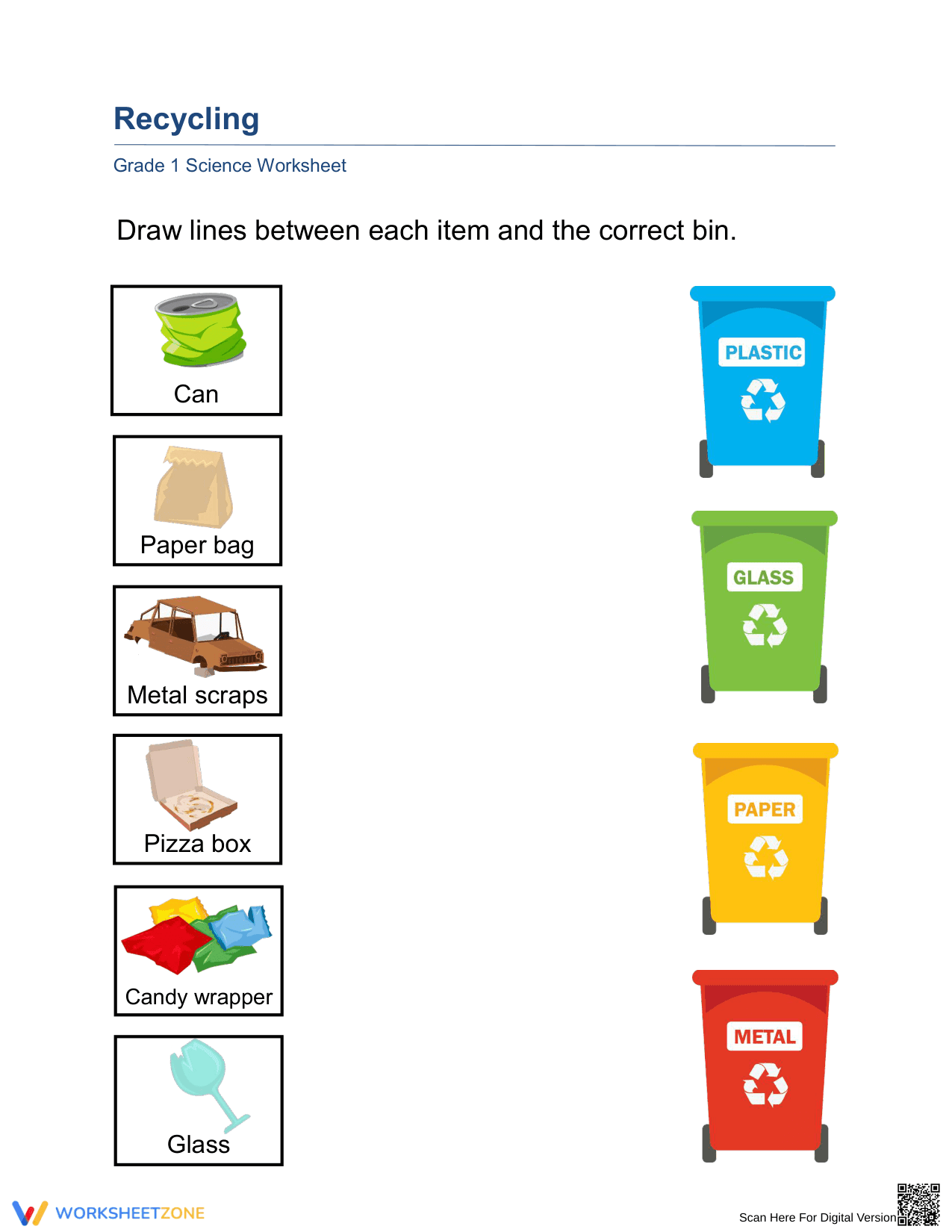
This Grade 1 Science worksheet empowers young learners to master environmental stewardship by sorting common household waste. Students connect items like paper bags and metal scraps to corresponding bins. This activity bridges the gap between abstract conservation and tangible actions, ensuring immediate classroom engagement and high retention.
At a Glance
- Grade: 1 · Subject: Science & Environment
- Standard:
K-ESS3-3— Categorize common household materials to demonstrate practical solutions for reducing environmental impact- Skill Focus: Material categorization and recycling
- Format: 2 pages · 6 problems · Answer key included · PDF
- Best For: Independent practice or environmental science centers
- Time: 10–15 minutes
What's Inside
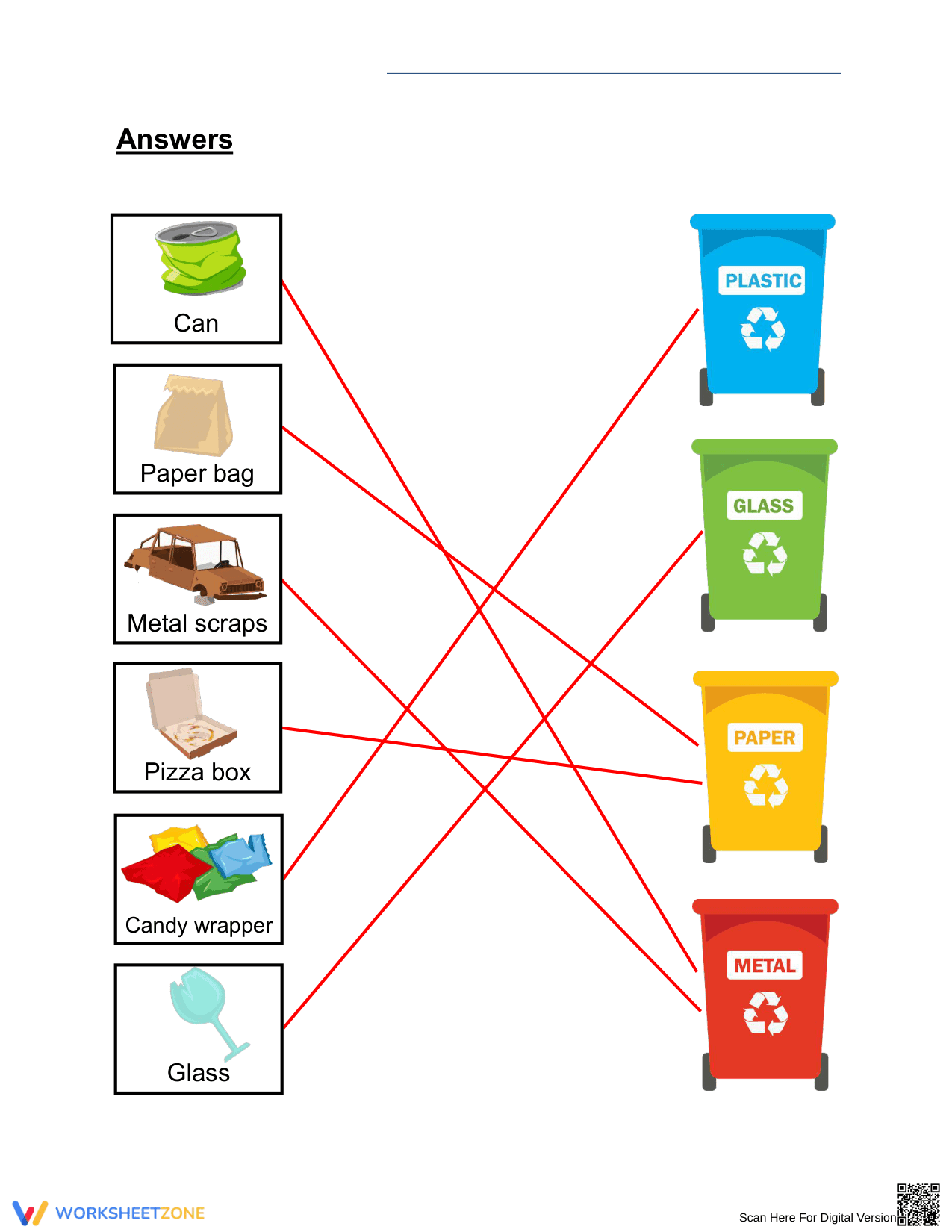
This two-page PDF includes a student sorting worksheet and a visual answer key. The task features six items to be matched with four bins: Plastic, Glass, Paper, and Metal. Clear illustrations support emergent readers in identifying objects independently without requiring heavy teacher assistance or complex literacy skills.
Zero-Prep Workflow
This resource offers a zero-prep workflow for busy educators. First, print the single-page task in under thirty seconds. Second, distribute the sheet; the intuitive "draw a line" instruction allows students to start immediately. Third, use the visual key for instant grading. Total prep time is under two minutes, perfect for sub plans.
Standards Alignment
Aligned with K-ESS3-3, this activity requires students to identify environmental solutions. By sorting waste, students demonstrate foundational knowledge of conservation and material properties. Both standard codes can be copied directly into lesson plans, IEP goals, or district curriculum mapping tools to ensure compliance.
How to Use It
Use this during a lesson on natural resources. It works well as a formative assessment; observe students as they distinguish between packaging materials. Completion typically takes twelve minutes. Follow up with a discussion on why sorting is essential for the recycling process and the role of local collection centers.
Who It's For
Optimized for first grade, this also suits kindergarten enrichment or second-grade review. Visual cues support English Language Learners and students with IEPs by reducing text-heavy demands. Pair this with a physical sorting activity or a classroom anchor chart for maximum instructional impact and student success.
The K-ESS3-3 standard emphasizes the importance of early environmental education as a mechanism for developing long-term conservation behaviors. This worksheet focuses on the plain-English skill of material categorization, a critical cognitive milestone for first-grade students learning to analyze their surroundings. Research from RAND AIRS 2024 indicates that structured sorting tasks in primary grades significantly improve a student's ability to recognize patterns and understand the relationship between human actions and environmental outcomes. By providing a clear, low-barrier entry point into complex ecological topics, this resource ensures that students build the necessary schema for more advanced Earth science concepts. The inclusion of a visual answer key and high-interest graphics aligns with best practices for gradual release of responsibility, allowing students to move from guided observation to independent application within a single fifteen-minute session.


