


























Views
Downloads
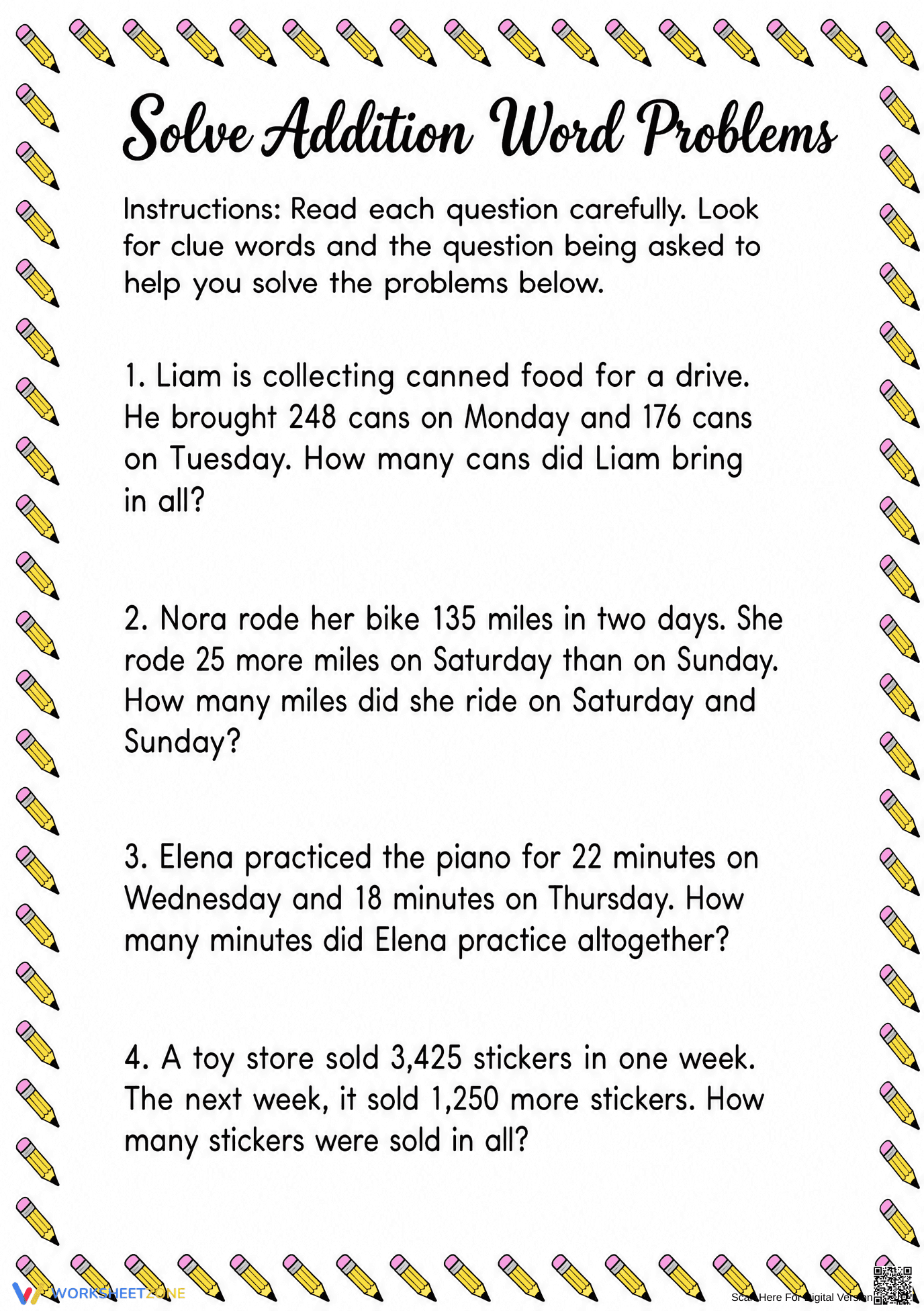

Addition Word Problems Printable | Grade 3 Math
Paste this activity's link or code into your existing LMS (Google Classroom, Canvas, Teams, Schoology, Moodle, etc.).
Students can open and work on the activity right away, with no student login required.
You'll still be able to track student progress and results from your teacher account.
This Grade 3 math worksheet provides students with focused practice on solving addition word problems. By reading carefully and identifying key clue words, learners will extract the correct multi-digit numbers and calculate accurate sums. This resource bridges the gap between basic computation and real-world mathematical application.
At a Glance
- Grade: 3 · Subject: Math
- Standard:
CCSS.MATH.CONTENT.3.NBT.A.2— Fluently add multi-digit numbers using place value strategies- Skill Focus: Addition Word Problems
- Format: 1 page · 4 problems · Answer key included · PDF
- Best For: Independent practice or homework
- Time: 10–15 minutes
What's Inside
Inside this single-page resource, educators will find four distinct word problems that require students to apply their addition skills to relatable scenarios, such as collecting canned goods or tracking miles ridden on a bicycle. The problems feature a mix of two-digit, three-digit, and four-digit numbers to provide a gentle escalation in computational difficulty. A complete answer key is included to ensure quick and accurate grading.
Zero-Prep Workflow
Enjoy a smooth, zero-prep workflow:
- Print (1 minute): Simply download the PDF and print a class set. The clean layout requires no special formatting.
- Distribute (1 minute): Hand out the worksheets as a warm-up, exit ticket, or independent practice activity.
- Review (3 minutes): Use the provided answer key to quickly check student work or project it for whole-class self-correction.
With under two minutes of prep, this resource is perfect for busy educators or emergency sub plans.
Standards Alignment
This activity is directly aligned to CCSS.MATH.CONTENT.3.NBT.A.2, which requires students to fluently add and subtract within 1000 using strategies and algorithms based on place value, properties of operations, and/or the relationship between addition and subtraction. It also supports reading comprehension in mathematics. Both standard codes can be copied directly into lesson plans, IEP goals, or district curriculum mapping tools.
How to Use It
Use this worksheet immediately after direct instruction on multi-digit addition for contextualized practice. Alternatively, assign it as a brief homework task to reinforce classroom learning. As a formative assessment tip, observe whether students correctly align their numbers by place value when setting up vertical addition equations. Expected completion time ranges from 10 to 15 minutes depending on reading fluency and computational speed.
Who It's For
Designed for third-grade students mastering multi-digit addition, this also serves as review for fourth graders. To differentiate, teachers can encourage students who need extra support to highlight specific numbers and clue words (like "in all" or "altogether") before attempting the math. It pairs perfectly with base-ten blocks or a place value anchor chart for visual learners.
Integrating word problems is critical for developing deep mathematical reasoning and long-term retention. According to EdReports 2024, instructional materials that consistently connect procedural skills to real-world applications significantly improve students' ability to transfer knowledge to entirely new contexts. This specific worksheet targets CCSS.MATH.CONTENT.3.NBT.A.2, directly helping students fluently add multi-digit numbers using place value strategies while simultaneously building their essential mathematical literacy. By requiring young learners to actively identify clue words and extract relevant numerical data from written text, the activity strongly reinforces the cognitive links between reading comprehension and computational accuracy. Regular, structured practice with these types of contextualized problems ensures that students do not merely memorize standard algorithms, but actually understand precisely when and how to apply them in everyday, practical situations. This targeted, evidence-based approach successfully builds the foundational problem-solving stamina that is absolutely required for more complex algebraic thinking and multi-step equations in later elementary grades.


