




























Views
Downloads



Segment Addition Postulate Practice | Essential Geometry

Paste this activity's link or code into your existing LMS (Google Classroom, Canvas, Teams, Schoology, Moodle, etc.).
Students can open and work on the activity right away, with no student login required.
You'll still be able to track student progress and results from your teacher account.
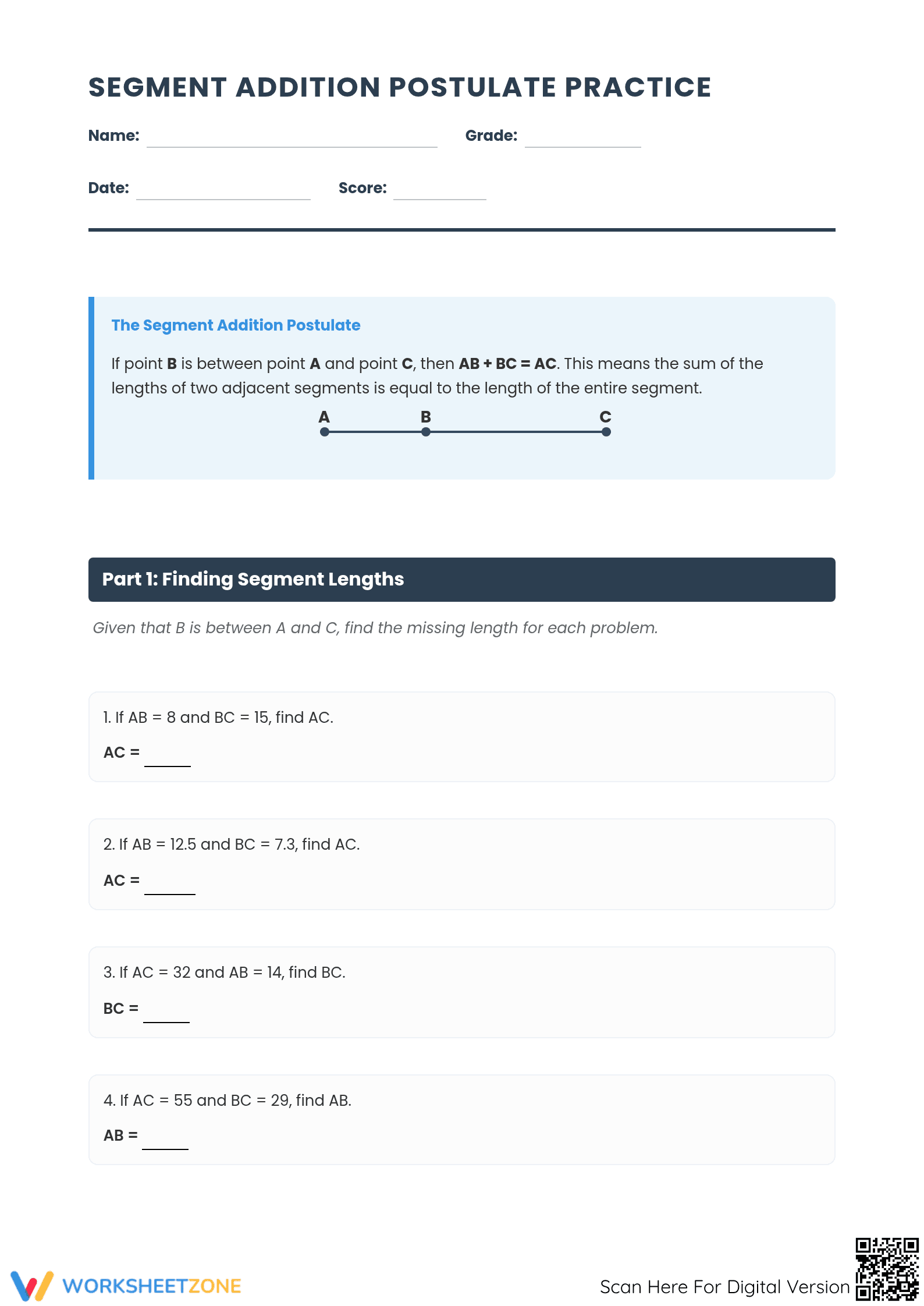
This Segment Addition Postulate worksheet provides a comprehensive practice set for students to master the foundational geometric principle that the whole is equal to the sum of its parts. By engaging with 25 tiered problems, learners develop the analytical skills necessary to solve for missing segment lengths and algebraic variables in a geometric context.
At a Glance
- Grade: 7 · Subject: Geometry
- Standard:
CCSS.MATH.CONTENT.7.EE.B.4— Use variables to represent quantities in a geometric problem and solve equations- Skill Focus: Segment Addition Postulate
- Format: 4 pages · 25 problems · Answer key included · PDF
- Best For: Independent practice and formative assessment
- Time: 45–60 minutes
What's Inside
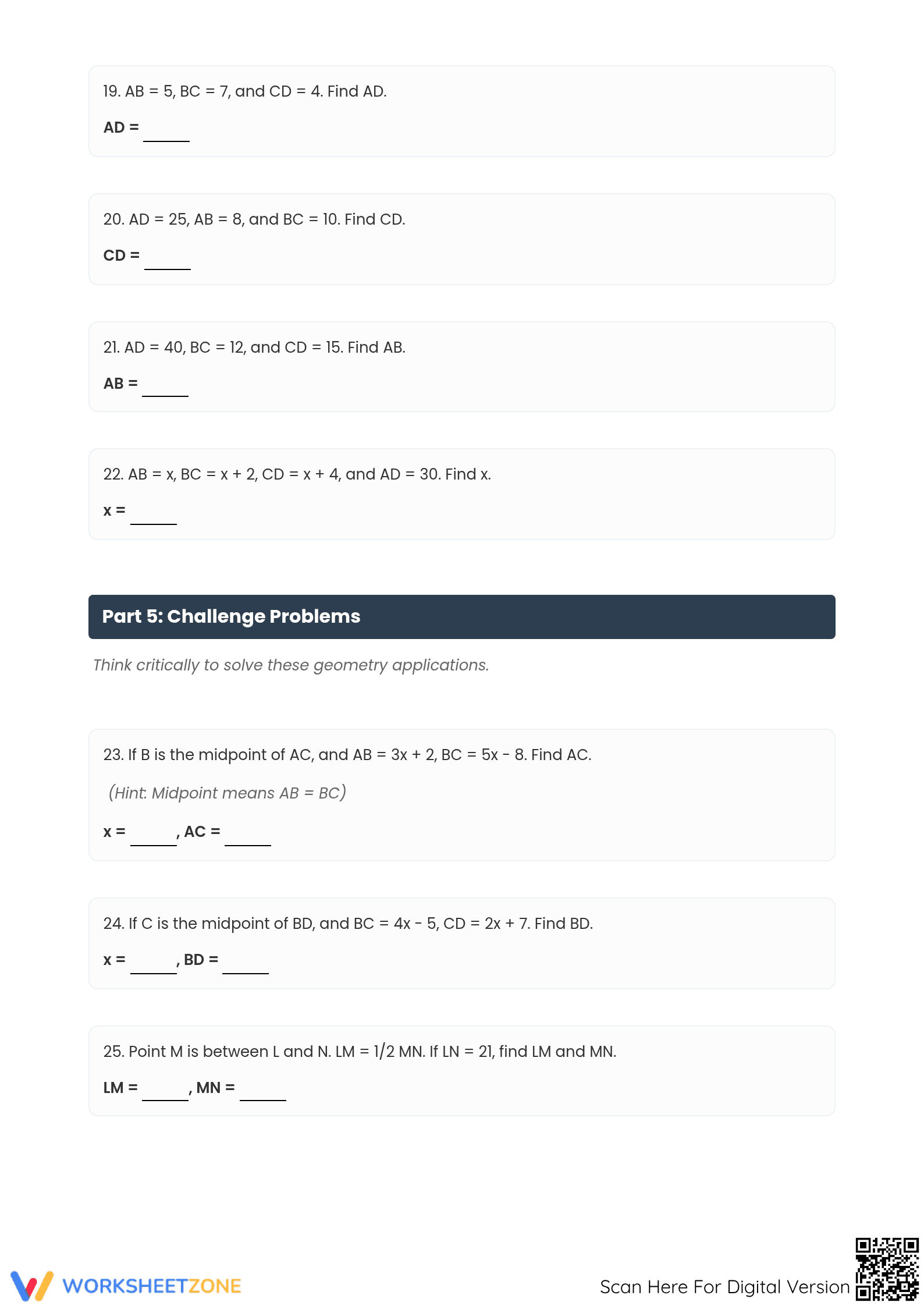
The worksheet is organized into five distinct parts that scaffold learning from basic arithmetic to complex algebraic applications. Part 1 focuses on numerical calculation. Part 2 introduces algebraic expressions requiring students to solve for "x." Part 3 combines these skills to find specific segment values. Part 4 expands to multiple collinear points, and Part 5 challenges students with midpoints. A complete answer key is provided.
Zero-Prep Workflow
This resource is designed for immediate classroom implementation with zero teacher preparation. Simply print the four-page PDF document, distribute to students for independent practice or homework, and use the included answer key for rapid grading or self-correction. Prep time is under two minutes.
Standards Alignment
The primary standard addressed is CCSS.MATH.CONTENT.7.EE.B.4, which requires students to use variables to represent quantities and construct simple equations to solve problems. By applying the Segment Addition Postulate, students translate geometric relationships into algebraic equations. This worksheet also supports High School Geometry standards by building precise definitions of line segments. Both standard codes can be copied directly into lesson plans, IEP goals, or district curriculum mapping tools.
How to Use It
Incorporate this worksheet as a "Check for Understanding" after direct instruction on the properties of line segments. Assign Parts 1 and 2 to verify grasp of basic postulates before moving to algebraic challenges. For formative assessment, observe students during Part 3; if they can successfully set up the equation but struggle with the solution, provide targeted algebraic support. Completion typically requires 45 to 60 minutes.
Who It's For
This resource is tailored for Grade 7 students transitioning from numerical geometry to algebraic reasoning. It is also suitable for High School Geometry students who require a refresher on foundational postulates. The clear scaffolding makes it accessible for students with IEPs requiring structured math tasks, while the challenge problems in Part 5 provide necessary extension for advanced learners. It pairs naturally with an introductory slide deck on collinearity.
Effective mathematics instruction requires a balance of procedural fluency and conceptual understanding. This worksheet aligns with the Segment Addition Postulate, a critical gateway concept that bridges arithmetic operations with algebraic modeling. By requiring students to solve 25 unique problems across five levels of complexity, the resource facilitates the "gradual release of responsibility" model. Structured practice in translating geometric diagrams into algebraic equations significantly improves student performance on standardized assessments. The inclusion of multi-point collinearity and midpoint problems ensures students develop a robust mental model of line segments. Educators can rely on this standards-aligned tool to provide high-quality evidence of student mastery within the CCSS.MATH.CONTENT.7.EE.B.4 framework for both general and specialized instructional settings.


