


























Views
Downloads

Essential Solid and 3D Figures Worksheet | Grade 4-7 Math
Paste this activity's link or code into your existing LMS (Google Classroom, Canvas, Teams, Schoology, Moodle, etc.).
Students can open and work on the activity right away, with no student login required.
You'll still be able to track student progress and results from your teacher account.
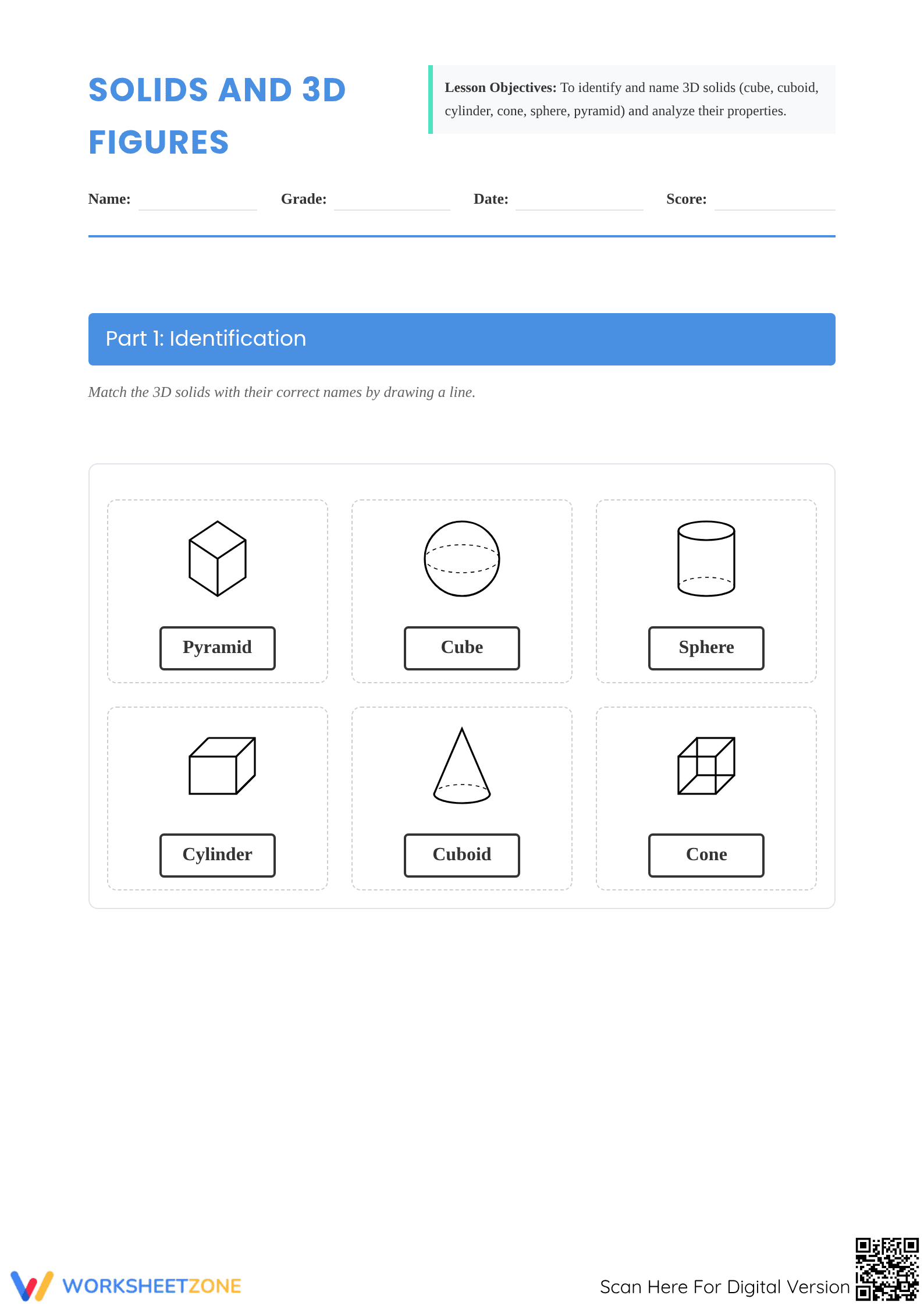
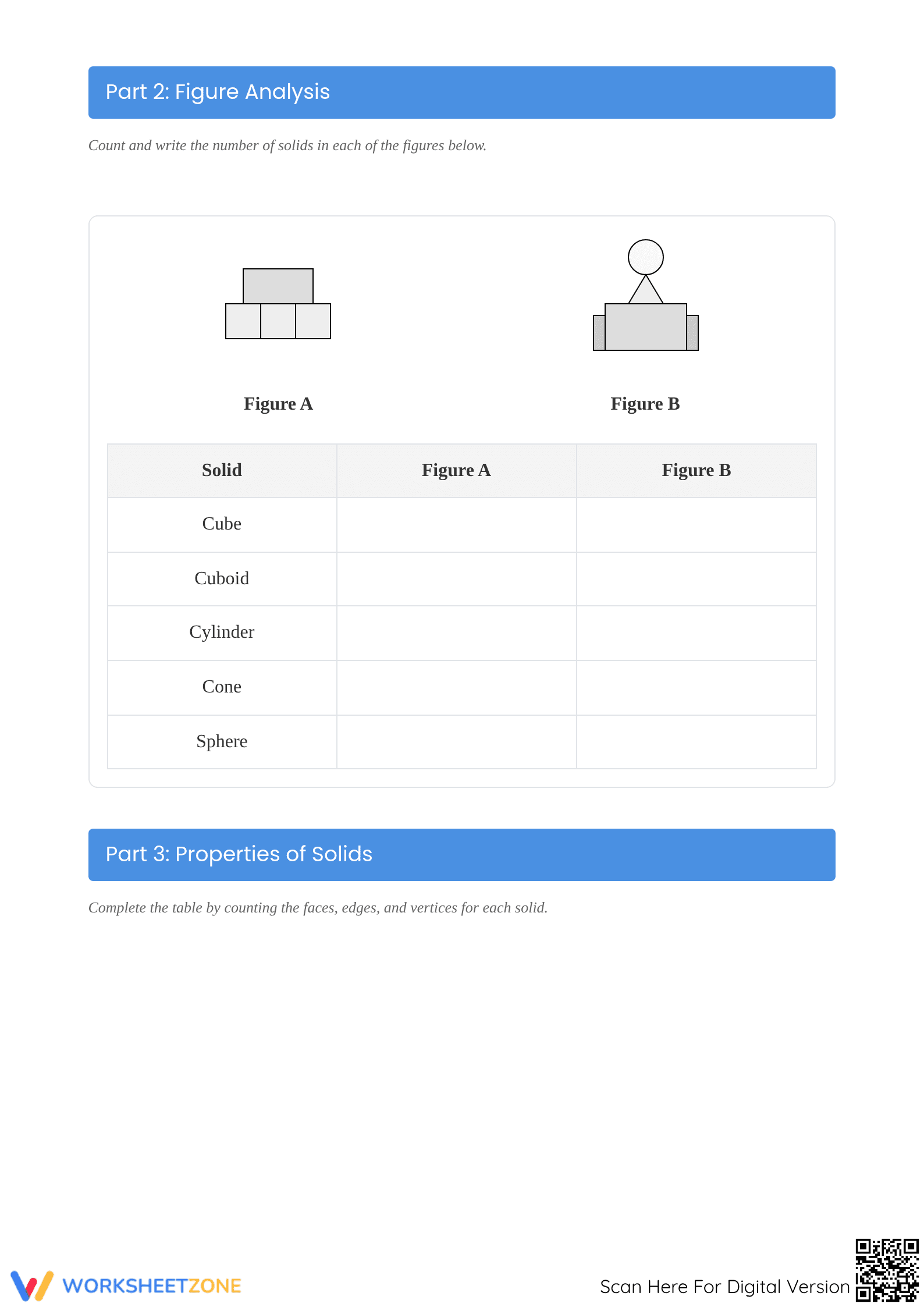
This essential solid and 3D figures worksheet provides students with a comprehensive review of geometry concepts across four detailed pages. Students will identify various 3D shapes and analyze their unique geometric attributes, such as faces, edges, and vertices.
At a Glance
- Grade: 4–7 · Subject: Geometry
- Standard:
CCSS.MATH.CONTENT.2.G.A.1— Identify and describe shapes by their number of faces, edges, and vertices- Skill Focus: 3D Shape Properties
- Format: 4 pages · 34 problems · Answer key included · PDF
- Best For: Geometry review and attribute mastery practice
- Time: 25–40 minutes
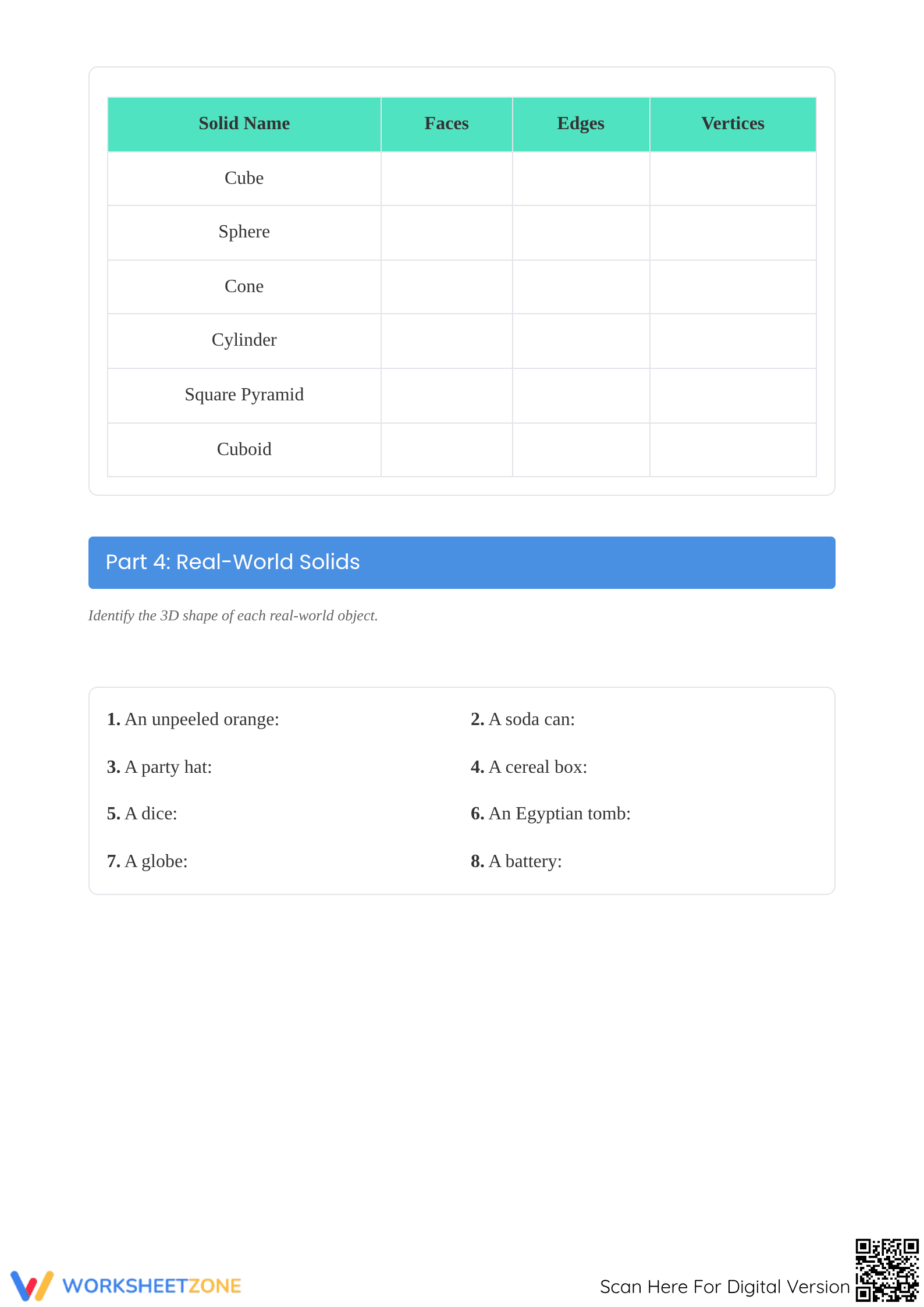
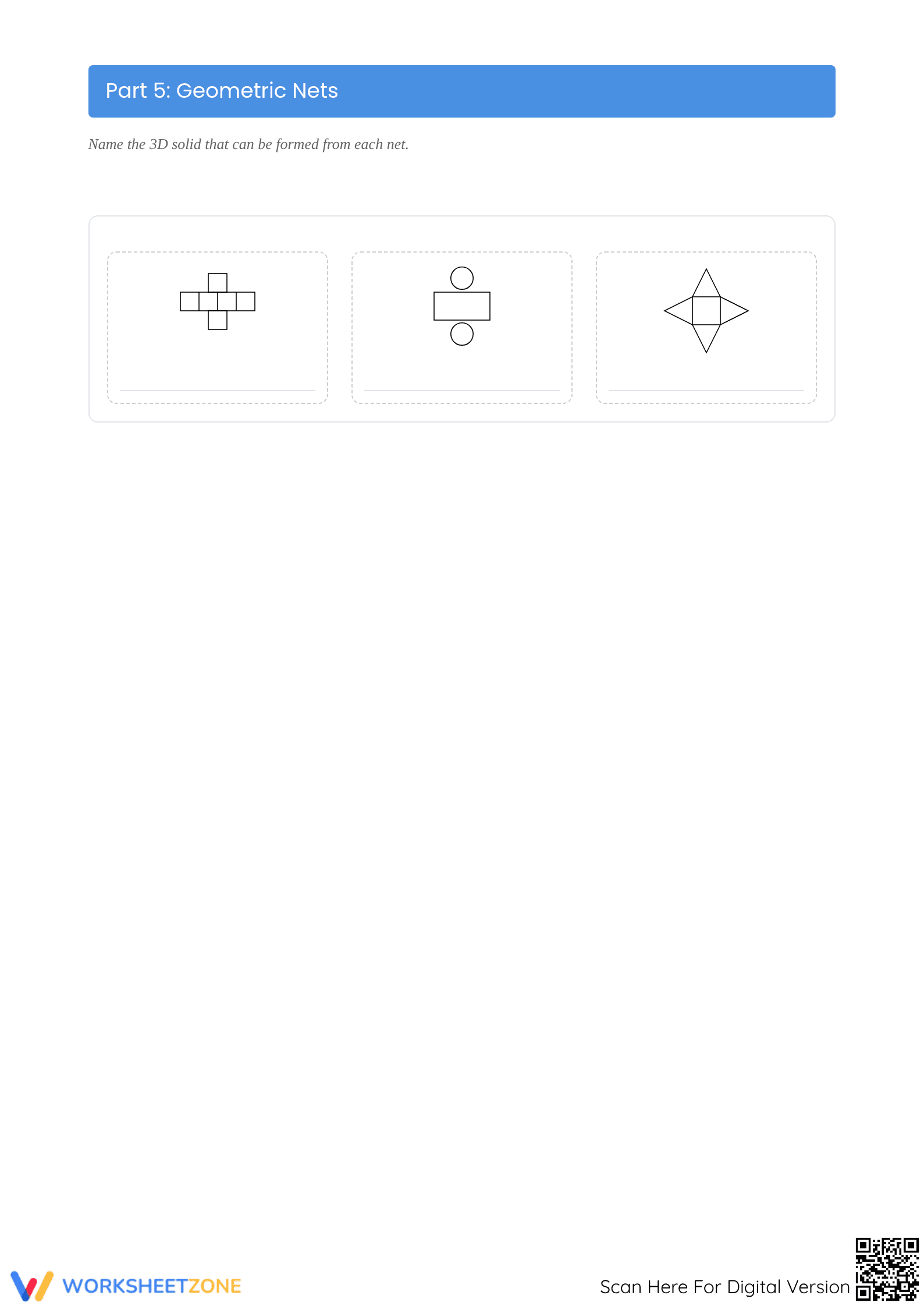
This four-page resource includes identification exercises where students name figures like spheres, cubes, cones, and prisms. It features a detailed data table requiring students to count and record the number of faces, edges, and vertices for seven different solid figures. The worksheet also provides a complete answer key for every page, allowing for quick grading or student self-assessment during independent practice sessions.
Skill Progression
- Guided Identification: Six initial tasks focus on correctly naming common solid figures using visual cues and foundational terminology.
- Attribute Analysis: Twenty-one entries in a comprehensive table challenge students to decompose shapes into their primary geometric components.
- Independent Synthesis: Final tasks require students to differentiate between similar figures based on specific properties like curvature and vertex counts.
This gradual release approach ensures that students move from simple recognition to complex attribute analysis with appropriate scaffolding to support diverse learners.
Standards Alignment
The primary alignment for this resource is CCSS.MATH.CONTENT.2.G.A.1, which requires students to "recognize and draw shapes having specified attributes, such as a given number of angles or a given number of equal faces." While introduced in earlier grades, this worksheet extends the complexity for Grades 4-7 by focusing on the relationship between 3D structures.
How to Use It
Use this worksheet as a formative assessment after introducing the properties of 3D figures to gauge student understanding of faces, edges, and vertices. It also serves as an excellent station activity during math rotations where students can use physical manipulatives to verify their answers.
Who It's For
This resource is designed for upper elementary and middle school students who are refining their geometry skills. It is particularly helpful for students requiring visual scaffolds to understand spatial relationships.
The analysis of three-dimensional figures and their geometric attributes is a critical component of spatial reasoning development in middle-grade mathematics. According to research from Fisher & Frey (2014) on the gradual release of responsibility, structured practice that moves from naming to attribute decomposition significantly improves long-term retention of spatial concepts. This worksheet aligns with CCSS.MATH.CONTENT.2.G.A.1 by requiring students to accurately identify solid figures and quantify their structural properties, including faces, edges, and vertices. By engaging with 34 distinct tasks across 4 pages, learners develop the necessary precision to differentiate between complex polyhedra and curved solids. Such focused practice is essential for meeting the rigor of standardized assessments and preparing for advanced geometric topics. Educators can rely on this resource as a verified tool for building geometry fluency, ensuring that students can articulate the defining characteristics of 3D shapes with mathematical accuracy and confidence.


