


























0
Views
0
Downloads

0.0
0
Save
0 Likes
Share
Skills Review: Practice with Angles Worksheet
0 Views
0 Downloads
Paste this activity's link or code into your existing LMS (Google Classroom, Canvas, Teams, Schoology, Moodle, etc.).
Students can open and work on the activity right away, with no student login required.
You'll still be able to track student progress and results from your teacher account.
Information
Description
What It Is:
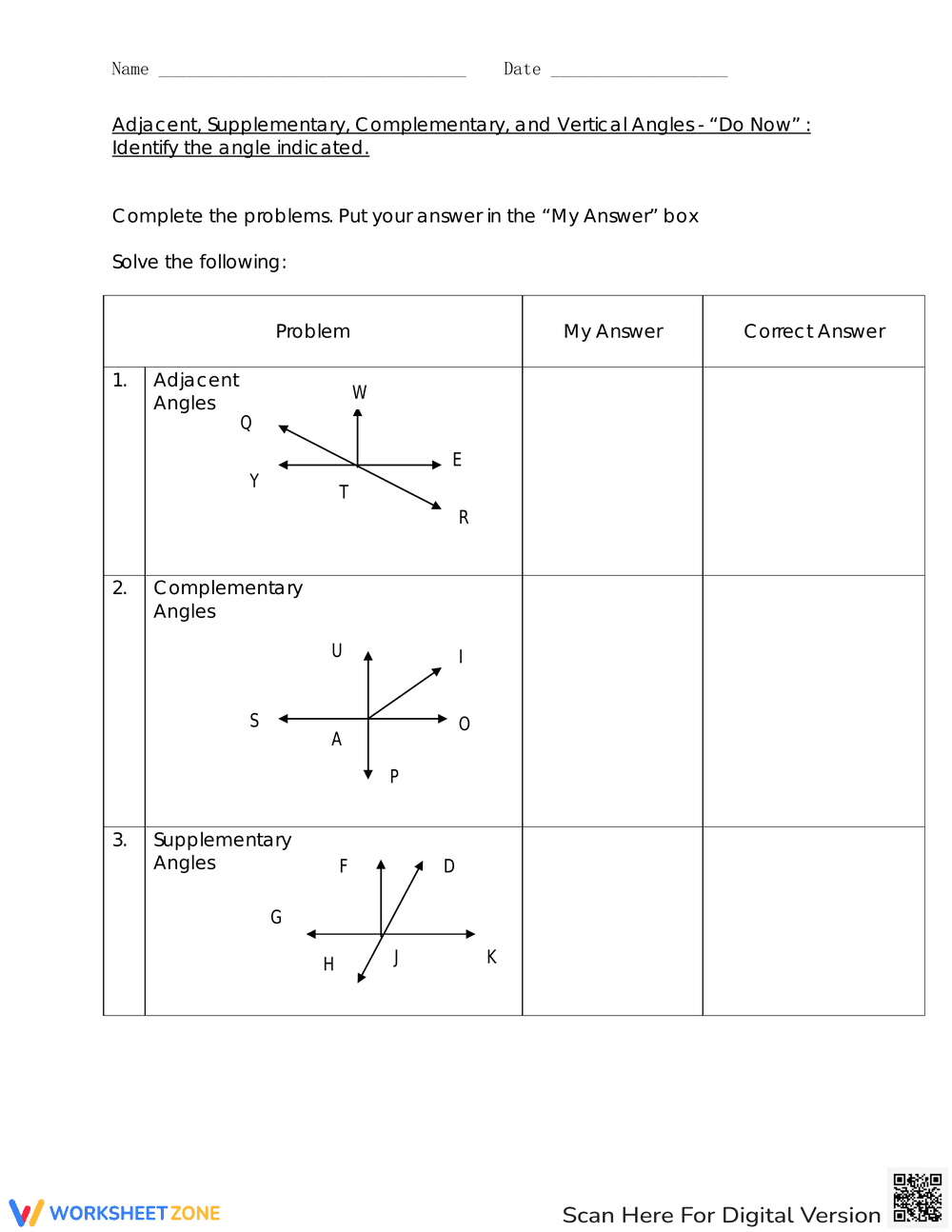
This is a geometry worksheet focusing on identifying different types of angles: adjacent, supplementary, and complementary. The worksheet presents diagrams of angles and asks the student to identify the specific angle indicated. There are three problems shown, one each for adjacent, complementary, and supplementary angles. The worksheet includes spaces for the student's answer and the correct answer.
Grade Level Suitability:
This worksheet is suitable for grades 6-8. It requires a basic understanding of geometric shapes and angle relationships, which are typically introduced in middle school mathematics.
Why Use It:
This worksheet helps students practice identifying and differentiating between adjacent, supplementary, and complementary angles. It reinforces the definitions of these angle types and improves students' visual recognition of them in diagrams. It also provides an opportunity for self-assessment, with space to compare their answer to the correct one.
How to Use It:
First, review the definitions of adjacent, supplementary, and complementary angles. Then, for each problem, examine the diagram and identify the type of angle shown. Write your answer in the 'My Answer' box. After completing the worksheet, check your answers against the 'Correct Answer' column (presumably to be filled in by the teacher or using an answer key).
Target Users:
This worksheet is designed for middle school students learning about geometry and angle relationships. It can be used by teachers as a classroom activity or homework assignment, or by students for self-study and review.
This is a geometry worksheet focusing on identifying different types of angles: adjacent, supplementary, and complementary. The worksheet presents diagrams of angles and asks the student to identify the specific angle indicated. There are three problems shown, one each for adjacent, complementary, and supplementary angles. The worksheet includes spaces for the student's answer and the correct answer.
Grade Level Suitability:
This worksheet is suitable for grades 6-8. It requires a basic understanding of geometric shapes and angle relationships, which are typically introduced in middle school mathematics.
Why Use It:
This worksheet helps students practice identifying and differentiating between adjacent, supplementary, and complementary angles. It reinforces the definitions of these angle types and improves students' visual recognition of them in diagrams. It also provides an opportunity for self-assessment, with space to compare their answer to the correct one.
How to Use It:
First, review the definitions of adjacent, supplementary, and complementary angles. Then, for each problem, examine the diagram and identify the type of angle shown. Write your answer in the 'My Answer' box. After completing the worksheet, check your answers against the 'Correct Answer' column (presumably to be filled in by the teacher or using an answer key).
Target Users:
This worksheet is designed for middle school students learning about geometry and angle relationships. It can be used by teachers as a classroom activity or homework assignment, or by students for self-study and review.


