


























Views
Plays

Essential Sketching and Dimensioning Guide | Grades 9-12
Paste this activity's link or code into your existing LMS (Google Classroom, Canvas, Teams, Schoology, Moodle, etc.).
Students can open and work on the activity right away, with no student login required.
You'll still be able to track student progress and results from your teacher account.
This comprehensive technical drawing worksheet provides high school students with focused practice on the critical standards of engineering communication. By identifying proper dimensioning styles and analyzing multi-view designs, learners develop the precision required for professional manufacturing specifications. Students will demonstrate mastery by recognizing line types and applying geometric dimensioning rules to complex isometric and orthographic sketches.
At a Glance
- Grade: 9–12 · Subject: Engineering / CTE
- Standard:
HS-ETS1-2— Design solutions by breaking down complex problems into manageable technical specifications- Skill Focus: Dimensioning and Sketching
- Format: 3 pages · 21 problems · Answer key included · PDF
- Best For: Engineering design and technical drawing assessments
- Time: 30–45 minutes
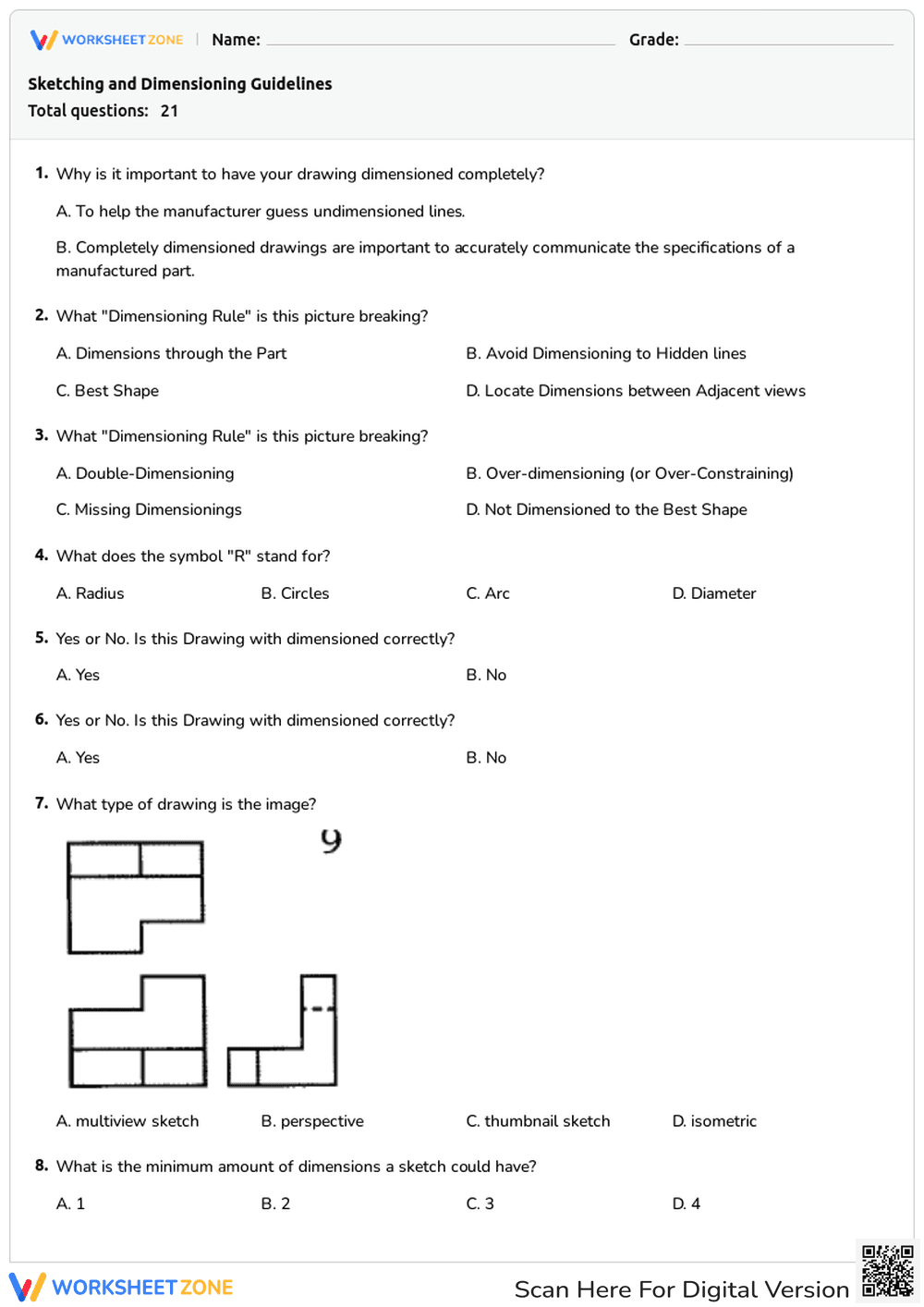
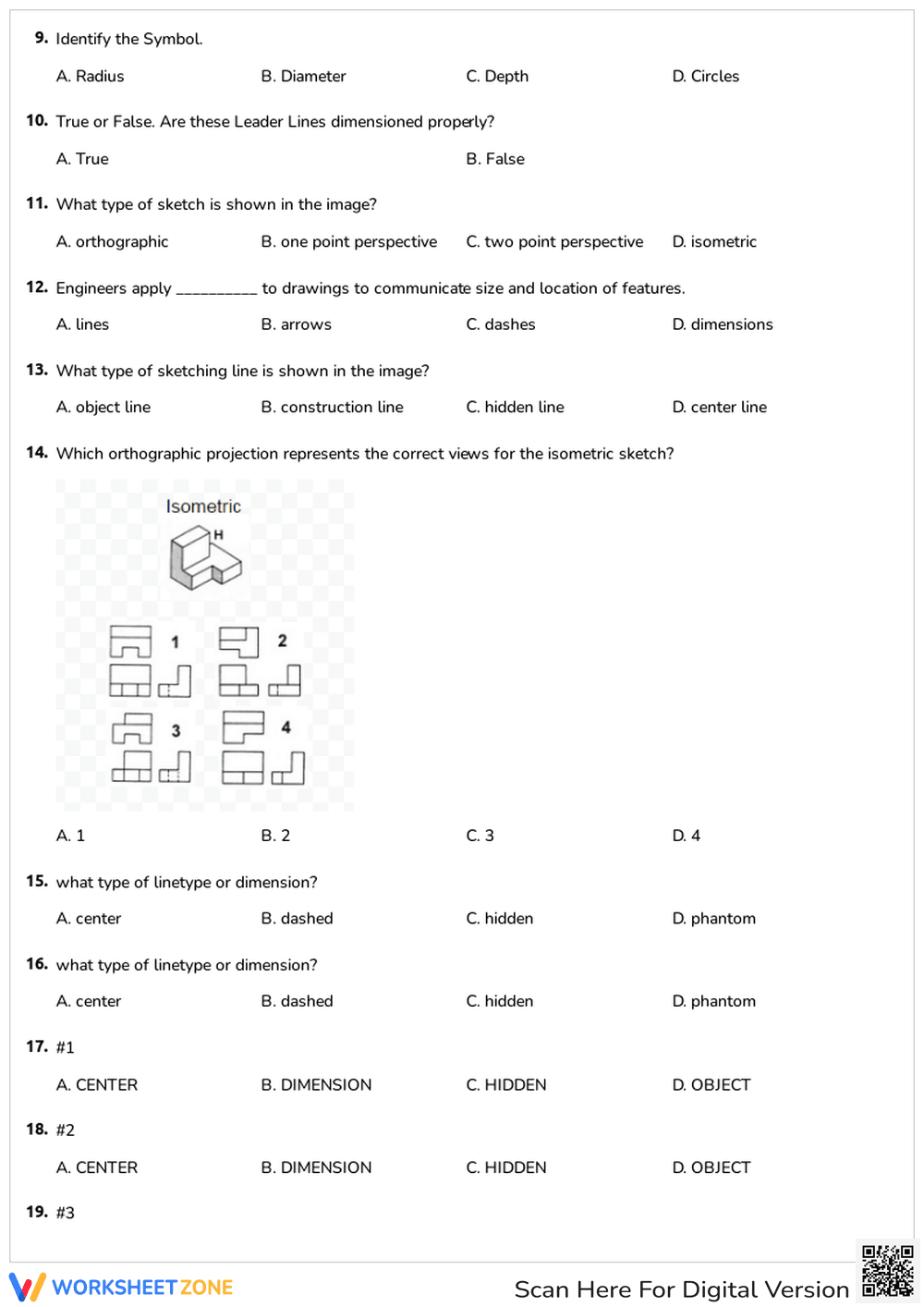
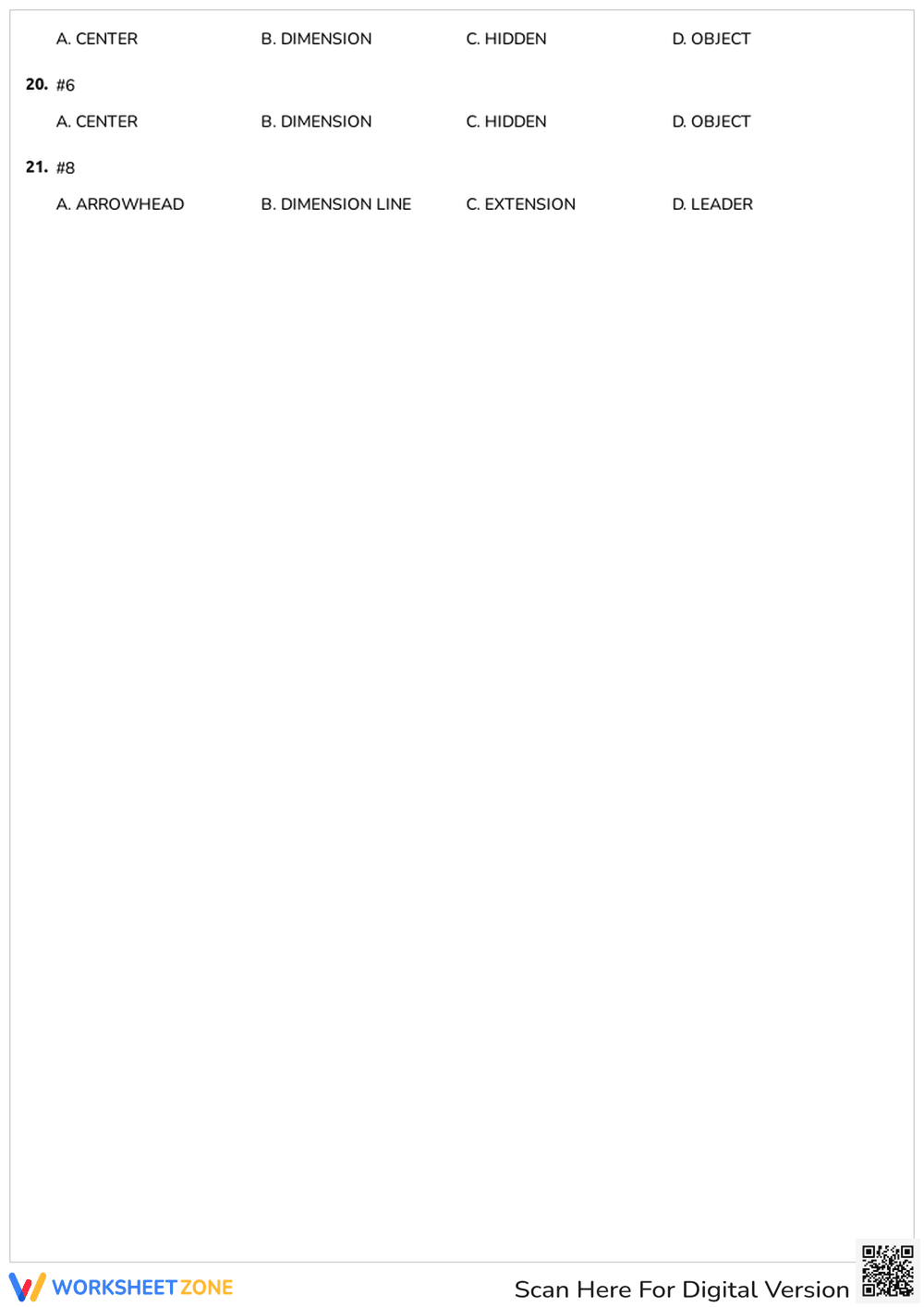
What's Inside: This three-page assessment features 21 multiple-choice questions designed to test both conceptual understanding and visual analysis. The worksheet includes detailed diagrams of isometric parts, multiview projections, and specific callouts for line types. Students must identify symbols for radius and diameter, distinguish between object and hidden lines, and select the correct orthographic views for given 3D shapes. A full answer key is provided for rapid grading.
Skill Progression
- Guided Practice: The initial section establishes the "why" behind technical standards, asking students to define the purpose of complete dimensioning in manufacturing (Questions 1-3).
- Supported Practice: Students transition to visual identification, using provided diagrams to name symbols like radius and diameter and identify specific line types such as leader and extension lines (Questions 4-13).
- Independent Practice: The final section requires high-level spatial reasoning, where students must match isometric sketches to their correct orthographic projections and identify rule violations in complex designs (Questions 14-21).
This structure follows a gradual-release model, moving from theoretical rules to practical visual application.
Standards Alignment: This resource is primarily aligned with `HS-ETS1-2`, focusing on the communication of design specifications. It also supports CCSS.ELA-LITERACY.RST.9-10.7 by requiring students to translate quantitative or technical information from visual sketches into conceptual conclusions. Both standard codes can be copied directly into lesson plans, IEP goals, or district curriculum mapping tools.
How to Use It: This worksheet is ideal as a formative assessment following a direct instruction lesson on manual drafting or CAD software basics. Assign it mid-unit to identify students struggling with spatial visualization before they begin independent design projects. For a quick check, observe student responses to the orthographic projection matching tasks; errors here often indicate a need for more hands-on 3D modeling practice. Expected completion time is 30 to 45 minutes.
Who It's For: This resource is designed for Grade 9-12 students in Career and Technical Education (CTE) pathways, including Engineering, Architecture, or Manufacturing. It provides excellent support for students preparing for industry certifications. This worksheet pairs naturally with a 3D modeling tutorial or an anchor chart detailing the alphabet of lines.
According to research by Fisher & Frey (2014), technical literacy in engineering requires students to move beyond simple identification to the synthesis of visual and textual data. This worksheet facilitates that transition by requiring students to apply the `HS-ETS1-2` standard through the analysis of 21 distinct technical scenarios. By evaluating dimensioning rules such as "avoiding hidden lines" and "locating dimensions between adjacent views," students build the foundational schema necessary for advanced CAD work. The inclusion of isometric-to-orthographic translation tasks directly addresses spatial reasoning gaps identified in recent NAEP technology and engineering literacy frameworks. This structured approach ensures that learners do not just memorize symbols but understand the logic of technical communication. This document serves as a reliable tool for measuring student readiness for complex engineering design challenges in a high school setting.


