


























Views
Downloads

Six Kingdoms Classification Worksheet | Grade 10 Printable
Paste this activity's link or code into your existing LMS (Google Classroom, Canvas, Teams, Schoology, Moodle, etc.).
Students can open and work on the activity right away, with no student login required.
You'll still be able to track student progress and results from your teacher account.
This Grade 10 biology worksheet helps students organize and compare the defining characteristics of the six biological kingdoms. By completing the structured table, learners will synthesize information about cell types, energy acquisition, and reproduction, building a strong foundation for advanced life science concepts.
At a Glance
- Grade: 10 · Subject: Biology
- Standard:
HS-LS4-1— Communicate scientific information about biological classification and ancestry.- Skill Focus: Classifying organisms by cellular traits
- Format: 2 pages · 30 problems · PDF
- Best For: Independent research or review
- Time: 20–30 minutes
What's Inside
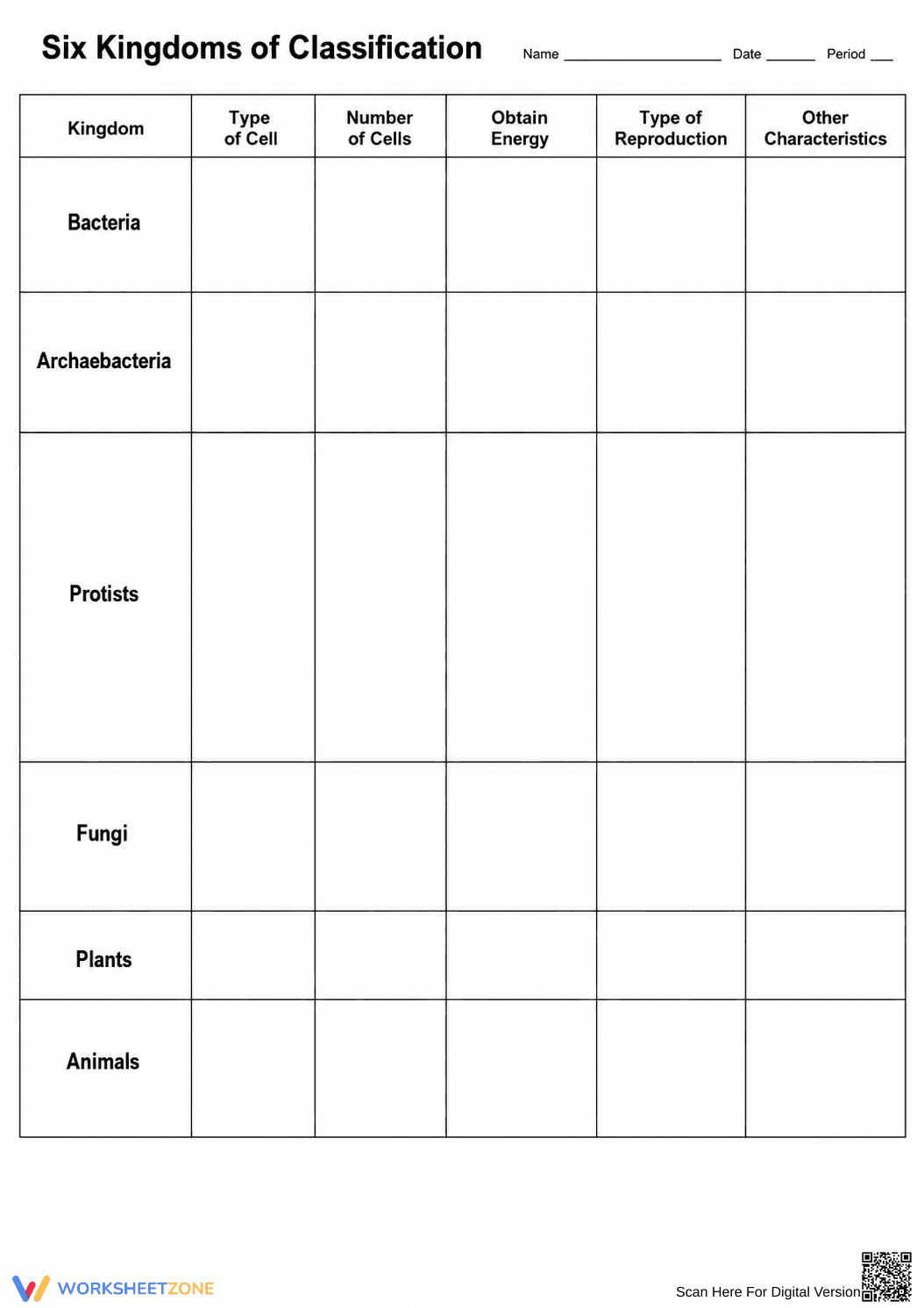
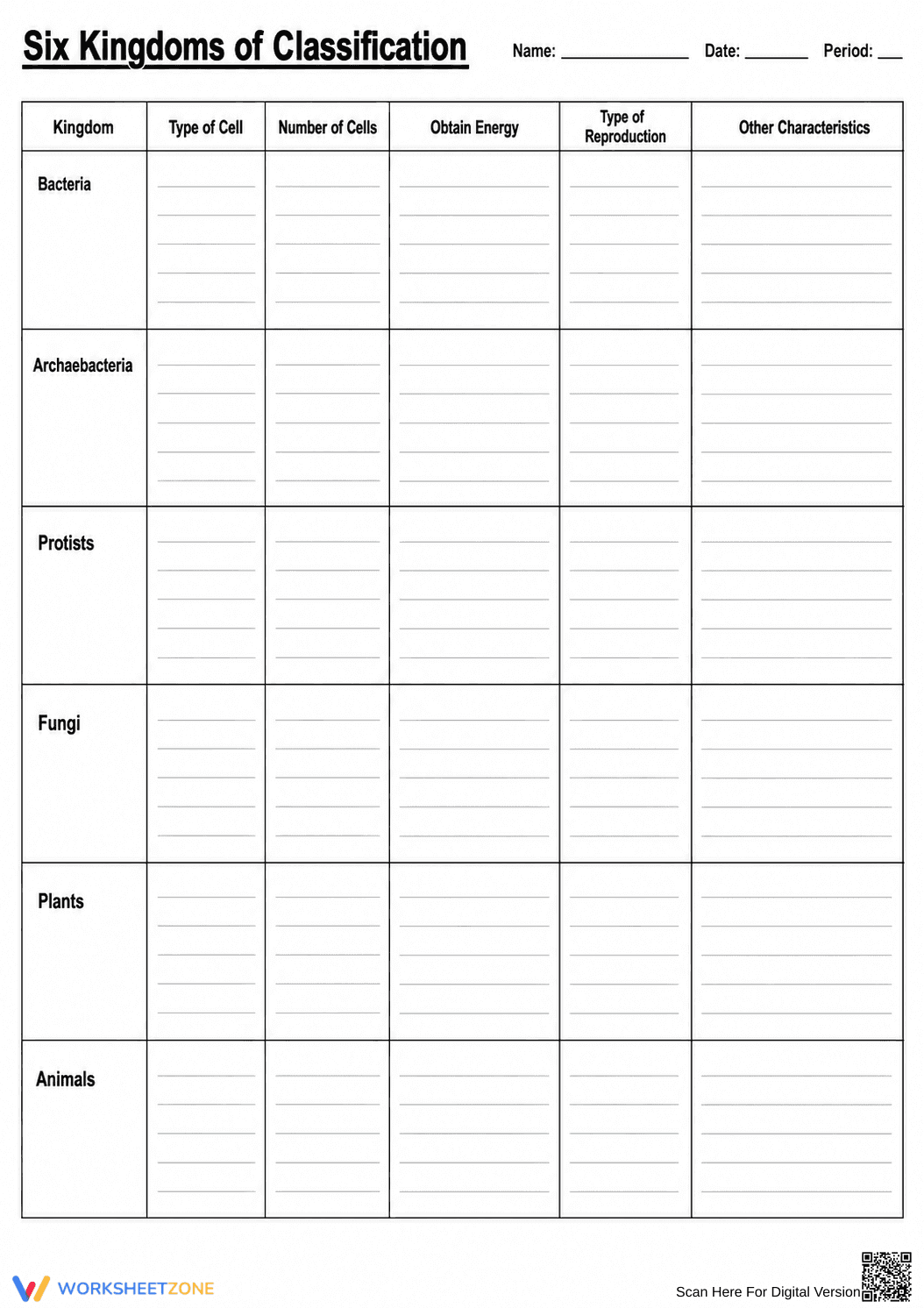
This resource features a comprehensive classification table spanning two pages. Students are tasked with filling in 30 specific data points across six rows (Bacteria, Archaebacteria, Protists, Fungi, Plants, and Animals) and five columns detailing cellular structure, cell number, energy sources, and reproductive methods. The clean, grid-based layout provides ample space for student writing.
Zero-Prep Workflow
- Print (1 min): Simply print the two-page PDF. No special formatting or cutting is required.
- Distribute (1 min): Hand out the tables alongside classroom textbooks or digital research devices.
- Review (5 mins): Go over the column headers to ensure students understand the specific biological terms required.
Total teacher prep time is under two minutes. This self-explanatory format makes it an ideal, stress-free addition to any biology sub plan.
Standards Alignment
Aligned to primary standard HS-LS4-1: Communicate scientific information that common ancestry and biological evolution are supported by multiple lines of empirical evidence. Understanding the distinct cellular and metabolic traits of the six kingdoms is essential for analyzing evolutionary relationships. Both standard codes can be copied directly into lesson plans, IEP goals, or district curriculum mapping tools.
How to Use It
Assign this table during direct instruction as a guided note-taking tool, allowing students to fill in each row as a new kingdom is introduced. Alternatively, use it as an independent research assignment where students must locate the required information using their textbooks or approved online databases. As a formative assessment tip, circulate the room and check the "Type of Cell" column early on to ensure students correctly distinguish between prokaryotic and eukaryotic organisms. Expected completion time is 20 to 30 minutes.
Who It's For
Designed for high school biology students, this worksheet is particularly helpful for visual learners who benefit from organizing complex data into structured categories. It pairs perfectly with an introductory lesson on taxonomy or a reading passage detailing the differences between prokaryotes and eukaryotes.
Mastering the classification of organisms into distinct groups based on cellular and metabolic characteristics is a fundamental component of high school life science education. According to a recent ScienceDirect TpT Analysis, utilizing structured graphic organizers and comparison tables significantly improves student retention of complex biological vocabulary and taxonomic hierarchies. When students actively research and categorize data rather than passively reading it, their cognitive engagement and long-term memory recall increase substantially. By aligning directly with HS-LS4-1 to communicate scientific information about biological classification and ancestry, this resource ensures students systematically process essential taxonomic data. This structured approach not only builds immediate content knowledge regarding prokaryotic and eukaryotic distinctions but also fosters the analytical skills necessary for deeper comprehension of evolutionary biology and common ancestry across all living systems.


