




























Views
Downloads




Printable Grade 1 Singular and Plural Verbs Worksheet

Paste this activity's link or code into your existing LMS (Google Classroom, Canvas, Teams, Schoology, Moodle, etc.).
Students can open and work on the activity right away, with no student login required.
You'll still be able to track student progress and results from your teacher account.
This Grade 1 grammar worksheet focuses on the fundamental concept of subject-verb agreement. Students learn to distinguish between singular and plural subjects and choose the corresponding verb form to complete sentences correctly. By mastering these early syntax rules, learners build a strong foundation for clear writing and effective communication in elementary English Language Arts.
At a Glance
- Grade: 1 · Subject: English Language Arts
- Standard:
CCSS.ELA-LITERACY.L.1.1.C— Use singular and plural nouns with matching verbs in basic sentences- Skill Focus: Subject-Verb Agreement
- Format: 4 pages · 10 problems · Answer key included · PDF
- Best For: Independent practice and grammar reinforcement
- Time: 15–20 minutes
What's Inside
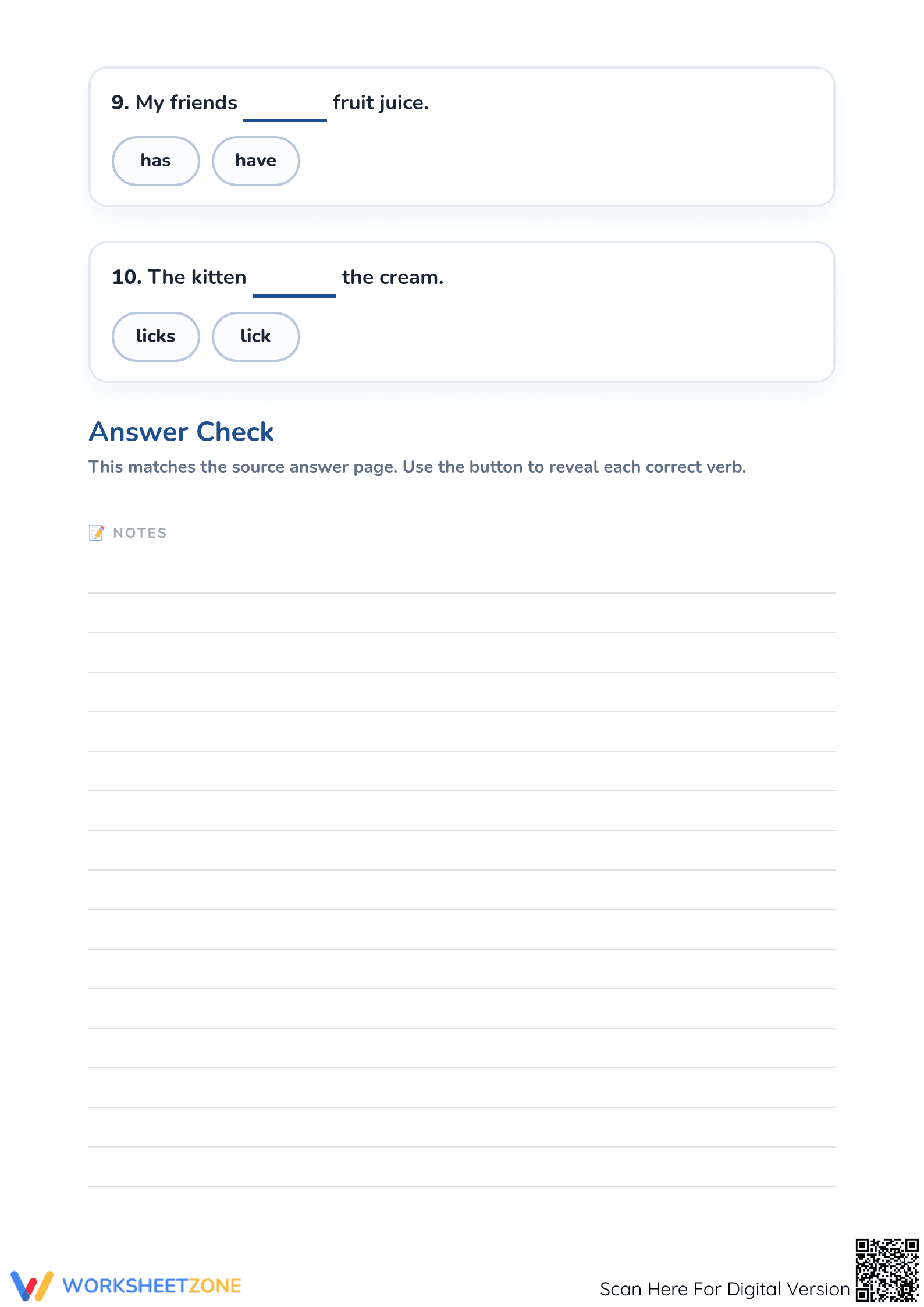
A detailed instruction page introduces singular and plural subjects with clear examples like "walks" versus "walk." The practice section contains 10 structured sentences where students select the correct verb from a multiple-choice bubble format. A dedicated "Answer Check" page provides a space for students to reflect on their work, while the final page contains a complete answer key with subject clues for teacher review or student self-correction.
Zero-Prep Workflow
This worksheet is designed for immediate classroom implementation with zero teacher preparation required.
- Print: Send the PDF to the printer and select the pages you need for your students (2 minutes).
- Distribute: Hand out the practice sheets during your grammar block or as a morning work assignment (1 minute).
- Review: Use the provided answer key to grade student work or display it on a screen for a quick whole-class check (2 minutes).
Standards Alignment
The primary focus of this activity is CCSS.ELA-LITERACY.L.1.1.C, which requires students to use singular and plural nouns with matching verbs in basic sentences. By practicing with common subjects and everyday actions, students internalize the "s" ending rule for singular third-person verbs. This alignment ensures that the material meets district expectations for first-grade language standards.
How to Use It
This resource is most effective when used as a formative assessment after an initial lesson on verbs. Teachers can distribute the worksheet to check for understanding before moving on to more complex sentence structures. During the activity, observe students as they complete the first few problems to identify any confusion between noun plurals and verb endings.
Who It's For
This worksheet is specifically tailored for first-grade students who are developing their foundational grammar skills. It is also suitable for English Language Learners (ELL) who need extra practice with English syntax and subject-verb agreement. The large text and clear visual cues support students with various learning needs. This resource pairs naturally with a short reading passage or an anchor chart displayed in the classroom.
According to the RAND AIRS 2024 report on elementary literacy, early mastery of foundational grammar rules like subject-verb agreement is a significant predictor of later writing proficiency and reading comprehension success. This worksheet aligns with the instructional shifts identified by EdReports 2024, emphasizing the importance of explicit, systematic practice in language conventions for primary learners. By targeting CCSS.ELA-LITERACY.L.1.1.C, educators provide students with the structural tools necessary to construct coherent sentences. Research by Fisher & Frey (2014) on the gradual release of responsibility supports the use of scaffolded practice like the multiple-choice format provided here to move students from guided instruction to independent mastery. This resource ensures that Grade 1 students receive the focused repetition required to internalize English syntax patterns, making it a valuable addition to any evidence-based literacy curriculum. The inclusion of a clear answer key allows for immediate feedback, which is critical for correcting misconceptions in the early stages of language acquisition.


