




























Views
Downloads

Subject-Verb Agreement Worksheet | Grade 1 Essential

Paste this activity's link or code into your existing LMS (Google Classroom, Canvas, Teams, Schoology, Moodle, etc.).
Students can open and work on the activity right away, with no student login required.
You'll still be able to track student progress and results from your teacher account.
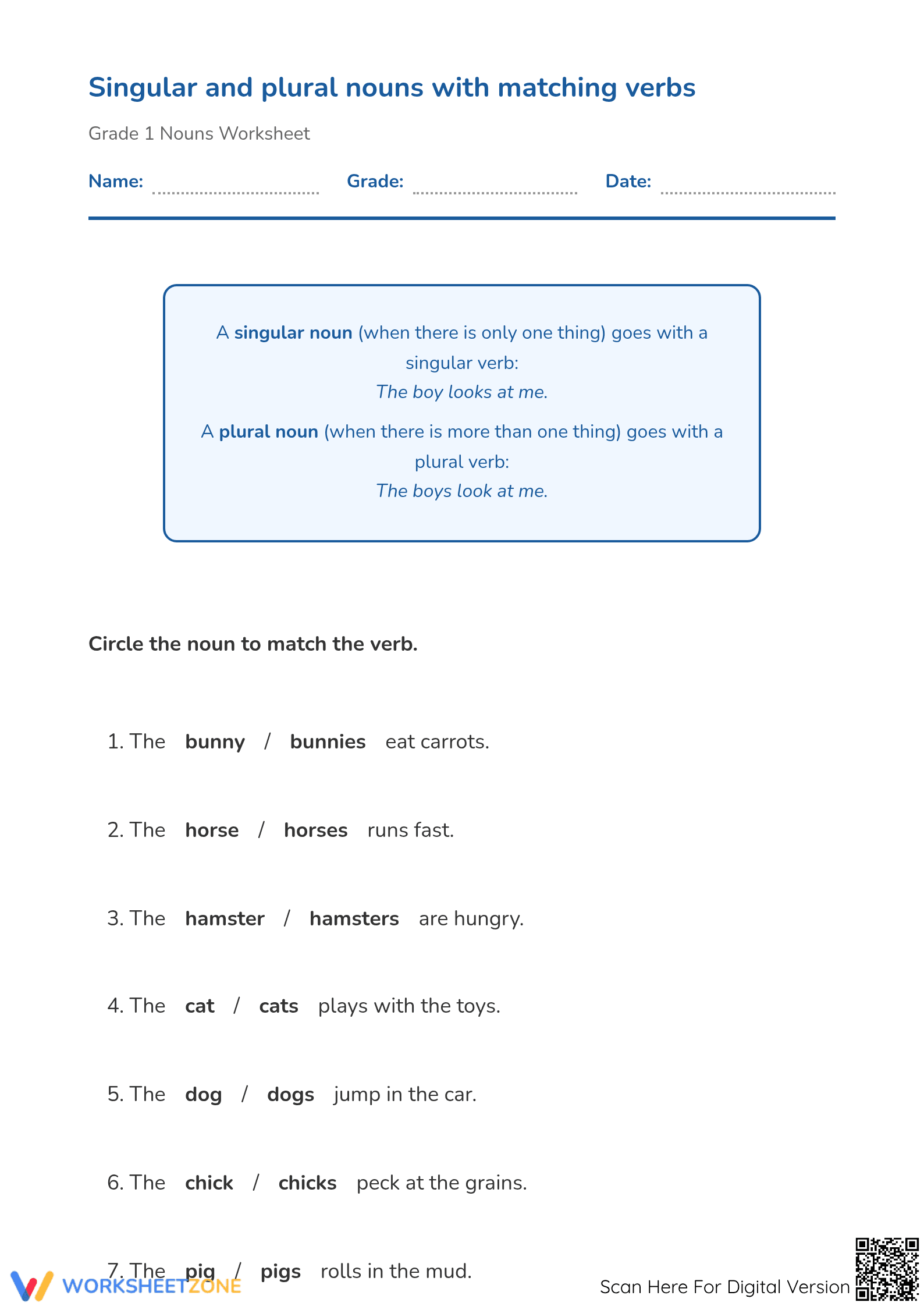
This Grade 1 ELA worksheet focuses on subject-verb agreement by requiring students to identify whether a singular or plural noun correctly matches a provided verb. By practicing these 10 targeted sentences, learners develop a foundational understanding of sentence structure and grammatical consistency, ensuring their writing and speaking remain clear and accurate.
At a Glance
- Grade: 1 · Subject: ELA
- Standard:
CCSS.ELA-LITERACY.L.1.1.C— Use singular and plural nouns with matching verbs in basic sentences- Skill Focus: Subject-verb agreement
- Format: 2 pages · 10 problems · Answer key included · PDF
- Best For: Independent grammar practice and formative assessment
- Time: 10–15 minutes
Inside this two-page PDF, you will find a clear instructional header that defines singular and plural noun-verb pairings with illustrative examples. The main activity consists of 10 sentence-completion tasks where students circle the correct noun form. A comprehensive answer key is provided to facilitate quick grading or student self-correction.
- Guided practice: The worksheet begins with a visual anchor box explaining the relationship between noun quantity and verb form.
- Supported practice: Students encounter 10 sentences with binary choices (e.g., bunny/bunnies), reducing cognitive load while focusing on the specific grammatical rule.
- Independent practice: Learners apply the rule across various animal-themed contexts to demonstrate mastery of the singular/plural distinction.
This resource follows a gradual-release model to build student confidence in identifying correct grammatical subjects through an I Do, We Do, You Do approach.
Standards Alignment
This resource is specifically aligned to CCSS.ELA-LITERACY.L.1.1.C, which requires students to use singular and plural nouns with matching verbs in basic sentences. It also supports general language conventions for early elementary writers. Both standard codes can be copied directly into lesson plans, IEP goals, or district curriculum mapping tools.
How to Use It
Use this worksheet as a quick check following a mini-lesson on pluralization. It is also effective as a morning work assignment to reinforce previous instruction. Teachers should observe if students are looking at the verb ending (like the "s" in "runs") to determine their choice. Completion typically takes 10 to 15 minutes.
Who It's For
This activity is designed for first-grade students or English Language Learners (ELL) who need targeted practice with subject-verb agreement. It pairs naturally with a classroom anchor chart on "The S-Ending Rule" for verbs or a shared reading passage where students hunt for matching subjects and verbs.
Subject-verb agreement is a critical milestone in early literacy development, as noted in the Fisher & Frey (2014) framework for purposeful instruction. This worksheet addresses CCSS.ELA-LITERACY.L.1.1.C by providing 10 structured opportunities for students to recognize how noun plurality dictates verb form. Research from the NAEP suggests that early mastery of these foundational grammar rules correlates with higher writing proficiency in later elementary years. By isolating the noun choice, this resource reduces extraneous variables, allowing Grade 1 learners to focus exclusively on the linguistic logic of matching subjects to verbs. The inclusion of a clear instructional model and an answer key ensures that the practice is both effective and efficient for classroom environments. This targeted approach helps solidify the mental schema required for automaticity in sentence construction, a key component of the Science of Reading's language structures domain.


