


























Views
Downloads
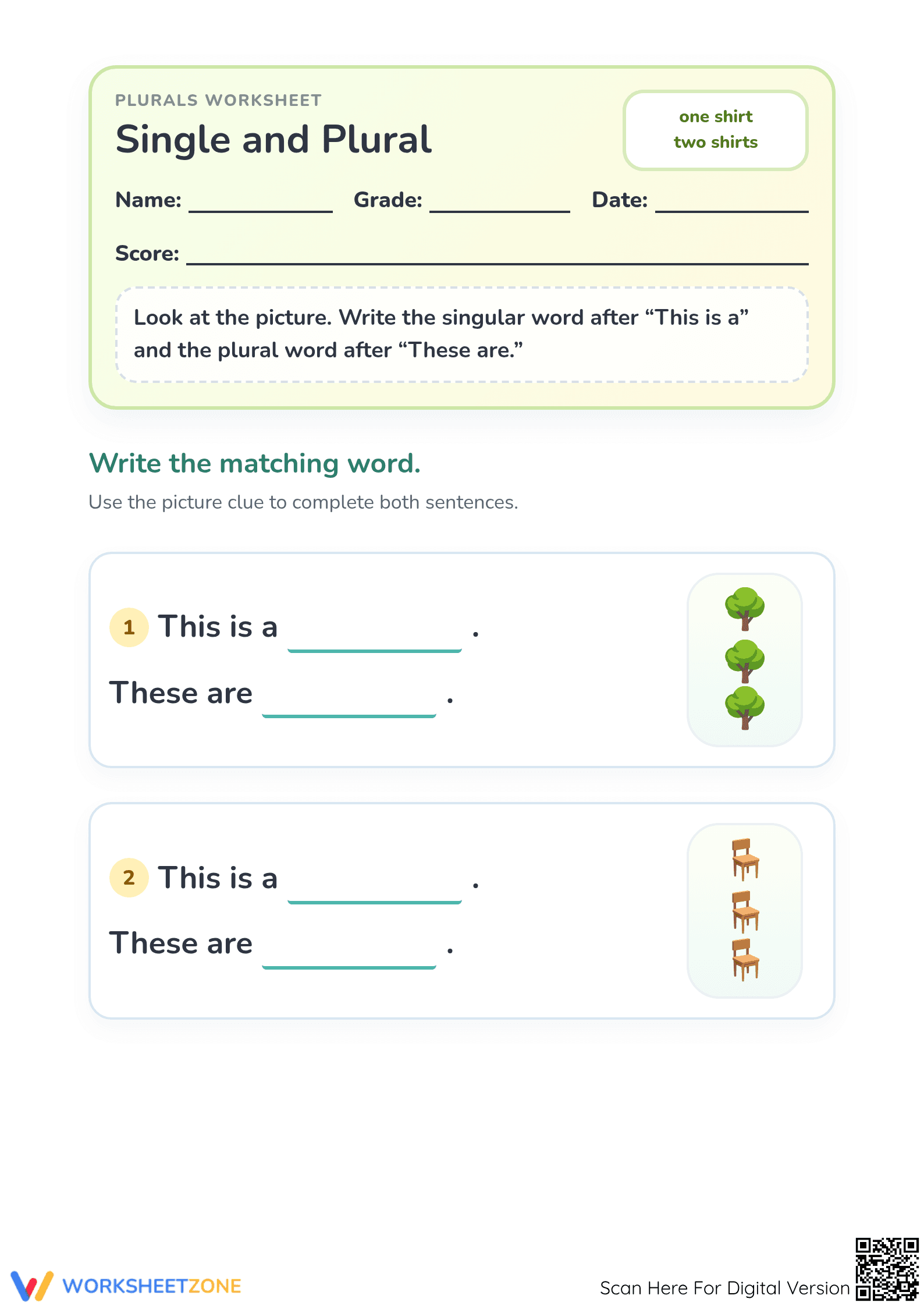


Essential Singular and Plural Nouns Worksheet | Grade K
Paste this activity's link or code into your existing LMS (Google Classroom, Canvas, Teams, Schoology, Moodle, etc.).
Students can open and work on the activity right away, with no student login required.
You'll still be able to track student progress and results from your teacher account.
This Kindergarten singular and plural nouns worksheet helps early learners distinguish between one and many using clear visual prompts. Students practice writing regular plural forms by adding the "s" suffix within structured sentence frames. This resource ensures students build a solid foundation in lexical word classes through repetitive, high-success tasks that bridge the gap between seeing and writing.
At a Glance
- Grade: Kindergarten · Subject: ELA
- Standard:
CCSS.ELA-LITERACY.L.K.1.C— Form regular plural nouns by adding /s/ or /es/ to words- Skill Focus: Regular plural noun formation
- Format: 2 pages · 3 problems · Answer key included · PDF
- Best For: Independent practice or morning work
- Time: 10–15 minutes
The packet contains 2 pages featuring 3 distinct image-based tasks. Each task provides a singular and plural set of objects, including trees, chairs, and lemons. Students complete the sentences "This is a..." and "These are..." to demonstrate their understanding of noun quantity and sentence agreement. A full answer key is provided to facilitate quick grading or student self-correction.
This resource is designed for a zero-prep workflow. First, print the 2-page PDF in less than 30 seconds. Second, distribute the sheets to students for independent or guided practice during your literacy block. Third, review the completed sentences using the included answer key in under 2 minutes. It is an ideal solution for busy teachers needing high-quality morning work or emergency sub plans.
This worksheet is aligned to CCSS.ELA-LITERACY.L.K.1.C: "Form regular plural nouns orally by adding /s/ or /es/ (e.g., dog, dogs; wish, wishes)." While the standard emphasizes oral production, this written practice reinforces the phonological and orthographic connection necessary for reading fluency. Both standard codes can be copied directly into lesson plans, IEP goals, or district curriculum mapping tools.
Use this during the "You Do" phase of a gradual release lesson on plurals. It works best after students have practiced identifying "more than one" with physical classroom manipulatives. Teachers can use the "These are..." sentence frame as a formative assessment check to see if students correctly apply the "s" ending. Expected completion time ranges from 10 to 15 minutes depending on writing speed.
This worksheet is tailored for Kindergarten students and Preschoolers ready for early literacy challenges. It is particularly effective for English Language Learners (ELLs) who need visual support to understand grammatical number and sentence structure. Pair this with a "Singular vs. Plural" anchor chart or a direct instruction lesson on word endings for maximum instructional impact.
According to the RAND AIRS 2024 report on early literacy interventions, visual scaffolding in grammar instruction significantly improves the retention of morphological rules among Kindergarten students. This worksheet targets CCSS.ELA-LITERACY.L.K.1.C by requiring students to transform singular nouns into regular plurals using clear pictorial evidence. By providing the "This is a" and "These are" sentence frames, the resource reduces cognitive load, allowing students to focus specifically on the lexical change from singular to plural. Research indicates that structured repetition of these word classes helps solidify the concept of plurality before students encounter complex irregular forms. This printable resource provides 3 high-quality tasks that serve as measurable evidence of student mastery. Educators can confidently integrate this tool into their curriculum mapping, knowing it aligns with evidence-based practices for early language acquisition and foundational writing skills.


