


























Views
Downloads


Essential Main Idea Worksheet | Grade 5-6 Reading
Paste this activity's link or code into your existing LMS (Google Classroom, Canvas, Teams, Schoology, Moodle, etc.).
Students can open and work on the activity right away, with no student login required.
You'll still be able to track student progress and results from your teacher account.
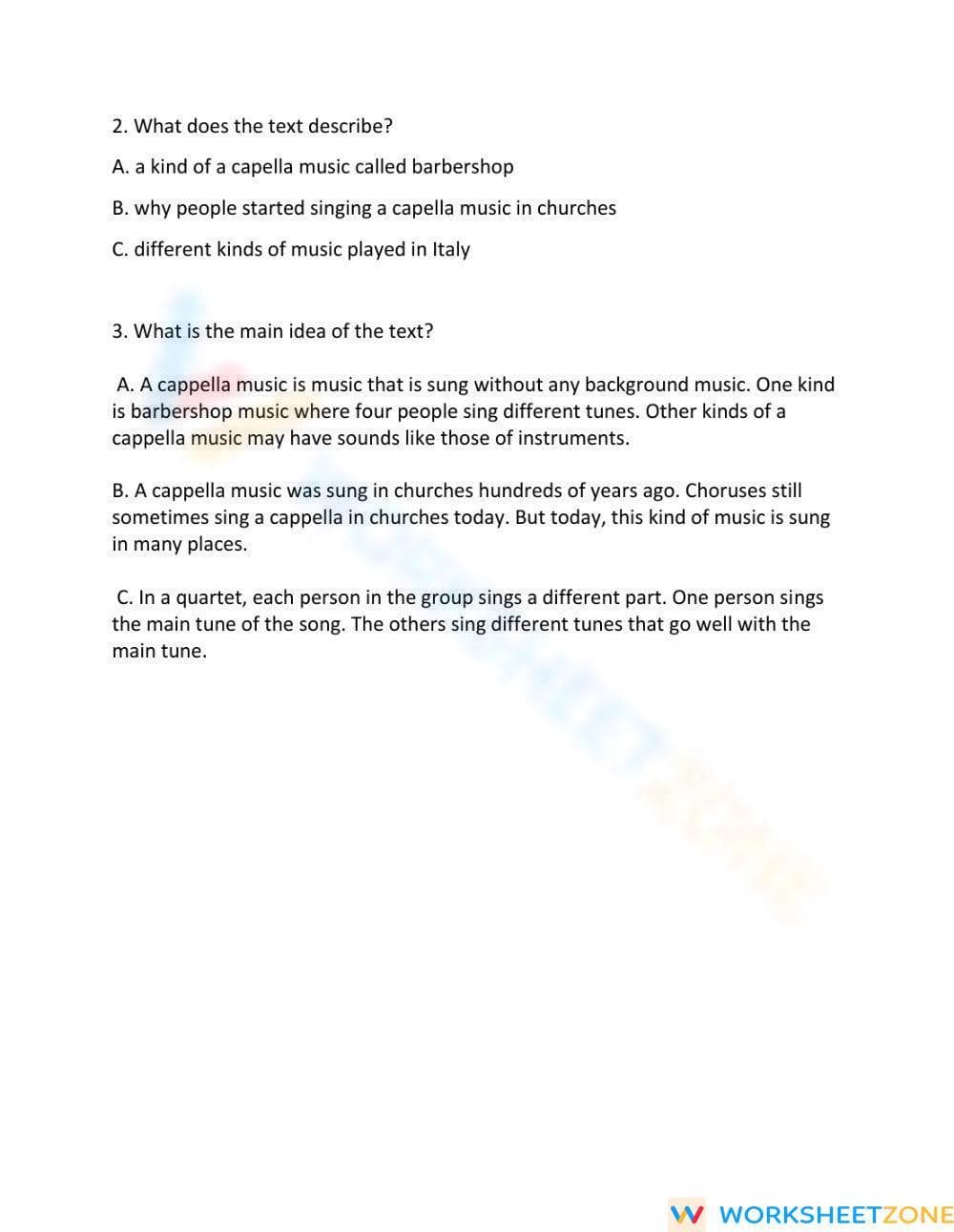
This reading comprehension worksheet helps students identify the central message and supporting evidence within an informational text. By analyzing a passage about a cappella music, learners practice distinguishing between interesting facts and the primary thesis. This resource ensures students can synthesize information to determine the most important points of a non-fiction selection.
At a Glance
- Grade: 5-6 · Subject: ELA
- Standard:
CCSS.ELA-LITERACY.RI.5.2— Determine main ideas of a text and explain how details support them- Skill Focus: Main Idea & Supporting Details
- Format: 2 pages · 3 problems · Answer key included · PDF
- Best For: Formative assessment of reading comprehension skills
- Time: 15–20 minutes
What's Inside
This resource features an engaging informational passage titled "Singing Without Instruments." It explores the history of a cappella music and the specific structure of barbershop quartets. Following the text, students encounter three targeted multiple-choice questions designed to test vocabulary in context, structural understanding, and the ability to select the most comprehensive summary of the text's main idea.
Skill Progression
- Guided Practice: Students engage in a structured reading of the passage, which uses clear paragraph breaks to signal shifts in sub-topics.
- Supported Practice: Learners answer specific questions about definitions and text descriptions to build a foundation for synthesis.
- Independent Practice: The final task requires students to evaluate three different summaries to identify the one that best captures the overarching main idea.
This gradual-release approach builds student confidence in text analysis through a clear I Do, We Do, You Do instructional sequence.
Standards Alignment
This resource is specifically aligned to `CCSS.ELA-LITERACY.RI.5.2`, which requires students to determine two or more main ideas of a text and explain how they are supported by key details. It also supports RI.6.2 by asking students to provide a summary of the text distinct from personal opinions or judgments. Both standard codes can be copied directly into lesson plans, IEP goals, or district curriculum mapping tools.
How to Use It
Use this worksheet as a mid-lesson check for understanding after introducing the concept of main idea versus supporting details. It works well as a formative assessment; teachers should observe if students can differentiate between a specific detail about barbershop quartets and the broader definition of a cappella music. Expect students to complete the reading and questions within 15 to 20 minutes.
Who It's For
This material is designed for 5th and 6th-grade students working on informational text standards. It is also an excellent resource for English Language Learners (ELLs) due to the clear, descriptive language and the inclusion of Italian musical terms with immediate definitions. Pair this with a short audio clip of a cappella music to provide a multi-sensory learning experience.
According to the RAND AIRS 2024 report on literacy instruction, providing students with short, high-interest informational texts is a critical component of developing reading stamina and comprehension mastery. This worksheet addresses the CCSS.ELA-LITERACY.RI.5.2 standard by requiring students to synthesize information about musical history and technique into a cohesive main idea. Research indicates that structured multiple-choice questions, when paired with evidence-based passages, allow educators to quickly identify gaps in a student's ability to distinguish between primary themes and secondary supporting details. By focusing on the specific student action of summarizing non-fiction content, this resource aligns with best practices for middle-grade ELA instruction. Educators can use the results of this 3-task assessment to inform small-group interventions or to document progress toward specific literacy benchmarks in standardized testing environments.


