


























Views
Downloads


Essential Simplifying Exponents Worksheet | Grade 6-8 Math
Paste this activity's link or code into your existing LMS (Google Classroom, Canvas, Teams, Schoology, Moodle, etc.).
Students can open and work on the activity right away, with no student login required.
You'll still be able to track student progress and results from your teacher account.
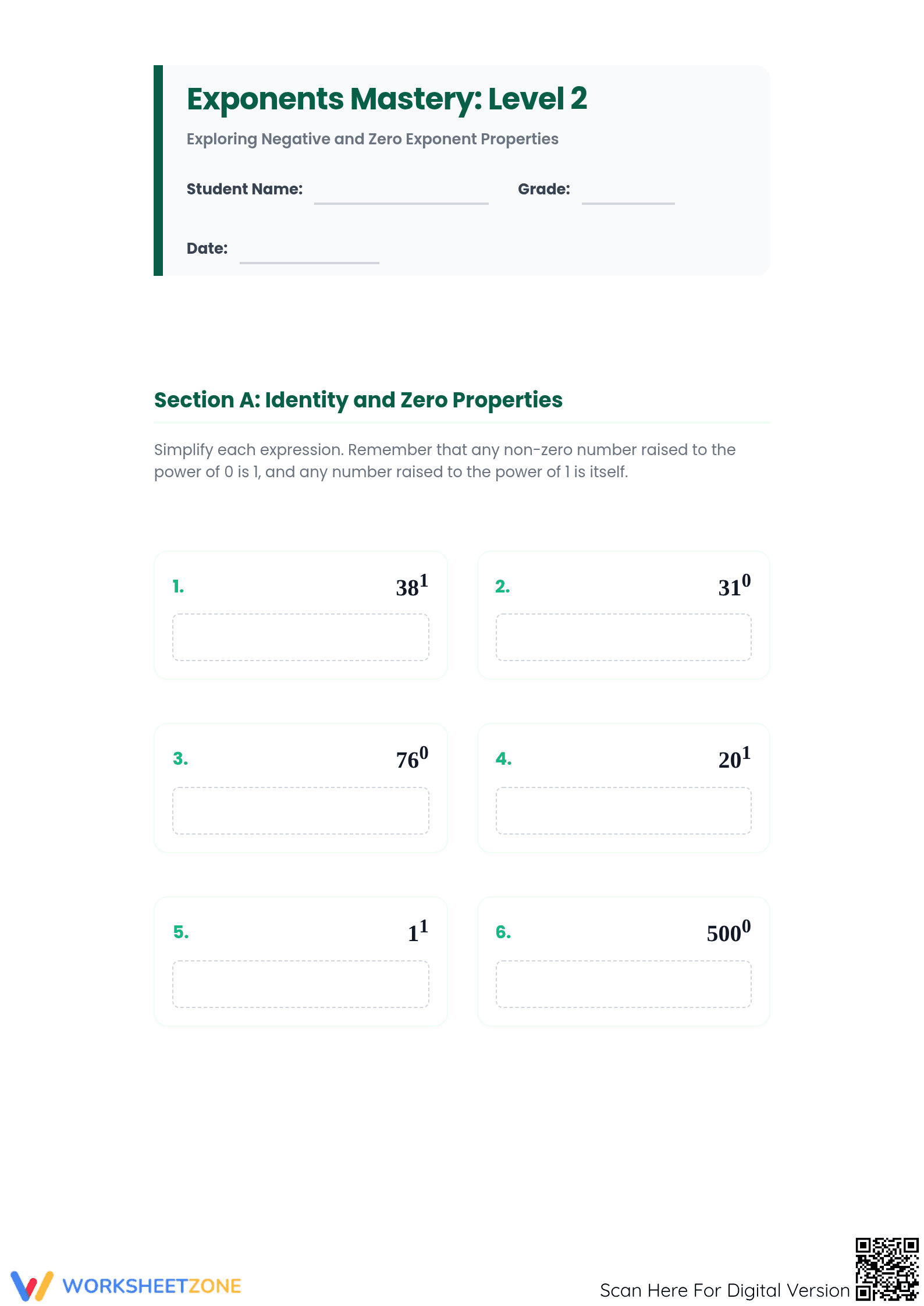
Mastering the properties of exponents is a foundational skill for middle school algebra. This comprehensive 5-page worksheet provides students with targeted practice in simplifying expressions involving zero, identity, and negative exponents. By converting complex exponential forms into whole numbers or fractions, students build the procedural fluency necessary for higher-level mathematics.
At a Glance
- Grade: 6–8 · Subject: Math
- Standard:
CCSS.MATH.CONTENT.8.EE.A.1— Apply integer exponent properties to generate equivalent numerical expressions- Skill Focus: Zero, identity, and negative exponent rules
- Format: 5 pages · 40 problems · Answer key included · PDF
- Best For: Homework, independent practice, or sub plans
- Time: 30–45 minutes
What's Inside
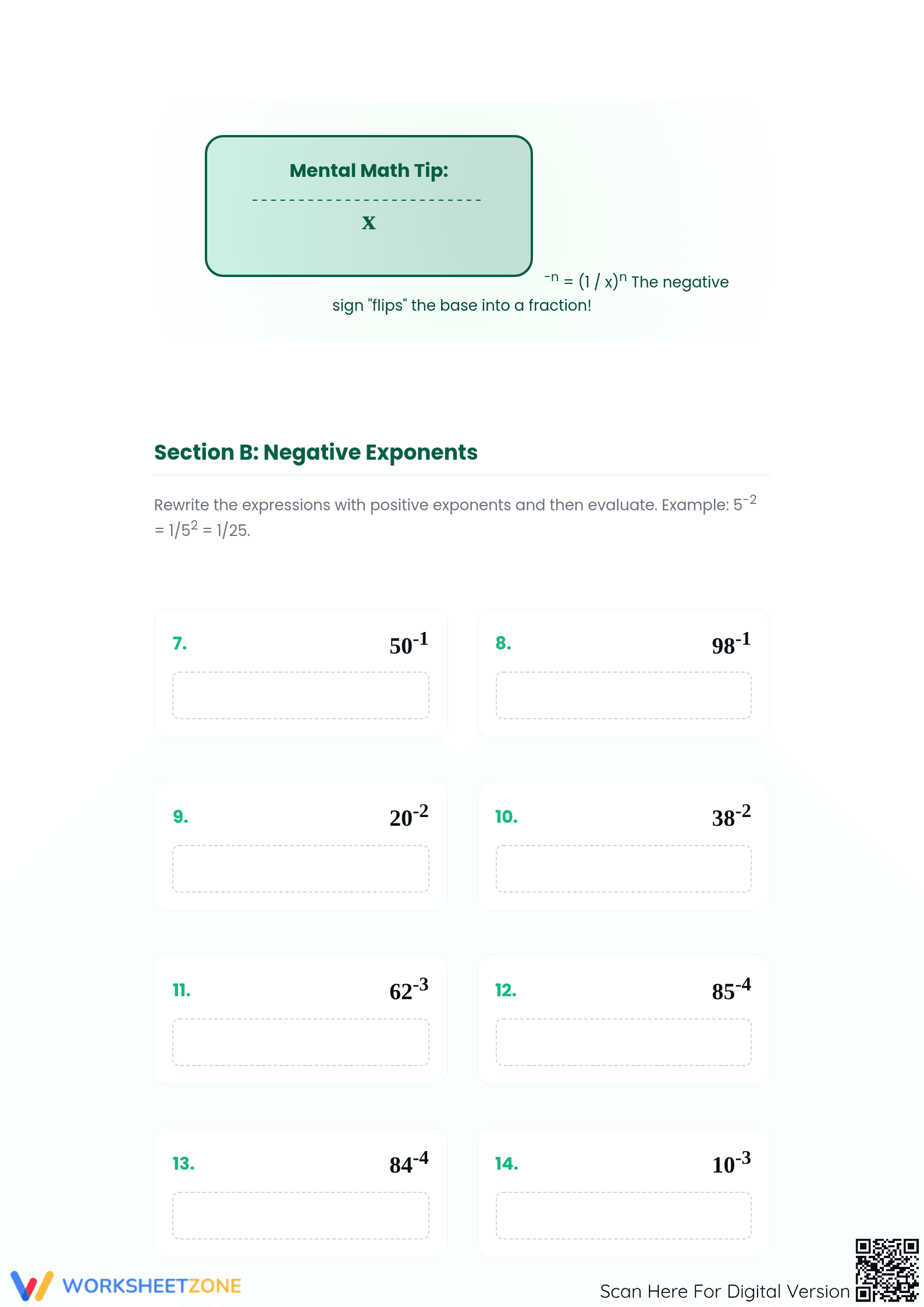
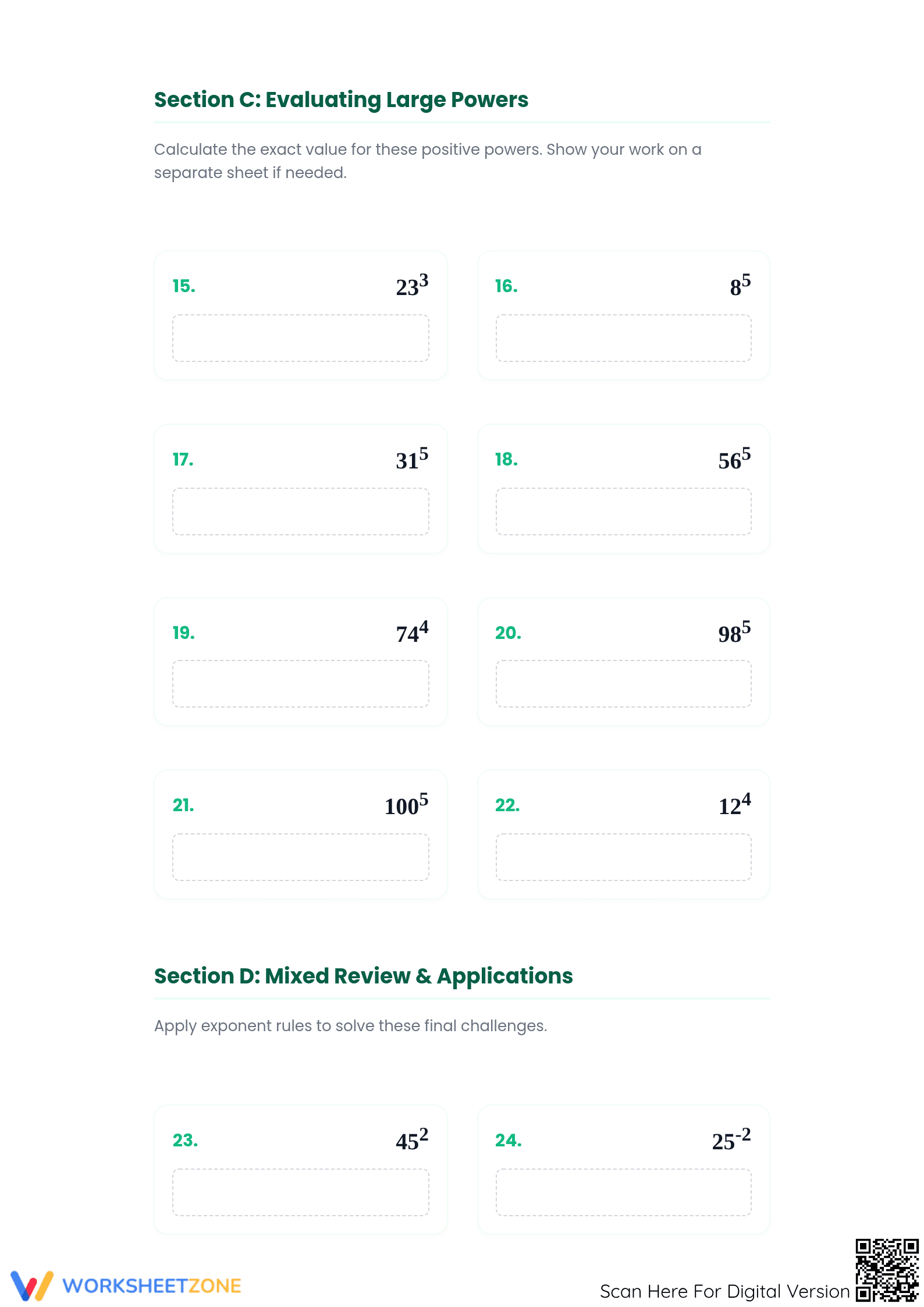
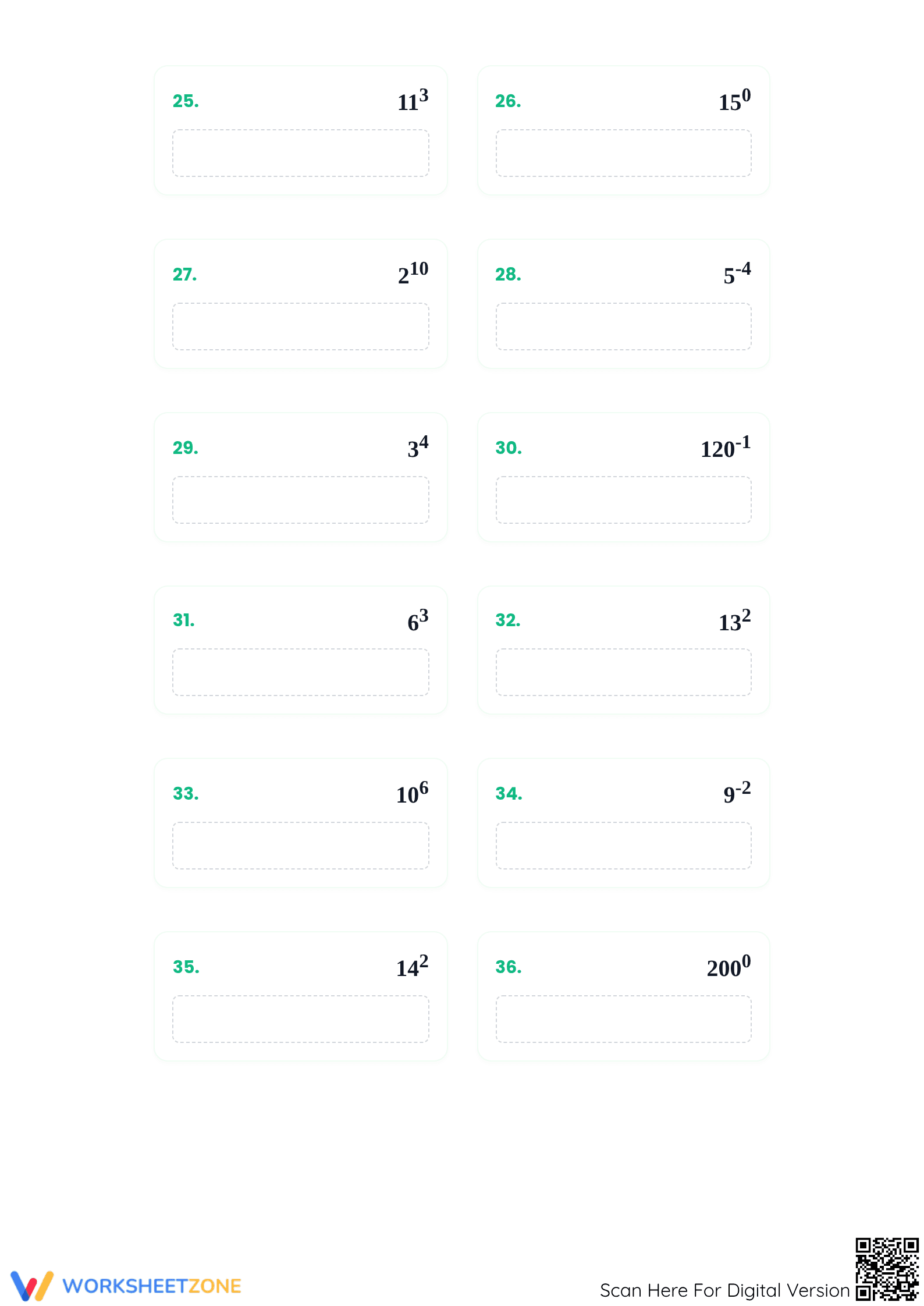
This practice set contains 40 unique problems spread across five structured pages. The layout includes a dedicated section for identity and zero properties, a focus on negative exponents with a "Mental Math Tip" box, and a challenging section for evaluating large powers. A mixed review section at the end ensures students can synthesize multiple rules. Each problem provides a clear workspace, and a complete answer key is provided for rapid grading.
Zero-Prep Workflow
Designed for the busy educator, this resource requires minimal preparation to implement.
- Print (1 minute): Select the pages you need and print enough copies for your class. No collating or complex folding required.
- Distribute (30 seconds): Hand out the worksheets as a warm-up, main activity, or exit ticket. The self-contained instructions allow students to start immediately.
- Review (30 seconds): Use the included answer key to check for accuracy or allow students to self-correct their work, reducing your grading load significantly.
Standards Alignment
The content is strictly aligned to CCSS.MATH.CONTENT.8.EE.A.1, which requires students to know and apply the properties of integer exponents to generate equivalent numerical expressions. It also supports CCSS.MATH.CONTENT.6.EE.A.1 by introducing numerical expressions with whole-number exponents. Both standard codes can be copied directly into lesson plans, IEP goals, or district curriculum mapping tools.
How to Use It
Use this worksheet as a summative assessment after direct instruction on exponent properties to gauge individual student mastery. Alternatively, assign specific sections as a "Do Now" activity to reinforce previous lessons. For formative assessment, observe students during Section B (negative exponents) to see if they correctly apply the reciprocal rule, providing immediate corrective feedback where necessary.
Who It's For
This resource is ideal for Grade 6, 7, and 8 students who are developing their algebraic thinking. It serves as an excellent remediation tool for high school students who need to refresh their exponent rules. Pair this worksheet with an interactive anchor chart or a short video lesson on negative exponents to provide a multi-modal learning experience. It is particularly effective for students who benefit from repetitive, structured practice sets.
The systematic approach to exponent properties featured in this resource aligns with the CCSS.MATH.CONTENT.8.EE.A.1 standard, ensuring that middle school learners develop the fluency required for algebraic success. According to the RAND AIRS 2024 report, high-quality, standards-aligned practice materials are essential for closing achievement gaps in mathematics, particularly in high-stakes topics like integer operations and powers. By providing 40 structured problems that progress from identity properties to complex negative exponents, this worksheet facilitates the gradual release of responsibility. Students transition from guided examples to independent evaluation of large powers, reinforcing their understanding of how exponents manipulate base numbers. This deliberate practice helps cement the "flip the base" rule for negative exponents, a common stumbling block identified in national assessments. Such targeted resources allow educators to implement evidence-based instructional strategies while maintaining a zero-prep classroom environment.


