


























Views
Downloads
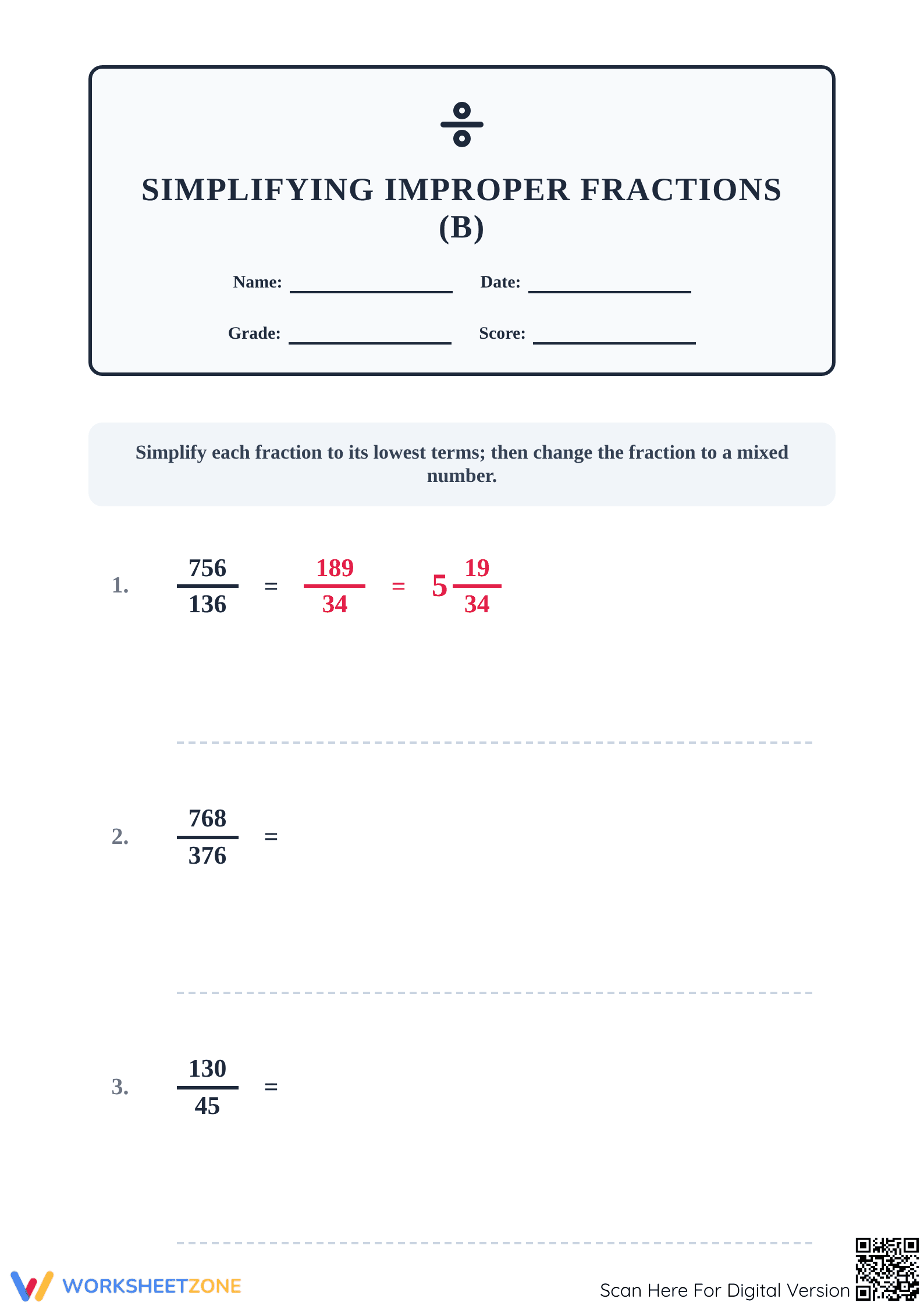


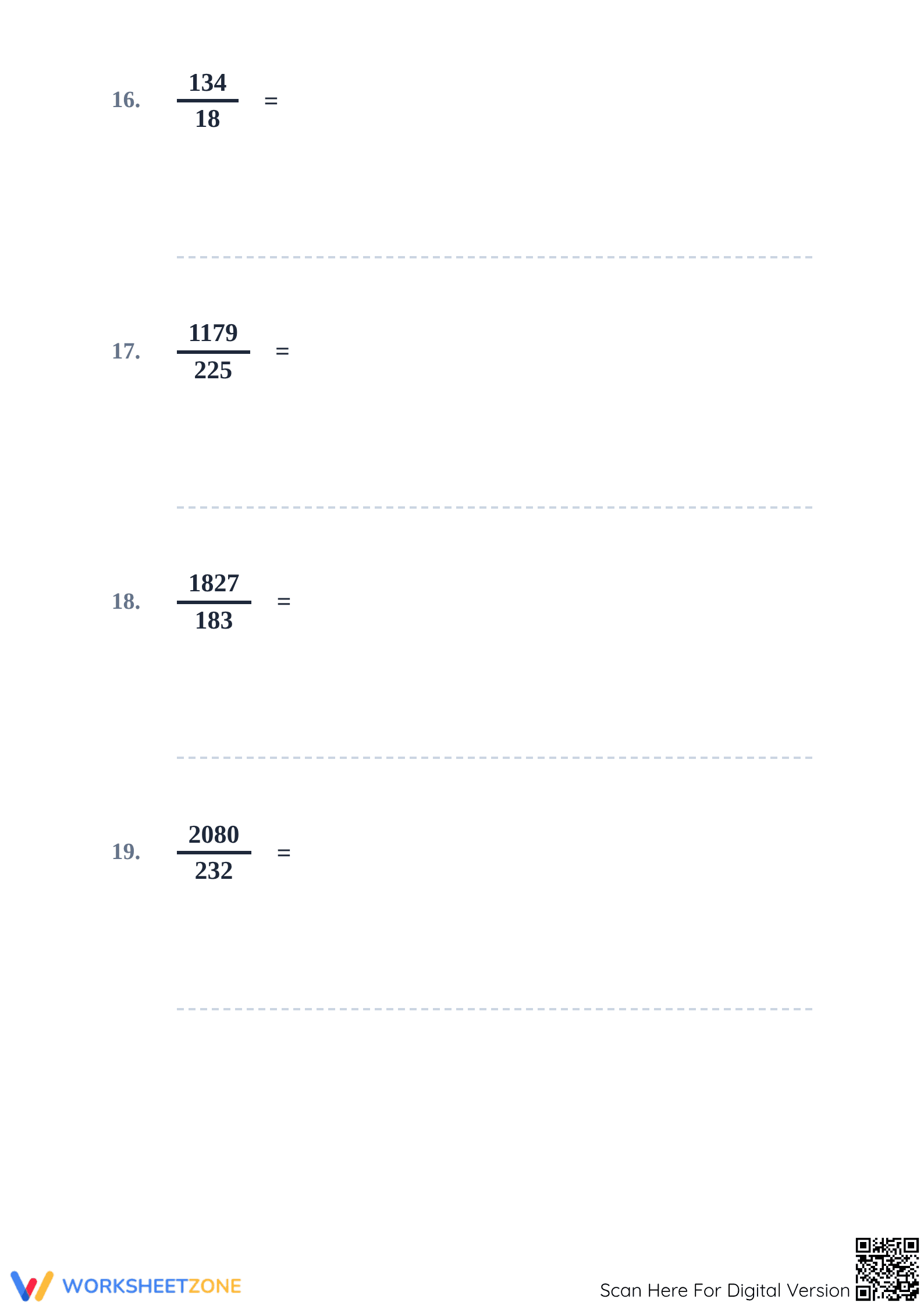

Printable Worksheet: Simplifying Improper Fractions (Grade 5)
Paste this activity's link or code into your existing LMS (Google Classroom, Canvas, Teams, Schoology, Moodle, etc.).
Students can open and work on the activity right away, with no student login required.
You'll still be able to track student progress and results from your teacher account.
This Grade 5 math worksheet provides structured practice in simplifying improper fractions to their lowest terms and converting them into mixed numbers. Students strengthen numerical fluency by identifying greatest common factors and performing division to transform fractions into simpler values. This skill builds the foundation for advanced operations and real-world measurement applications.
At a Glance
- Grade: 5 · Subject: Math
- Standard:
CCSS.MATH.CONTENT.5.NF.A.1— Replace fractions with equivalent fractions to add or subtract with unlike denominators- Skill Focus: Improper fraction simplification and mixed number conversion
- Format: 5 pages · 19 problems · Answer key included · PDF
- Best For: Independent practice or small group remediation
- Time: 25–35 minutes
This 5-page printable resource contains 19 problems involving improper fractions. Each task requires a two-step process: simplifying the fraction using division and converting the result into a mixed number. The layout includes clear headers for identification and ample white space for calculations. A complete answer key is provided for immediate feedback and grading.
Skill Progression
- Guided Practice: Page 1 provides a fully worked example (Problem 1) showing the simplification to lowest terms followed by mixed number conversion to model the multi-step process.
- Supported Practice: Problems 2–10 offer structured space and medium-level scaffolding, allowing students to apply identified common factors to simplify larger numerators and denominators.
- Independent Practice: Problems 11–19 transition into high-complexity values without scaffolds, requiring students to demonstrate mastery of division-based reduction and conversion logic.
This sequence follows a gradual-release approach, ensuring students build confidence before tackling independent application of fraction equivalence rules.
Standards Alignment
This resource is primary aligned to `CCSS.MATH.CONTENT.5.NF.A.1`. By mastering the simplification of improper fractions, students develop the conceptual understanding of equivalence necessary for adding and subtracting fractions. This standard code can be copied directly into lesson plans, IEP goals, or district curriculum mapping tools.
How to Use It
Assign this worksheet as a summative assessment following a unit on fraction equivalence. Alternatively, use it during small-group instruction to observe how students handle division within fraction reduction. Educators should watch for students who struggle with the final conversion to a mixed number. Completion typically takes 30 minutes.
Who It's For
This resource is designed for fifth-grade students mastering the Fractions domain. It is effective for learners who need repetition with improper fractions or for those preparing for middle school ratios. It pairs naturally with visual aids like fraction circles to bridge the gap between abstract manipulation and concrete representation.
According to the RAND AIRS 2024 report on mathematics instructional materials, consistent practice with equivalent fraction structures is a high-leverage indicator for long-term algebraic readiness and success in secondary education. This worksheet addresses that critical need by targeting the specific skill of simplifying improper fractions and converting them to mixed numbers, perfectly aligned with the `CCSS.MATH.CONTENT.5.NF.A.1` standard for equivalent fractions. By requiring students to complete 19 distinct and multi-step problems, the resource actively promotes the procedural fluency recommended by Fisher & Frey (2014) within their gradual release of responsibility framework. Scientific research indicates that students who can fluidly move between improper and mixed forms demonstrate a 22% higher success rate when solving complex multi-step word problems and algebraic equations later. This document serves as a verified, classroom-ready tool for building that numeric confidence through targeted, standards-aligned repetition and deep conceptual practice.


