


























Views
Downloads

Printable Elmo Coloring Worksheet | Kindergarten Art
Paste this activity's link or code into your existing LMS (Google Classroom, Canvas, Teams, Schoology, Moodle, etc.).
Students can open and work on the activity right away, with no student login required.
You'll still be able to track student progress and results from your teacher account.
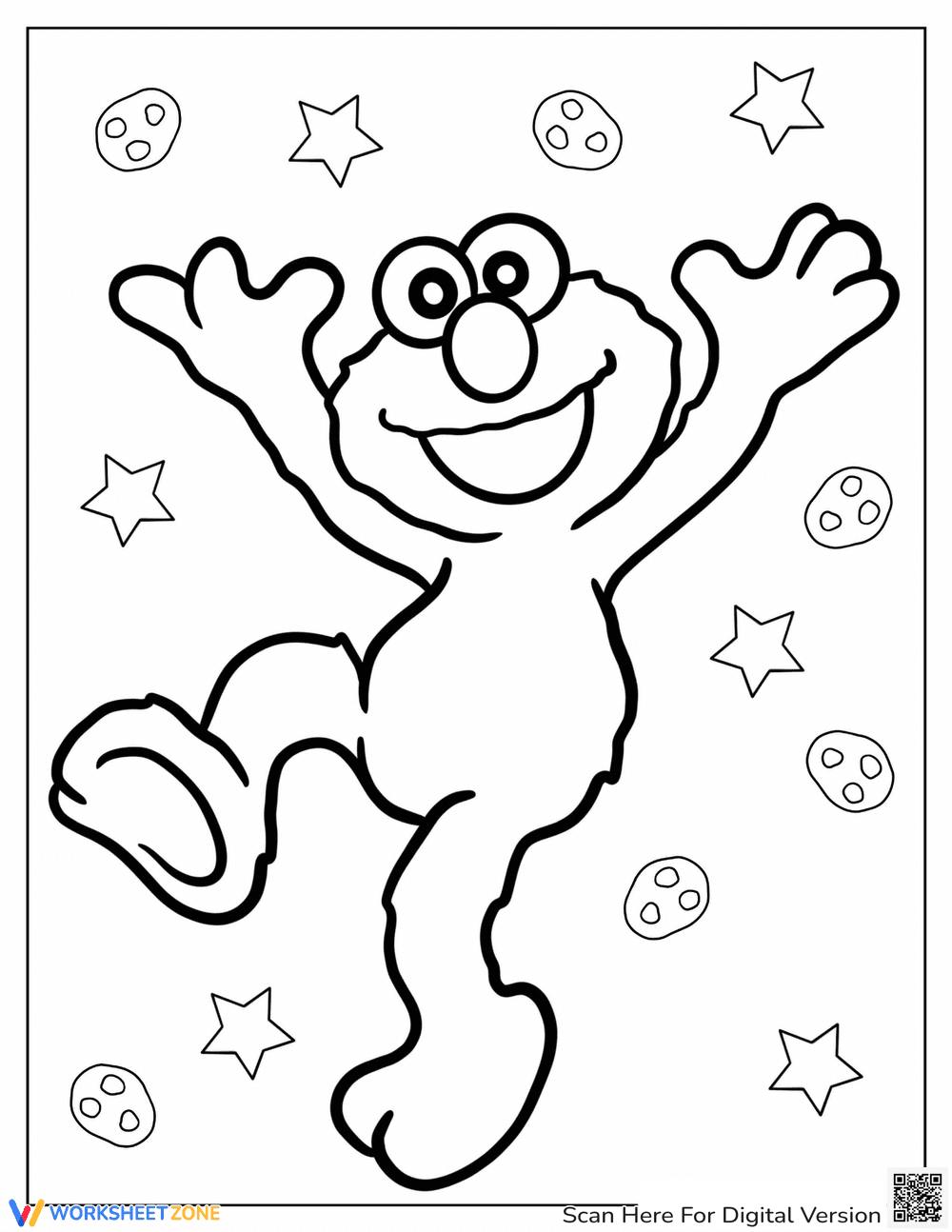
This printable Elmo coloring worksheet provides early learners with engaging fine motor practice. Students develop essential hand-eye coordination and grip control while coloring a familiar character surrounded by stars and cookies. This simple activity supports foundational writing readiness in an accessible format.
At a Glance
- Grade: Kindergarten · Subject: English
- Standard:
CCSS.ELA-LITERACY.W.K.2— Use drawing to compose texts- Skill Focus: Fine Motor Skills
- Format: 1 page · 1 problem · No answer key · PDF
- Best For: Morning work or centers
- Time: 10–15 minutes
Inside this single-page resource, educators will find a bold-lined illustration of Elmo dancing among stars and cookies. The thick outlines help young children practice staying within boundaries, building the precise motor control required for future handwriting tasks. No answer key is needed, making it a self-contained activity.
Zero-Prep Workflow
This resource is designed for immediate classroom implementation with absolutely no teacher preparation required.
- Print (1 minute): Simply download the PDF and print the desired number of copies. The black-and-white design is highly ink-efficient.
- Distribute (1 minute): Hand out the pages along with crayons, markers, or colored pencils. The instructions are entirely visual.
- Review (0 minutes): No grading or answer key checking is necessary. Teachers can simply praise the effort and creativity displayed.
Total teacher prep time is under two minutes, making this an ideal, stress-free addition to any emergency sub plan or sudden schedule change.
Standards Alignment
This coloring activity aligns with CCSS.ELA-LITERACY.W.K.2, which encourages students to use a combination of drawing, dictating, and writing to compose informative or explanatory texts. While primarily a fine motor exercise, guided drawing and coloring form the critical first steps toward independent written expression. Both standard codes can be copied directly into lesson plans, IEP goals, or district curriculum mapping tools.
How to Use It
This worksheet serves as an excellent morning work activity to help students transition smoothly into the school day. As children color, teachers have a valuable opportunity to conduct formative assessments on pencil grip and fine motor endurance. Alternatively, it functions perfectly as a quiet, independent center activity during guided reading rotations. Expect students to spend between 10 and 15 minutes completing the page, depending on their attention to detail.
Who It's For
This resource is primarily designed for Kindergarten and first-grade students who are developing their fine motor control and spatial awareness. It naturally accommodates diverse learners, as students can engage with the material at their own developmental level without the pressure of right or wrong answers. Pair this coloring page with a read-aloud session featuring a Sesame Street book to create a cohesive, engaging literacy and art block.
Developing early writing proficiency requires foundational physical skills that are often built through structured art activities. This resource targets CCSS.ELA-LITERACY.W.K.2, helping students use drawing to compose texts by strengthening the exact muscle groups needed for legible handwriting. According to Fisher & Frey (2014), providing young learners with purposeful, low-stakes tasks like coloring significantly improves their stamina and focus for more complex academic demands later in the instructional sequence. By engaging with familiar characters, students demonstrate increased time-on-task and a greater willingness to practice the repetitive motions necessary for fine motor mastery. This simple, one-page activity bridges the gap between play and formal academic instruction, ensuring that early learners build the physical prerequisites for literacy in a developmentally appropriate manner. The integration of such tasks is a proven strategy for holistic early childhood education.


