


























Views
Downloads
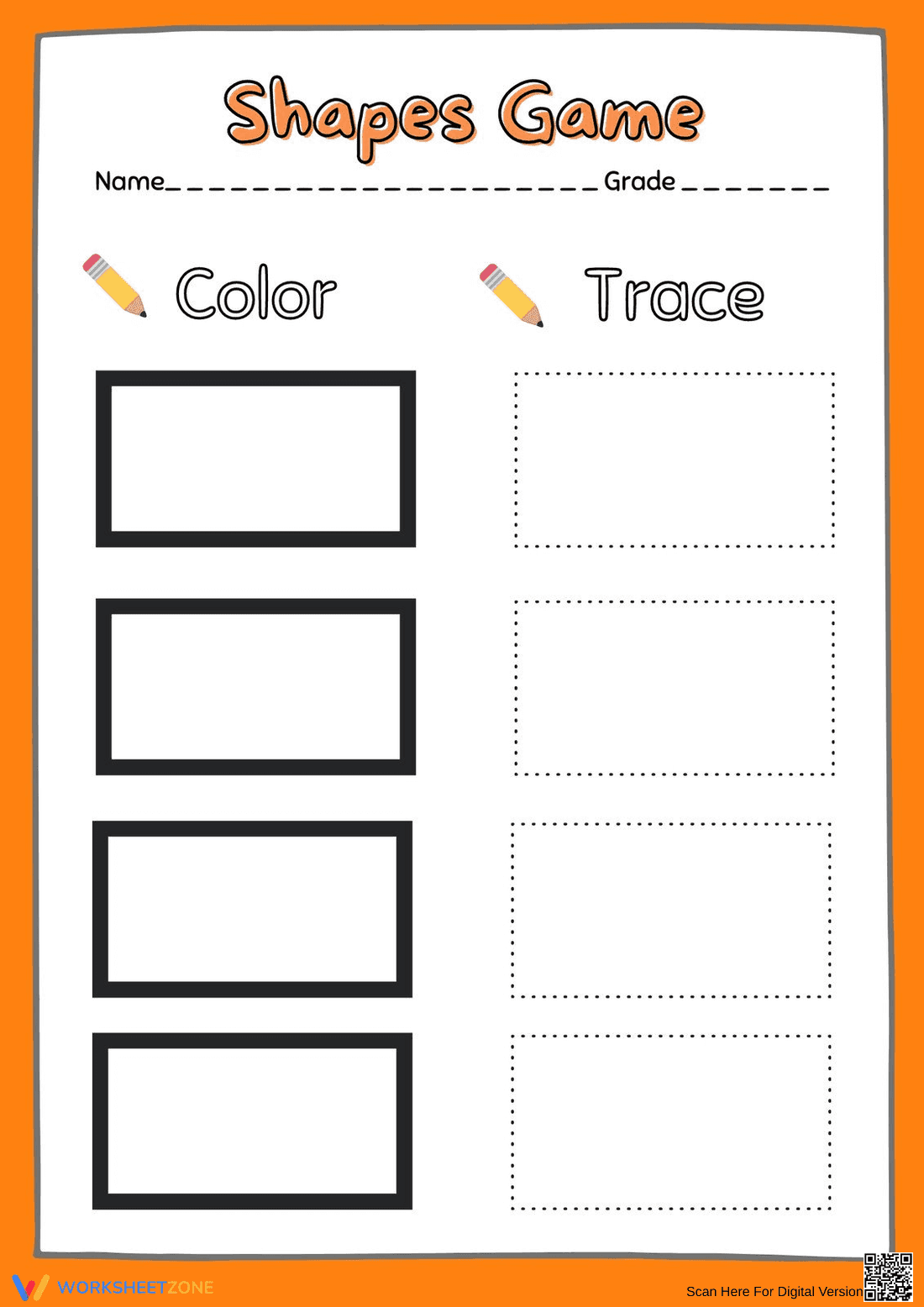

Rectangle Tracing Worksheet — Printable Grade K Math
Paste this activity's link or code into your existing LMS (Google Classroom, Canvas, Teams, Schoology, Moodle, etc.).
Students can open and work on the activity right away, with no student login required.
You'll still be able to track student progress and results from your teacher account.
This Grade K geometry worksheet provides early learners with focused practice on identifying and forming rectangles. By combining coloring and tracing activities, students develop essential fine motor skills while reinforcing shape recognition, ensuring a strong foundation for future mathematical concepts.
At a Glance
- Grade: K · Subject: Math
- Standard:
CCSS.MATH.CONTENT.K.G.B.5— Draw shapes to model real-world objects- Skill Focus: Tracing and identifying rectangles
- Format: 1 page · 8 problems · No answer key needed · PDF
- Best For: Independent practice and centers
- Time: 10–15 minutes
Inside this single-page resource, educators will find a straightforward, two-column layout designed for young learners. The left column features four solid rectangles for students to color, promoting shape identification. The right column provides four dotted rectangles for tracing practice, supporting pencil control and fine motor development. The clean design minimizes visual clutter, allowing kindergarteners to focus entirely on the geometry task.
Zero-Prep Workflow
- Print (1 minute): Simply download the PDF and print the required number of copies. The black-and-white design ensures low ink consumption.
- Distribute (1 minute): Hand out the worksheets along with crayons and pencils. The intuitive layout means students can begin immediately with minimal verbal instructions.
- Review (1 minute): Quickly scan student work to assess tracing accuracy and shape comprehension.
Total teacher prep time is under two minutes, making this ideal for morning work or substitute plans.
Standards Alignment
This worksheet aligns directly with CCSS.MATH.CONTENT.K.G.B.5, which requires students to model shapes in the world by building shapes from components and drawing shapes. By tracing the dotted lines, students practice the physical mechanics of drawing rectangles. It also supports basic shape identification goals. Both standard codes can be copied directly into lesson plans, IEP goals, or district curriculum mapping tools.
How to Use It
Deploy this worksheet during morning arrival as a calm, focused activity that transitions students into the school day. Alternatively, use it as an independent station during math centers while the teacher works with small groups. As a formative assessment tip, observe students while they trace the shapes; note their pencil grip and whether they can stay on the dotted lines, which indicates fine motor readiness. Expected completion time ranges from 10 to 15 minutes.
Who It's For
Designed primarily for kindergarten students, this resource also serves as remedial practice for first graders needing fine motor support. For differentiation, provide textured materials for tracing, or ask advanced students to draw their own rectangles on the back. It pairs perfectly with a whole-group anchor chart about 2D shapes.
Effective early childhood mathematics instruction relies heavily on integrating physical movement with cognitive tasks. According to a recent EdReports 2024 analysis of foundational math curricula, activities that combine tactile engagement—such as coloring and tracing—with geometric concepts significantly improve long-term shape retention. This worksheet targets CCSS.MATH.CONTENT.K.G.B.5, helping students draw shapes to model real-world objects. By requiring learners to first color a solid shape and then trace its outline, the activity bridges visual recognition and physical reproduction. This dual approach ensures that young students do not merely memorize shape names, but internalize their structural properties through guided fine motor practice. Consistent exposure to these targeted, low-barrier tasks builds the spatial reasoning necessary for more complex geometry in later grades, making this simple tracing exercise a critical component of early math intervention.


