


























Views
Downloads

Printable Circle Shapes Worksheet | Grade K Math
Paste this activity's link or code into your existing LMS (Google Classroom, Canvas, Teams, Schoology, Moodle, etc.).
Students can open and work on the activity right away, with no student login required.
You'll still be able to track student progress and results from your teacher account.
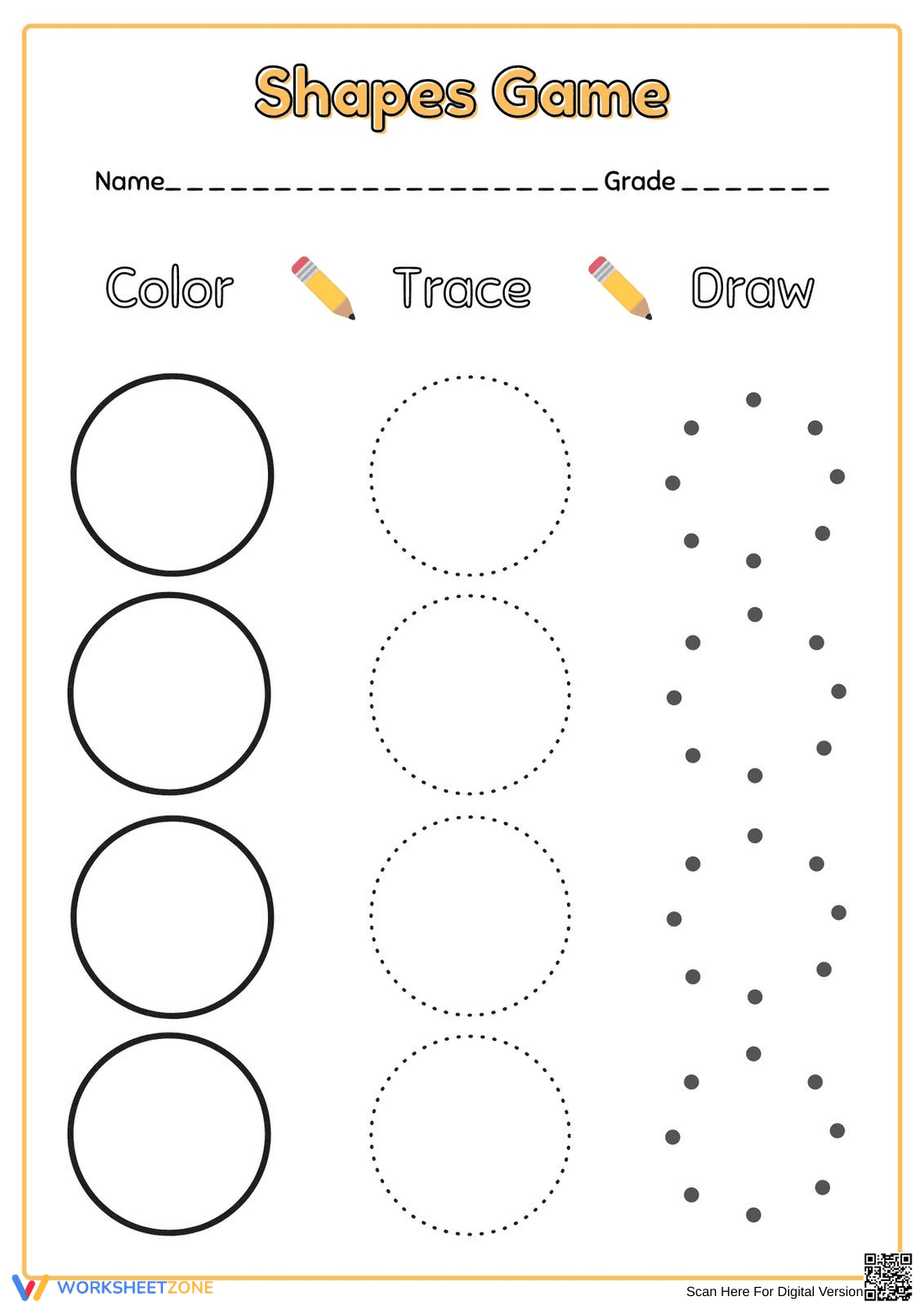
This Grade K math worksheet helps early learners master circle recognition and formation through targeted fine motor practice. Students will color, trace, and draw circles to build foundational geometry skills and hand-eye coordination. The clear, repetitive structure ensures young students can complete the tasks with minimal guidance.
At a Glance
- Grade: K · Subject: Math
- Standard:
CCSS.MATH.CONTENT.K.G.B.5— Draw shapes to model objects in the world- Skill Focus: Shape recognition and drawing
- Format: 1 page · 12 problems · No answer key needed · PDF
- Best For: Independent practice or centers
- Time: 10–15 minutes
This single-page resource features three distinct columns designed to progressively build shape formation skills. The first column provides four solid circles for students to color, reinforcing shape identification. The middle column contains four dotted circles for guided tracing practice. The final column offers four dot-to-dot circle outlines, challenging students to draw the shape independently while maintaining proper proportions.
This worksheet is designed for immediate classroom implementation with a streamlined workflow:
- Print (1 minute): Simply download the PDF and print the required number of copies. No special materials or cutting required.
- Distribute (1 minute): Hand out the worksheets along with crayons and pencils. The visual instructions make the task immediately clear to early readers.
- Review (1 minute): Quickly scan completed pages to assess fine motor control and shape accuracy.
Total teacher preparation time is under two minutes, making this an excellent option for morning work, emergency sub plans, or quick transition activities.
This resource is aligned to primary standard CCSS.MATH.CONTENT.K.G.B.5: Model shapes in the world by building shapes from components and drawing shapes. It also supports early fine motor development necessary for writing. Both standard codes can be copied directly into lesson plans, IEP goals, or district curriculum mapping tools.
Deploy this worksheet during morning arrival as a calm, focused activity that settles students into the daily routine. Alternatively, use it as an independent math center station while the teacher conducts small group instruction. As a formative assessment tip, observe students while they work in the "Draw" column to check their pencil grip and stroke direction. Expected completion time ranges from 10 to 15 minutes depending on the child's fine motor proficiency.
This resource is ideal for Kindergarten students, pre-K learners preparing for school, and occupational therapy sessions focusing on fine motor control. The visual cues provide built-in differentiation for English Language Learners or students who struggle with multi-step verbal directions. Pair this worksheet with a hands-on lesson using physical shape manipulatives or a read-aloud book about shapes to reinforce the geometric concepts.
Early childhood geometry instruction, specifically aligned with CCSS.MATH.CONTENT.K.G.B.5 to draw shapes to model objects in the world, plays a critical role in cognitive development. According to a 2024 report by EdReports, integrating physical drawing tasks with shape recognition significantly improves spatial reasoning and later mathematical achievement. When students actively color, trace, and draw circles, they transition from passive observers to active creators, solidifying their understanding of geometric properties. This foundational practice not only supports math standards but also builds the essential fine motor pathways required for future handwriting success. By providing structured, repetitive practice in a low-stakes format, educators can effectively assess and support early learners' developmental milestones. This targeted approach ensures that young students build the confidence and physical dexterity necessary for more complex academic tasks as they progress through primary grades.


