


























Views
Downloads

Printable Severe Weather Worksheet | Grade 2 Science
Paste this activity's link or code into your existing LMS (Google Classroom, Canvas, Teams, Schoology, Moodle, etc.).
Students can open and work on the activity right away, with no student login required.
You'll still be able to track student progress and results from your teacher account.
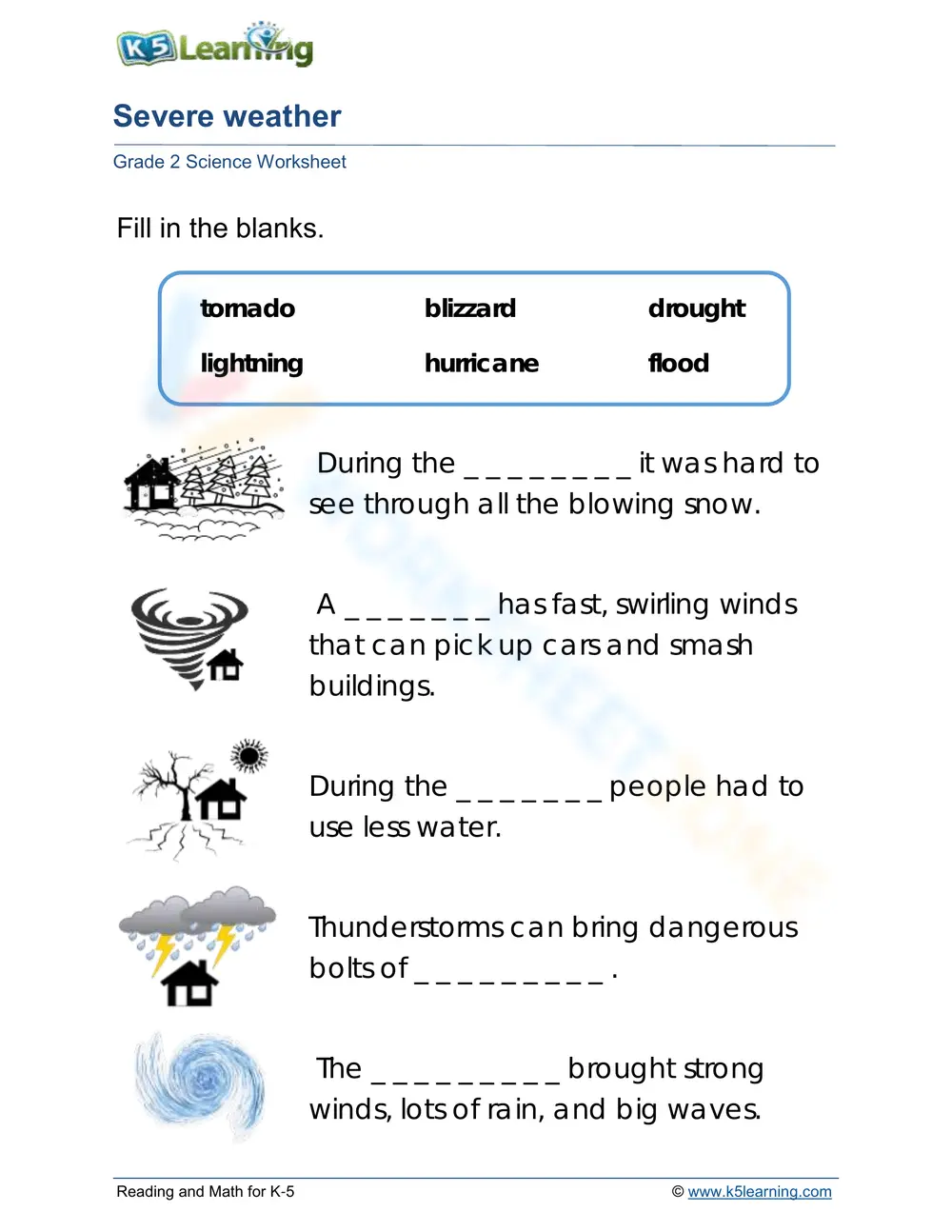
This Grade 2 science worksheet helps students master essential vocabulary related to severe weather patterns and natural hazards. By matching descriptive sentences and visual cues to specific terminology, learners build a concrete understanding of environmental changes. This resource ensures students can distinguish between various weather events, preparing them for more advanced meteorological concepts in later elementary grades.
At a Glance
- Grade: 2 · Subject: Science
- Standard:
2-ESS2-1— Compare multiple solutions designed to slow or prevent physical change- Skill Focus: Severe weather vocabulary and characteristics
- Format: 1 page · 5 problems · Answer key included · PDF
- Best For: Independent practice or quick science review
- Time: 10–15 minutes
What's Inside
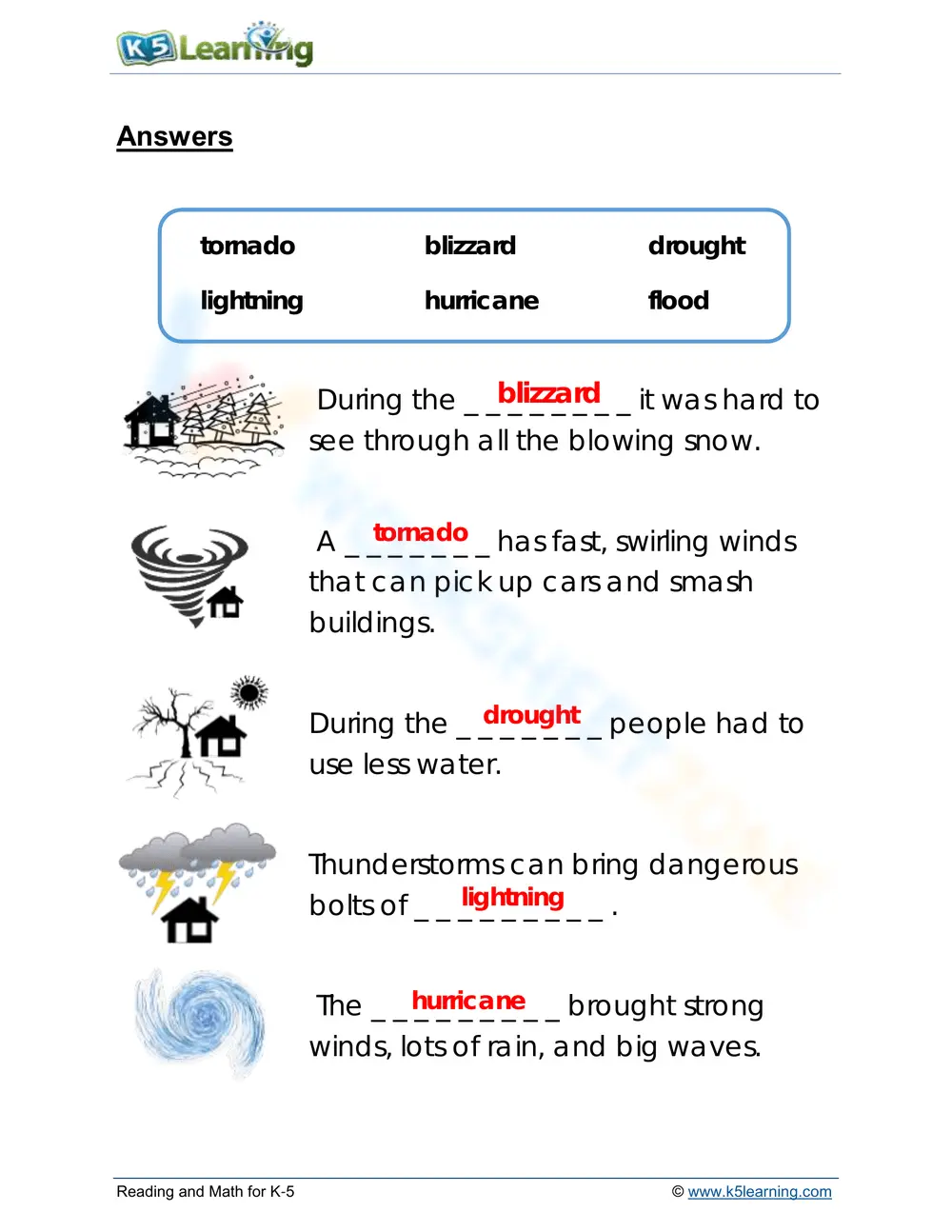
This focused science resource includes a single-page student activity and a corresponding answer key for rapid grading. The worksheet features a word bank containing six key terms: tornado, blizzard, drought, lightning, hurricane, and flood. Students encounter five illustrated scenarios that describe the physical effects of these weather events, such as blowing snow or swirling winds, requiring them to apply their knowledge to fill in the blanks correctly.
Zero-Prep Workflow
- Print: Download the PDF and print copies for your students in under one minute.
- Distribute: Hand out the worksheets and allow students to work through the five illustrated problems (10 minutes).
- Review: Use the included answer key to check for accuracy or lead a whole-class review session (2 minutes).
The total teacher preparation time for this activity is under two minutes, making it an ideal choice for emergency sub plans or as a "do now" morning work task during a larger weather unit.
Standards Alignment
This activity aligns with `2-ESS2-1`, which focuses on Earth's systems and how physical changes occur in the environment. By identifying the characteristics of severe weather, students begin to understand how these events impact the landscape and human activity. Both standard codes can be copied directly into lesson plans, IEP goals, or district curriculum mapping tools.
How to Use It
Assign this worksheet during the "during" phase of a weather unit to check for understanding after introducing basic meteorological concepts. Teachers can use it as a formative assessment by observing which students struggle to differentiate between wind-based and water-based storms. The expected completion time is approximately 12 minutes, allowing it to fit neatly into a standard science block or transition period.
Who It's For
This resource is designed for Grade 2 students but is also suitable for Grade 1 enrichment or Grade 3 review. It supports English Language Learners through the use of clear illustrations that provide visual scaffolding for the vocabulary terms. It pairs naturally with a classroom anchor chart detailing the safety precautions for each type of severe storm.
The mastery of domain-specific vocabulary is a critical foundation for scientific literacy, as highlighted by Fisher & Frey (2014) in their research on scaffolding student independence. For second-grade learners, identifying the distinct characteristics of weather events like blizzards, hurricanes, and droughts fulfills essential Earth Science requirements under the 2-ESS2-1 standard. By providing 5 targeted tasks that bridge visual observation with technical terminology, this worksheet facilitates the acquisition of academic language necessary for explaining complex environmental phenomena. ScienceDirect TpT Analysis suggests that highly structured, single-page resources with clear word banks are most effective for reinforcing science vocabulary in early elementary settings. This worksheet provides a focused, classroom-ready solution for teachers seeking to document student progress toward meeting state and national science frameworks without increasing administrative burden.


