




























Views
Downloads

Grade 5 Series Circuits — Printable No-Prep Worksheet

Paste this activity's link or code into your existing LMS (Google Classroom, Canvas, Teams, Schoology, Moodle, etc.).
Students can open and work on the activity right away, with no student login required.
You'll still be able to track student progress and results from your teacher account.
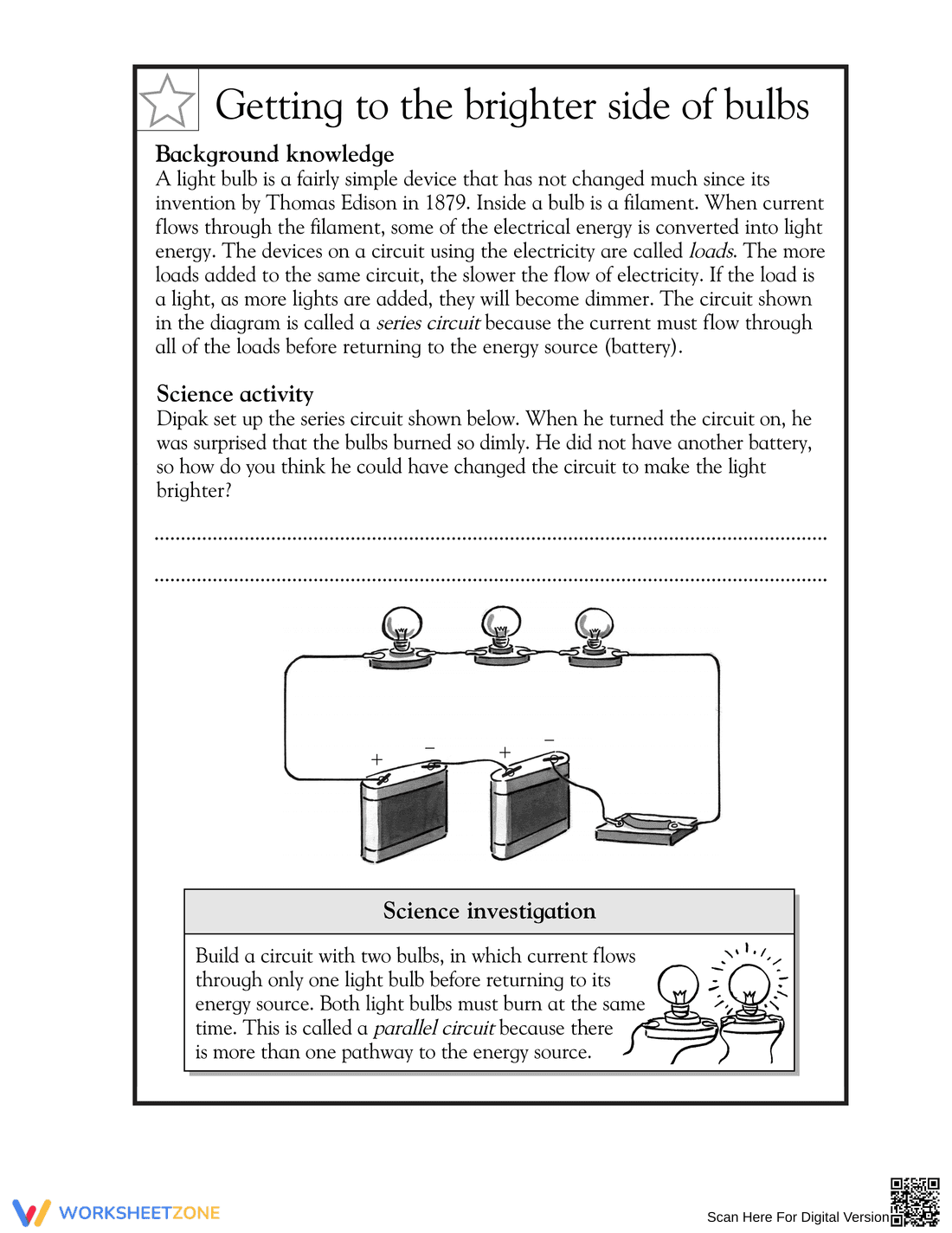
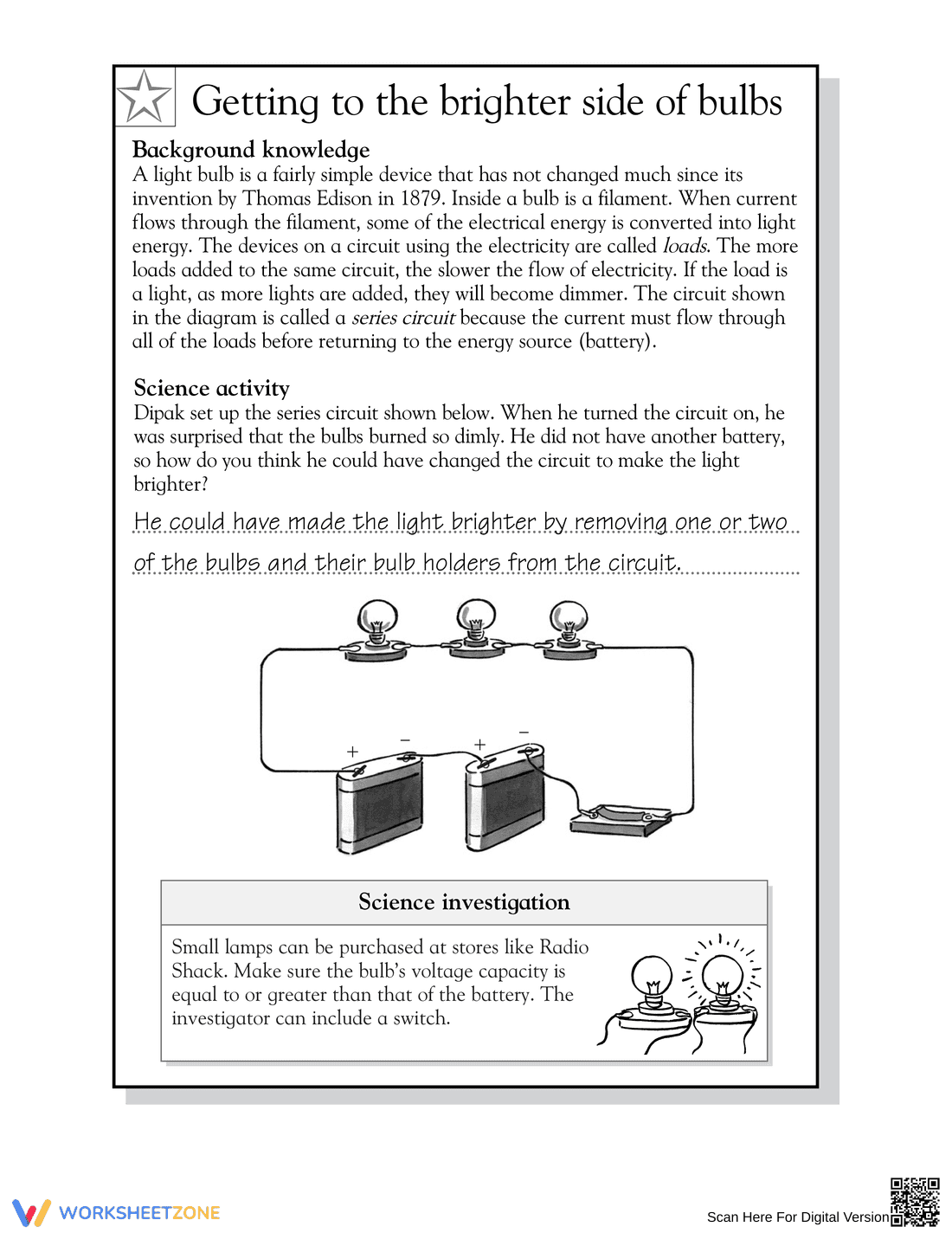
This hands-on science worksheet introduces fifth-grade students to the fundamental principles of electric circuits. Through a combination of reading, analysis, and a guided investigation, learners will explore the difference between series and parallel circuits. The activity challenges students to apply their knowledge to solve a practical problem, reinforcing how circuit design affects electrical flow and brightness.
At a Glance
- Grade: 5 · Subject: Science
- Standard:
4-PS3-4— Design and test a device that converts energy from one form to another.- Skill Focus: Series and parallel circuits
- Format: 1 page · 2 problems · No answer key included · PDF
- Best For: Independent practice, science centers, or homework
- Time: 15–25 minutes
This single-page printable provides everything needed for a self-contained lesson on basic circuitry. It includes a "Background Knowledge" section that defines key terms like loads, series circuits, and filaments. The worksheet features two distinct tasks: a critical thinking question based on a diagram of a series circuit, and a "Science Investigation" prompt that challenges students to design a parallel circuit.
Zero-Prep Workflow
Designed for immediate classroom use, this resource requires virtually no teacher preparation. The workflow is simple and efficient, taking less than two minutes.
- Print (1 min): A single, economical page for fast printing.
- Distribute (1 min): Hand out for individual or group work. The background reading means no prior lecture is needed.
- Review (10 min): Discuss student responses and have groups demonstrate their circuit designs.
Its format is excellent for a sub plan or a focused science station.
Standards Alignment
This worksheet aligns with NGSS 4-PS3-4: Apply scientific ideas to design, test, and refine a device that converts energy from one form to another. Students meet this standard by analyzing one circuit and constructing another to achieve a different outcome. The task also connects to 4-PS3-2 by having students observe energy transfer. These standard codes can be copied directly into lesson plans or curriculum maps.
How to Use It
Use this resource to introduce or reinforce concepts. As an introduction, it lets students discover circuit properties firsthand. As reinforcement, it solidifies learning after a direct lesson. For a quick formative assessment, observe students building the parallel circuit; a functional build shows understanding of the concept. The activity should take 15-25 minutes.
Who It's For
Ideal for 5th-grade physical science students. The clear diagrams and text support all learners. To differentiate for students needing help, provide a pre-drawn diagram of the parallel circuit to guide them. This activity pairs well with a classroom anchor chart comparing series and parallel circuits for students to reference.
This Grade 5 resource applies standard 4-PS3-4, requiring students to design and test a simple electrical device. By moving from analysis of a series circuit to building a parallel one, the activity engages students in NGSS engineering practices. Hands-on tasks are vital for understanding abstract concepts like energy transfer. Research shows that engaging students in scientific practices is more effective than memorizing facts (RAND AIRS 2024). This worksheet requires students to apply the definition of a parallel circuit by constructing one, leading to a more durable understanding of how electrical circuits function.


