




























Views
Downloads

Grade 5 Separating Mixtures — Essential No-Prep Worksheet

Paste this activity's link or code into your existing LMS (Google Classroom, Canvas, Teams, Schoology, Moodle, etc.).
Students can open and work on the activity right away, with no student login required.
You'll still be able to track student progress and results from your teacher account.
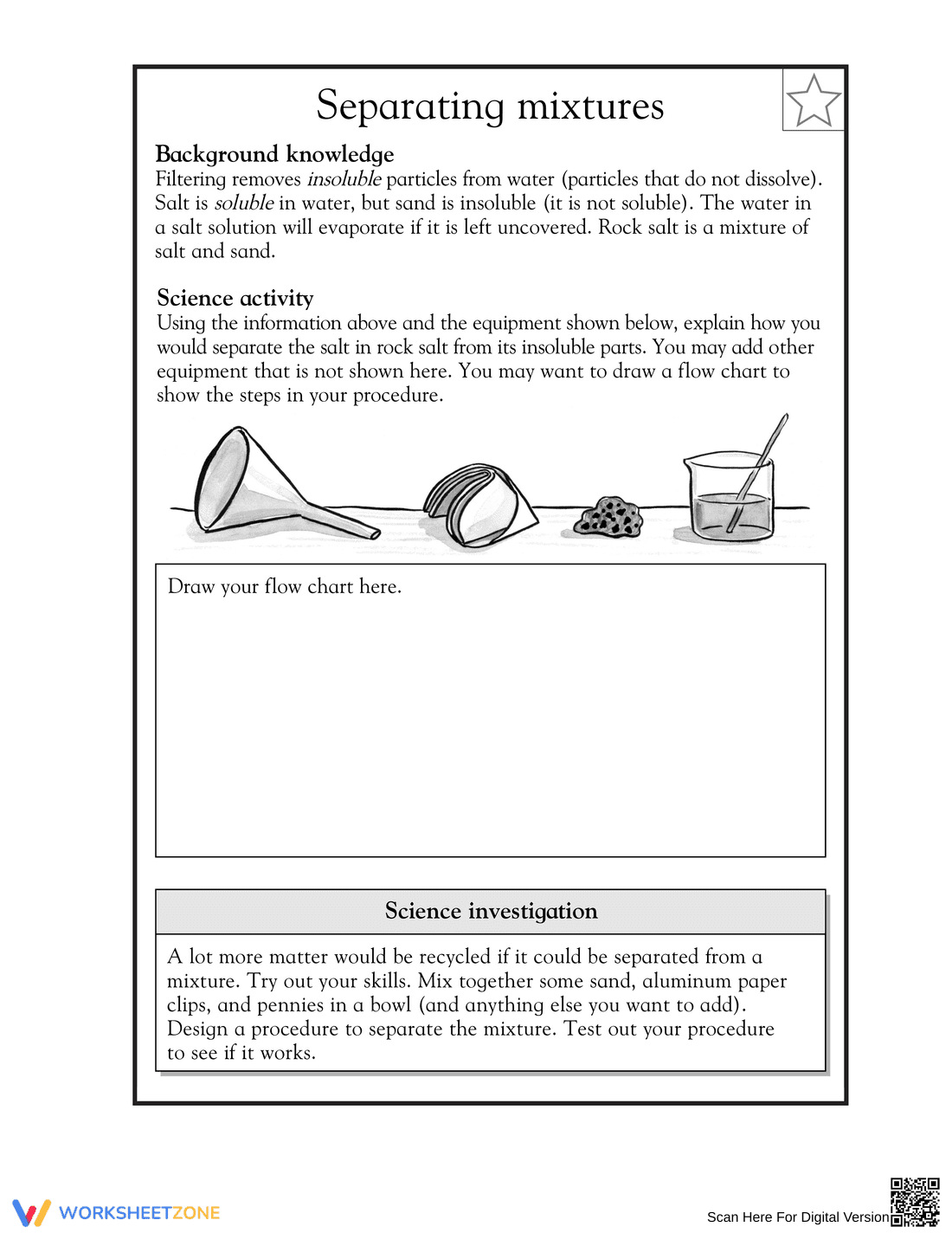
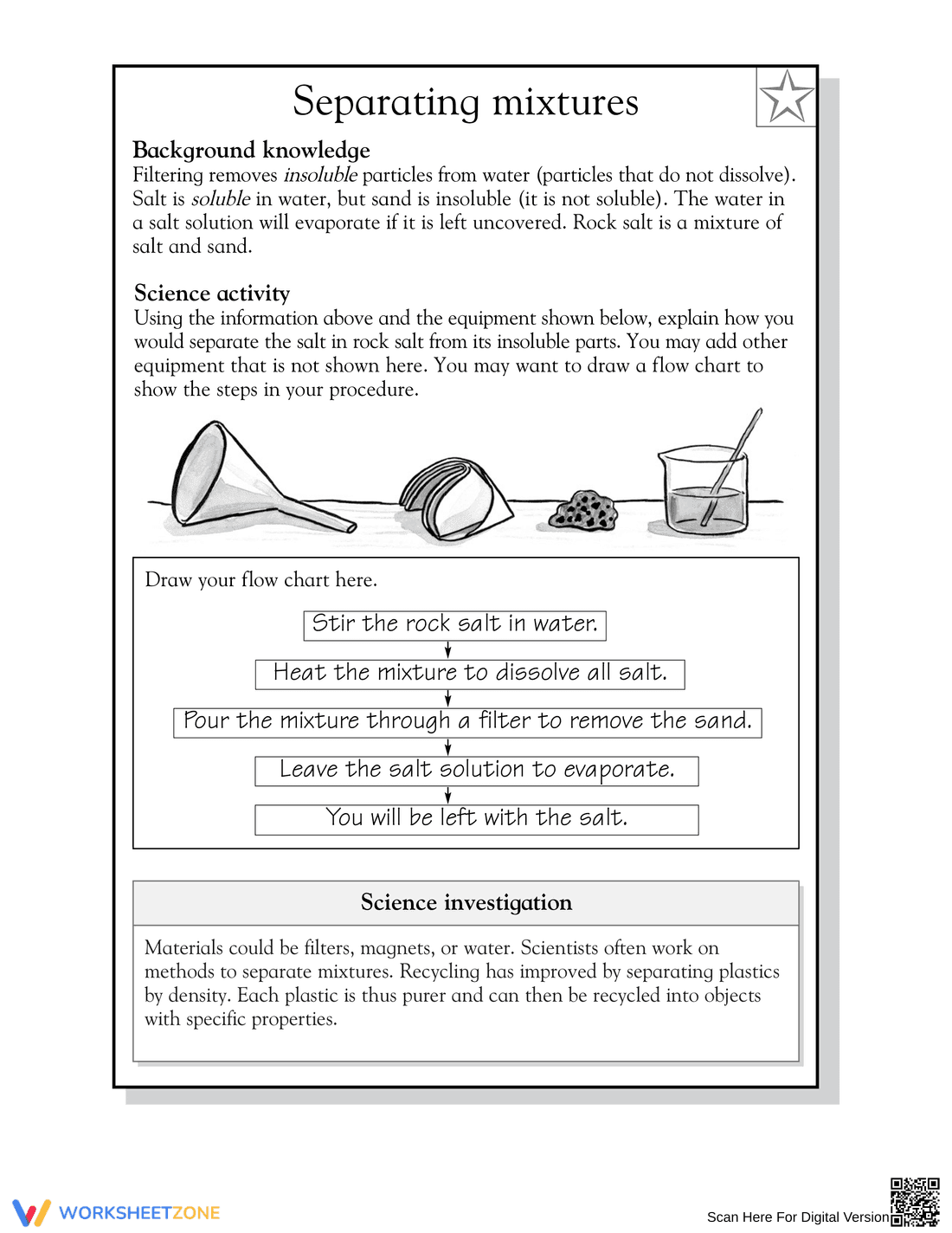
Master the physical properties of matter through the lens of separating mixtures. By investigating the solubility of rock salt and the mechanical separation of materials, learners develop critical thinking skills for laboratory procedures. Students will devise their own experimental flow charts to achieve pure outcomes and demonstrate scientific reasoning.
At a Glance
- Grade: 5 · Subject: Science
- Standard:
5-PS1-3— Identify materials based on their properties like solubility and state- Skill Focus: Separating soluble and insoluble mixtures
- Format: 1 page · 2 investigations · Answer key not included · PDF
- Best For: Classroom lab prep or science centers
- Time: 20–30 minutes
This PDF features background knowledge on filtration and evaporation. The primary task requires students to explain and draw a flow chart for separating rock salt. A secondary investigation challenges students to design a procedure for a complex mixture involving sand and metal, encouraging creative problem-solving and application of physical property concepts.
Zero-Prep Workflow
Print the single-page PDF (1 minute). Distribute sheets and provide basic drawing tools (1 minute). Review student-designed flow charts to assess their understanding of physical changes (3 minutes). This workflow requires under five minutes of teacher preparation, making it a reliable choice for busy classrooms or emergency sub plans.
Standards Alignment
Aligned with 5-PS1-3, students make observations to identify materials based on properties. By focusing on solubility, students apply knowledge of matter to solve problems. This standard code can be copied directly into lesson plans, IEP goals, or district curriculum mapping tools to ensure alignment with national physical science frameworks.
How to Use It
Use this as a summative assessment after lessons on solutions. It allows teachers to observe if students can translate theory into logical sequences. Alternatively, use it as a pre-lab activity to visualize upcoming experiments. Monitor the flow charts for logical sequencing and correct use of scientific terminology like filtrate and residue.
Who It's For
Tailored for fifth-graders exploring chemistry, this resource offers scaffolding for general education while providing open-ended challenges for advanced learners. It pairs perfectly with anchor charts on states of matter or hands-on salt water demonstrations. The clear instructions ensure all students can engage with the material independently and accurately.
Aligned to the 5-PS1-3 standard, this worksheet focuses on the critical science skill of identifying materials based on properties like solubility. Research from EdReports 2024 emphasizes that providing students with opportunities to design their own experimental procedures, rather than just following a recipe, significantly increases long-term retention of scientific concepts. By requiring the creation of a visual flow chart, the activity supports dual-coding theory, helping students bridge the gap between abstract chemical properties and tangible physical results. The investigation of rock salt provides a classic, accessible model for understanding mixtures that is frequently cited in primary science curricula as a foundational step toward more advanced laboratory work. This resource ensures that students are not merely memorizing definitions of soluble and insoluble particles but are actively applying those definitions to achieve a specific outcome in a laboratory-style environment.


